 Purerock
format
Himalayan Shilajit Gummies: What 'Himalayan' Really Means
“Himalayan” is the single most common word on a shilajit gummies label, and it’s also the hardest one to verify. With raw resin, origin claims at least intersect with something you can observe — texture, smell, how it dissolves. With a gummy, the shilajit has already been extracted, processed, mixed into a sugar-and-gelling-agent base, shaped, and coated before it ever reaches you. Whatever mountain it came from is now a claim on a label, not something you can sanity-check by handling the product. This guide is about how to read that claim critically, not about accepting or rejecting it on faith.
Key takeaways
- “Himalayan” on a gummies label is a supply-chain claim, not a purity guarantee — a gummy’s processing removes every sensory signal you could otherwise use to sanity-check origin.
- The word is usually doing three jobs at once (geographic sourcing, traditional-method association, altitude-as-purity proxy), and most labels never say which one they mean.
- Fulvic acid retention through gummy manufacturing matters more than raw resin origin — a high-fulvic-acid Himalayan resin can still end up in a low-fulvic-acid finished gummy.
- “Natural” and “Himalayan” are frequently paired but answer different questions — “natural” describes the extract source, not the gummy base’s colors, flavors, or sweeteners.
- A credible label answers checkable questions (named region, documented sourcing, finished-product testing); an unverifiable label leans entirely on evocative imagery.
Why origin matters more — and is harder to verify — on gummies
Shilajit is a mineral-rich exudate that seeps from rock strata in high-altitude mountain ranges, most commonly cited from the Himalayas, but also produced commercially from the Altai mountains, parts of the Caucasus, and other high-altitude regions. The Himalayan association isn’t marketing invention — it’s the range most associated with the traditional Ayurvedic use of shilajit historically. But that historical association is exactly what makes “Himalayan” an easy word to put on a label regardless of where the raw material actually came from.
With raw resin, a buyer at least has some indirect signals: consistency, how it behaves when dissolved in warm water, smell. None of those are reliable proof of origin either, but they’re something. A gummy strips all of that away. By the time shilajit extract is standardized, blended with a gummy base, and processed at scale, there is no sensory information left that could tell you which mountain range it came from. You are relying entirely on the manufacturer’s supply chain documentation — which, for most consumer supplement brands, you will never actually see.
This is the core reframe worth internalizing: on a gummies label, “Himalayan” is a supply-chain claim, not a quality signal. It says something (unverifiable to you) about where raw material was sourced. It says nothing on its own about purification method, contaminant testing, or how much active fulvic acid survived the trip from raw resin to finished gummy.
It’s also worth noting why this distinction matters more for gummies than for other formats. A capsule at least preserves the extract in something closer to its concentrated, dried form — you’re one processing step removed from the raw material, not several. A gummy adds an entire additional manufacturing layer: a heated base, added sugars or sugar alcohols, flavoring agents, and a coating step, each of which is a point where the original extract gets diluted, blended, or altered. That doesn’t make gummies a worse format inherently — plenty of people prefer them for taste and convenience — but it does mean the distance between “Himalayan resin was used somewhere in this supply chain” and “this specific gummy delivers a meaningful, tested dose of that resin’s active compounds” is longer than it is for other formats.
What “Himalayan” is actually claiming
When a gummies label says “Himalayan shilajit,” it’s typically making one of a few distinct claims, often blurred together:
- Geographic sourcing — the raw resin was collected from rock formations somewhere in the Himalayan range (which spans multiple countries and a huge range of altitudes, so this alone is vague).
- Traditional-method association — an implicit nod to Ayurvedic tradition, even when the actual manufacturing process is modern industrial extraction and purification.
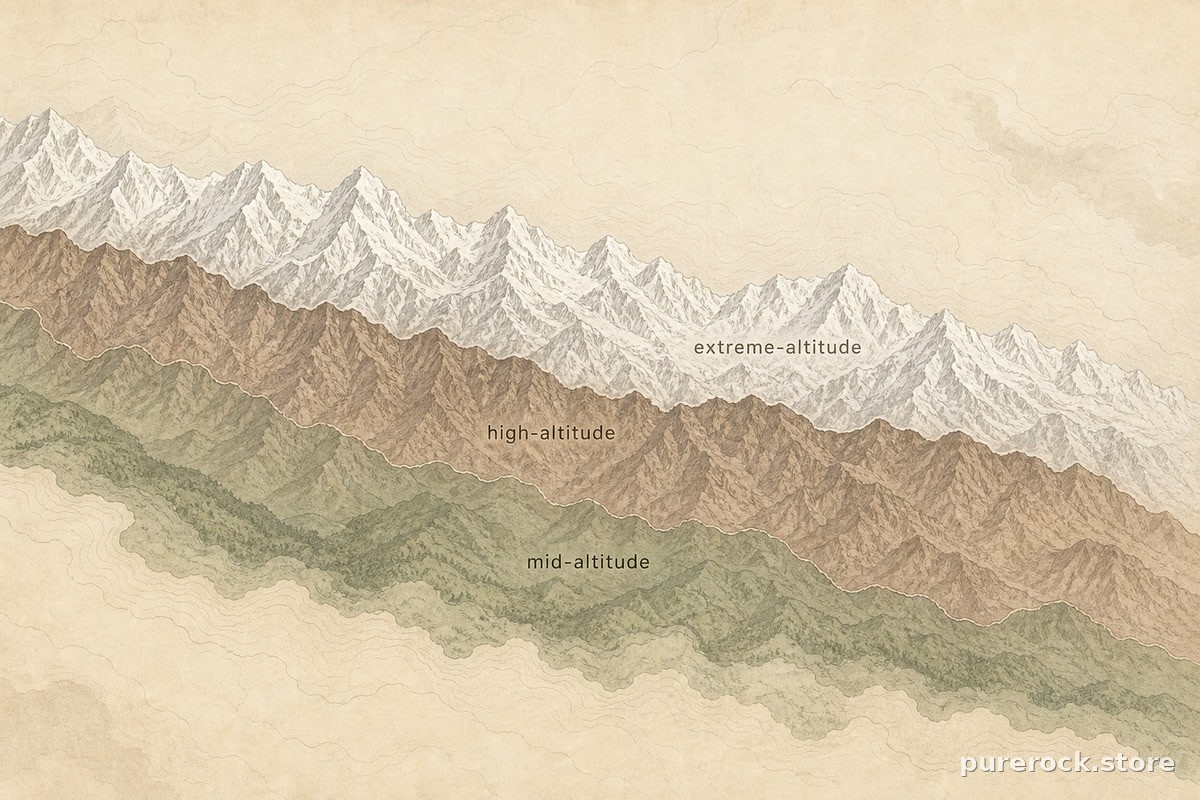
- Altitude as a purity proxy — a common marketing shorthand that higher-altitude collection implies a cleaner, less-contaminated source material, which has some plausibility (less agricultural runoff, less industrial contamination at extreme elevation) but is not something you can verify from a label, and altitude alone doesn’t guarantee downstream purification quality.
None of these claims are inherently false, and geographic origin can be a genuinely meaningful part of a supply chain story. The problem is that a single word doing three jobs at once, with zero substantiation, is easy to print and hard to challenge.
Altitude and region claims: what to actually look for
Marketing copy for shilajit gummies frequently cites specific altitude ranges — numbers in the 16,000 to 18,000 foot range appear often — as a credibility signal. Treat a bare altitude number the way you’d treat any other unsourced statistic: it’s plausible, but it’s not evidence unless it’s tied to something checkable.

What would make an altitude or region claim more credible:
- A named country or specific region (Nepal, Kashmir, Himachal Pradesh) rather than just “the Himalayas,” which is not a single sourcing location.
- Any documentation trail — import records, supplier certifications, or a stated relationship with a specific harvesting cooperative — even in summary form on the brand’s site.
- Consistency between the origin story and the manufacturing story. A brand that claims remote, high-altitude hand-collection but manufactures gummies at industrial scale with no mention of how raw resin gets from collection site to processing facility is telling an incomplete story.
What should raise skepticism: a bare claim with no region, no supplier information, and language that leans entirely on evocative imagery (“ancient glaciers,” “pristine peaks”) rather than anything checkable. That’s not proof the origin claim is false — plenty of legitimate small operations simply don’t publish supply chain detail — but it does mean the claim is functionally unverifiable from where you’re standing as a buyer.
It also helps to understand why altitude gets used as a proxy in the first place. The reasoning behind the “higher altitude means cleaner source material” claim isn’t baseless: at extreme elevation, there’s generally less agricultural runoff, less industrial pollution, and less human traffic near the collection site than at lower elevations closer to populated areas. That’s a plausible mechanism. But plausibility isn’t the same as verification, and altitude alone says nothing about what happens after collection — how the resin is stored, transported, and purified before it becomes gummy input. A resin collected at 17,000 feet that then sits in unregulated storage or gets processed in a facility with no contaminant testing doesn’t retain the purity advantage that altitude alone would suggest. The altitude claim, in other words, describes one point in a long chain, and buyers often treat it as if it describes the whole chain.
Fulvic acid retention through gummy manufacturing
Origin aside, the more practically important question for a gummy specifically is how much of the source material’s active profile survives processing. Fulvic acid is the compound most commonly used as a marker for shilajit identity and quality, and it’s also sensitive to processing conditions.
Turning raw resin into a stable, shelf-safe gummy typically involves several steps that raw resin alone doesn’t need to go through: standardizing and drying the extract, dissolving or suspending it into a gummy base (usually a heated gelatin or pectin slurry), and then cooling, cutting, and coating the gummies. Heat exposure during that base-forming step is the step most likely to affect heat-sensitive compounds, though the research quantifying exactly how much fulvic acid content is lost during commercial gummy processing (as opposed to resin drying or capsule encapsulation) is still limited and not something brands typically publish in detail.
What this means practically: a Himalayan-sourced resin with a high fulvic acid percentage at the point of extraction does not automatically translate into an equivalently high fulvic acid gummy. The number that matters for a finished gummy product is the fulvic acid content tested in the finished gummy, not the fulvic acid content of the raw resin before it went into manufacturing. A credible brand should be able to provide (or at least reference) testing done on the finished product, not just the raw material.
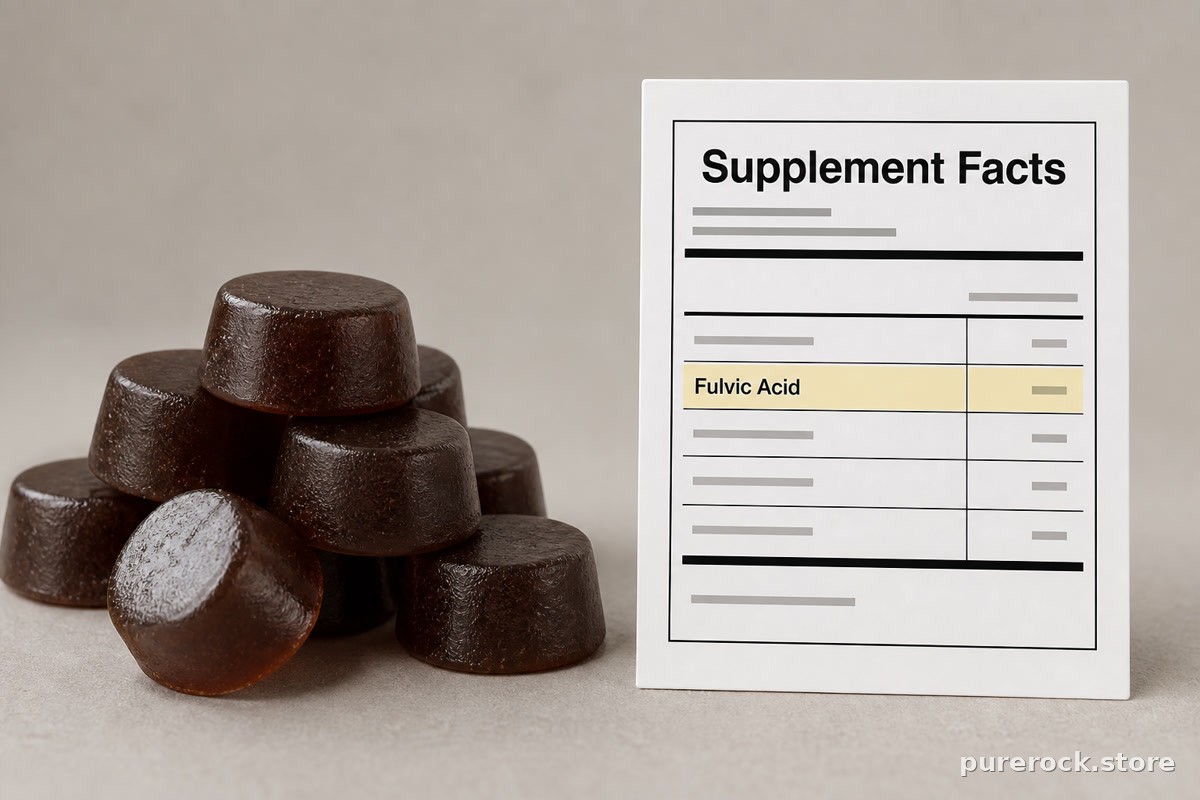
There’s a related labeling nuance worth flagging: some gummy products list fulvic acid content as a percentage of the shilajit extract used (for example, “extract standardized to 40% fulvic acid”), while others list a per-gummy milligram figure for the finished product. These are not interchangeable numbers. A 40%-standardized extract used at a very small dose per gummy can still deliver less total fulvic acid than a lower-percentage extract used at a higher dose. When comparing gummies, the per-serving milligram figure for the finished product is the more useful number — the percentage figure describes the input, not what actually ends up in your mouth.
“Natural” on a Himalayan shilajit gummies label
“Natural” is a second word that does a lot of unearned work on these labels, often paired directly with “Himalayan” — “Himalayan natural shilajit gummies” is itself a common search phrase, which tells you buyers are actively trying to parse what these two words mean together. On a gummy specifically, “natural” is worth separating into what it can and can’t tell you:
- What it typically signals: the shilajit extract itself is derived from the natural mineral exudate rather than fulvic acid from another source (fulvic and humic extracts are also made from materials such as peat or lignite, and those are not the same substance studied in most shilajit research).
- What it doesn’t automatically mean: that the gummy base itself is free of artificial colors, artificial flavors, or refined sugar. A gummy can accurately claim “natural shilajit” while still containing artificial dyes and corn-syrup-based sweeteners in the base — those are separate claims governed by separate parts of the label.
- What to check instead: the supplement facts panel and ingredient list, not the front-of-package word. Look specifically at whether colors are listed by name (a plant-based source) or by number (an artificial dye), and whether the sweetener is a refined sugar, sugar alcohol, or something else.
If a brand’s front label leans hard on “natural” and “Himalayan” together but the ingredient panel shows artificial colors and a generic “proprietary blend” with no fulvic acid percentage, that’s a mismatch worth noticing — the marketing language and the substantiating detail aren’t telling the same story.
A practical framework for reading a Himalayan gummies label
Rather than treating “Himalayan” as a yes/no purity signal, use it as one data point in a small set of questions:
- Is the origin claim specific or vague? A named region beats a continent-sized mountain range with no further detail.
- Is there any documentation for the origin claim, even indirect (supplier relationship, import certification, sourcing page)?
- Is fulvic acid content tested on the finished gummy, with a percentage or per-gummy milligram figure — not just claimed on the raw extract?
- Does a third-party Certificate of Analysis exist, covering heavy metals and fulvic acid, from a lab you can independently verify?
- Does “natural” refer specifically to the shilajit extract, and does the rest of the ingredient panel match that framing (no undisclosed artificial colors under a “natural” front label)?

A gummy that answers all five with real, checkable information is giving you something close to the actual value of a Himalayan-origin claim. A gummy that answers zero of them and relies entirely on the word “Himalayan” plus evocative mountain imagery is asking you to take the origin claim on faith — which may still be true, but isn’t something you can verify from the outside.
In practice, most brands fall somewhere in the middle: they’ll name a country or region without full documentation, or they’ll publish a Certificate of Analysis for heavy metals but not for fulvic acid content specifically. Treat the framework as a scoring tool rather than a pass/fail test — the more of the five questions a brand answers with specific, checkable information, the more weight its origin claim reasonably deserves. A brand answering three or four thoroughly is generally a stronger signal than one answering all five vaguely.
What the research actually says about shilajit’s effects
It’s worth being precise about what’s being studied when research on shilajit is cited in marketing. Most published research on shilajit’s physiological effects has used purified, standardized resin or extract preparations in small clinical studies — not consumer gummy products, and not preparations specifically verified as Himalayan-sourced versus other regions. Findings on markers like testosterone levels or fatigue-related outcomes in specific study populations are suggestive rather than conclusive, and the research base remains limited in size. None of it establishes that a specific gummy product, Himalayan-labeled or otherwise, replicates those results — that depends on whether the finished product delivers a comparable dose of the same active compounds, which circles back to lab testing and dose transparency rather than the origin claim alone.
FAQ
Does “Himalayan” on a gummies label mean the product is higher quality than one without it? Not automatically. It’s a sourcing claim about where raw resin came from, not a statement about purification, contaminant testing, or how much of the active fulvic acid content survived gummy manufacturing. A well-documented, third-party-tested gummy without a specific origin claim can be a more trustworthy product than a “Himalayan” gummy with no supporting documentation at all.
Can I tell where shilajit was sourced by looking at the gummy itself? No. Once shilajit extract is processed into a gummy — standardized, blended into a heated base, cut, and coated — there’s no texture, smell, or visual cue left that could indicate origin. That sensory information exists (imperfectly) for raw resin, not for the finished gummy format.
Is Himalayan shilajit actually better than shilajit from other regions like the Altai mountains? There isn’t strong independent evidence establishing that Himalayan-sourced shilajit is categorically superior to shilajit from other high-altitude regions. The Himalayas have the strongest traditional and historical association, which is a meaningful cultural context, but it isn’t the same as a documented quality advantage. Region-specific comparisons of contaminant load or fulvic acid content are not something most consumer brands publish.
Why do gummies list fulvic acid differently than resin does? Resin is often sold with a fulvic acid percentage tied directly to the raw material. Gummies more commonly list either an extract standardization percentage or a milligram amount per gummy, and the two aren’t directly comparable without knowing the dose. When comparing products, the per-gummy milligram figure for the finished product is generally the more useful number for judging what you’re actually getting per serving.
What’s the single most useful thing to check instead of the word “Himalayan”? Whether the brand publishes third-party lab testing — ideally a Certificate of Analysis covering both heavy metals and fulvic acid content — for the finished gummy product specifically, not just the raw extract. That single document tells you more about what’s actually in the product than any origin claim on the front label.
The honest bottom line on origin claims
“Himalayan” on a shilajit gummies label is a claim worth taking seriously as one input, not as a substitute for the harder work of checking dose transparency, fulvic acid testing, and third-party lab verification. Origin can plausibly correlate with quality — some regions do have long-established, lower-contamination sourcing chains — but the word alone, printed on packaging, doesn’t prove anything about the specific product in your hand. Read it as a starting point for questions, not as an answer.
Related Guides
- Shilajit gummies: do they work?: the umbrella guide to the format.
- Himalayan shilajit: what the origin label does and doesn’t tell you.
- Shilajit side effects and safety: documented versus theoretical risks.