 Purerock
format
Shilajit Gummies: Do They Work? An Evidence Check
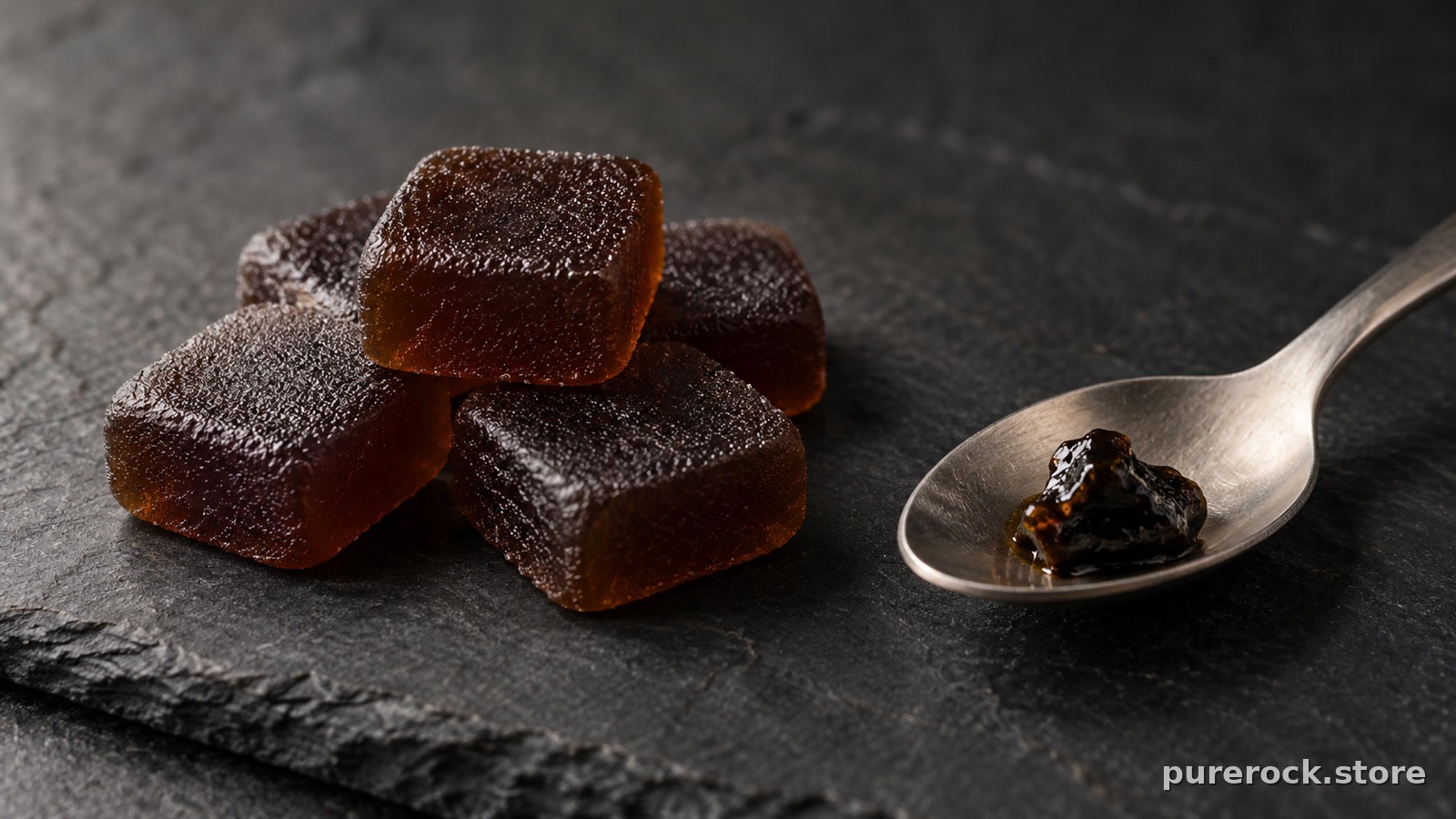
Nobody has published a clinical trial of shilajit in gummy form. The human trials used purified resin or a standardized extract, so whether gummies work comes down to one question: does a gummy deliver the same amount of the same material? Usually you can’t tell from the label, which is why reading the panel matters more than the marketing.
This page is the overview. It covers what a gummy contains, how to read the panel, and how to do the dose math. The narrower questions each have their own page, linked below.
Key Takeaways
- No published human trial tested shilajit gummies. Trial results come from purified resin or extract, so they don’t automatically transfer to a gummy.
- Trials used 250 to 500 mg of purified shilajit per day. A gummy only matches that if its panel discloses the shilajit amount and the extract is comparable.
- A “proprietary blend” line with one total weight can hide how little shilajit is in the gummy.
- Fulvic acid percentages depend on the lab method, and gummies rarely say which one was used.
- Gummies suit people who won’t take resin or capsules consistently. If you want the most predictable dose per dollar, resin or capsules are easier to verify.
Do Shilajit Gummies Work?
The honest answer is that it’s unknown for gummies and limited for shilajit itself. Here is what the human trials actually tested:
- Pandit et al., 2016 (Andrologia): a randomized, double-blind, placebo-controlled trial of purified shilajit at 250 mg twice a day for 90 days in healthy men aged 45 to 55. Total testosterone, free testosterone and DHEAS were significantly higher than placebo.
- Keller et al., 2019 (Journal of the International Society of Sports Nutrition): 63 recreationally active men, 8 weeks, 250 or 500 mg a day of a branded shilajit extract versus placebo. The strength-retention result appeared only at 500 mg and only in the half of participants with higher baseline strength.
- Pingali and Nutalapati, 2022 (Phytomedicine): 60 postmenopausal women with osteopenia, 48 weeks, 250 or 500 mg a day of a standardized aqueous extract versus placebo. Bone density measures declined on placebo and were attenuated in both shilajit groups.
All three used a purified shilajit or standardized extract, all are small, and none used a gummy. For a fuller trial-by-trial read, see does shilajit work.
A gummy changes three things the trials didn’t test. It adds a sugar or pectin base. It is heated during manufacturing. And the shilajit portion is often a small fraction of the piece. None of those necessarily ruin the product, but each is a reason the trial results can’t be assumed to carry over. Any “gummies work” claim on a product page is borrowing evidence from resin.
I also searched PubMed for published analyses of how much shilajit gummies actually contain versus their labels and found none. Lab testing of finished shilajit products exists: a consumer-testing group reported that one product contained far more fulvic acid than its label implied. Its published summary covers resins and extracts, not gummies. The same point applies in reverse: if label accuracy varies for the simplest formats, don’t assume it is better for the most processed one.
What’s Actually in a Shilajit Gummy
A gummy is a candy that carries a small amount of extract. The base is most of the piece. Typical components, by role:
| Component | What it does | What to check |
|---|---|---|
| Gelling agent (pectin or gelatin) | Holds the shape | Pectin is plant-based; gelatin is animal-derived. See vegan shilajit gummies |
| Sugar, glucose syrup, or sugar alcohols | Sweetness and texture | Grams of added sugar per serving |
| Acids and flavors (citric acid, “natural flavor”) | Mask the earthy, bitter taste | Fine for most people, but a trigger for some |
| Colors | Make a dark extract look appealing | Natural vs. artificial |
| Coating (oil or wax) | Stops sticking | Wax coatings can be animal-derived |
| Other “blend” ingredients (herbs, vitamins, minerals) | Marketing differentiation | Whether amounts are disclosed |
The last row is the one that muddies evaluation. Many shilajit gummies add ashwagandha, vitamin D, zinc or similar ingredients. Each added ingredient takes space in a piece that can only hold so much, and it makes it harder to attribute anything you notice to shilajit. If you want to understand shilajit specifically, a single-ingredient product is a cleaner experiment.
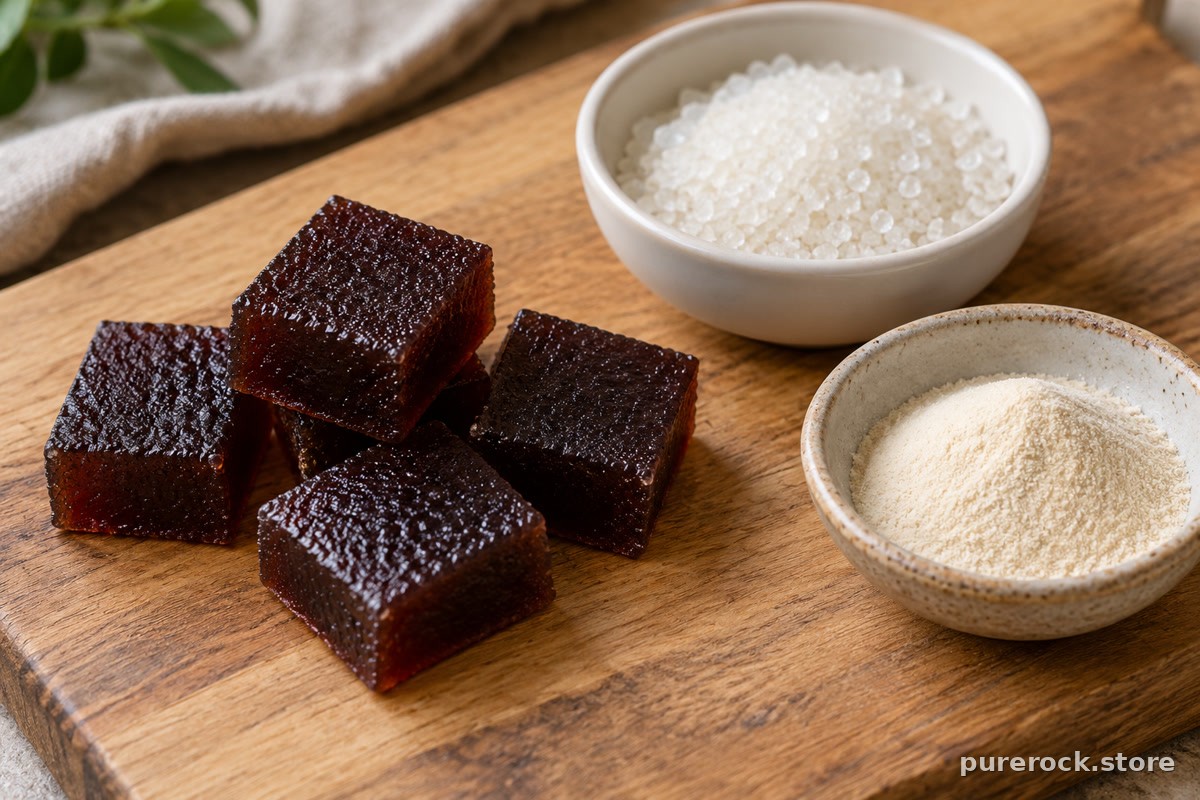
How to Read the Supplement Facts Panel
Most of the information you need is on the panel and the ingredient list. Work through it in this order:
- Find the shilajit line. Look for “shilajit” with a milligram amount, ideally with the part used (purified extract, resin). If the only mention is inside a list of other ingredients, you can’t know the dose.
- Spot a proprietary blend. A “blend” is listed with one combined weight, and its ingredients appear in descending order by weight. If shilajit is listed after three other ingredients, it is a smaller share of that total than they are. A blend of 500 mg could contain 20 mg of shilajit and the panel would still be legal.
- Check the serving size. “Serving size: 2 gummies” is common. The mg on the panel may be for two, and the bottle is priced per piece.
- Read the “Other ingredients” list. This is where the sugar, base and flavors appear. Compare the “Added Sugars” line to the American Heart Association’s upper limit of about 100 calories (roughly 25 g) a day for most women and 150 calories (roughly 37 g) for most men (Johnson et al., 2009, a scientific statement). A couple of gummies won’t move that needle much on their own, but it adds up with the rest of your day.
- Look for a third-party mark or certificate. A lab certificate of analysis that matches the batch number is better than a logo. Our guide to spotting fake or unpurified shilajit lists what a legitimate certificate should show.
For the full checklist version, including red flags, see best shilajit gummies.

Fulvic Acid: Why the Percentage Is Hard to Compare
Marketing pages lean on fulvic acid content. The problem is that “fulvic acid” is defined by a lab procedure rather than a fixed molecule, and different procedures can report different amounts for the same material. We explain this in shilajit vs fulvic acid.
For gummies this compounds. A percentage might describe the starting extract rather than the finished gummy, and the finished gummy is mostly base. Useful questions for any gummy:
- Is the percentage of the extract, or of the whole gummy?
- Which assay method produced it?
- Is it a per-serving milligram figure, or only a percentage?
- Does the certificate cover the finished gummy or just the raw ingredient?
If the maker can’t answer these, “fulvic acid” on the front of the package is decoration.
Heavy Metals and Testing
Shilajit is a mineral-rich natural material, so testing for contaminants is the main safety question. A 2024 review in Biological Trace Element Research (Hussain and Saeed) reported that most published metal levels in shilajit fell below WHO and FDA herbal limits, with a few studies finding exceedances. A separate 2022 elemental analysis of Indian and Pakistani shilajit samples (Aldakheel et al.) reported lead, arsenic and mercury above the standard permissible limit in some samples. Together these tell you the risk depends on the batch, which is why a certificate matters.
A gummy adds a wrinkle: the metal content of the finished product depends on the shilajit used, and also on other ingredients in the base. Ask for a certificate of analysis that lists lead, arsenic, cadmium and mercury results for the finished product, from an independent lab. If you are pregnant, see the safety pointers below.
Cost per Effective Dose: Do the Math Yourself
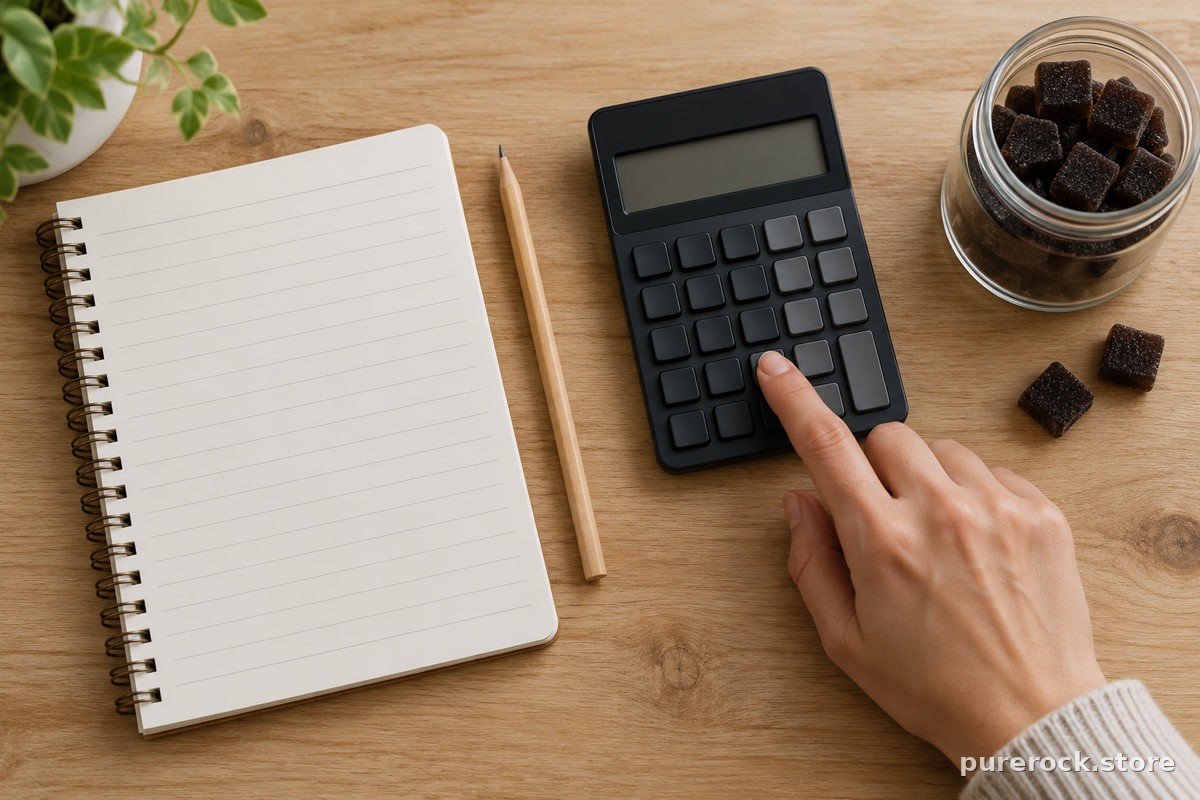
Price per gummy is meaningless. What you want is the cost per milligram of disclosed shilajit. The formula:
cost per mg of shilajit = bottle price ÷ (gummies per bottle × mg shilajit per gummy)
To see why it matters, here is the arithmetic with made-up numbers (not real products or prices). Suppose a bottle has 60 gummies and the panel discloses 50 mg of shilajit extract per gummy. The bottle holds 3,000 mg. A trial-range dose of 500 mg a day would need 10 gummies, so the bottle would last six days. A resin or capsule product that discloses 500 mg per serving gets you that dose in one serving. The gummy can look cheap per piece and still be the most expensive way to reach a trial dose.
Now the reverse: if the panel lists a blend and no shilajit amount, the denominator is unknown and you can’t calculate anything. That’s the point. See shilajit price for how to compare across formats, and capsules vs. resin vs. gummies for how the three formats differ on dose and shelf life.
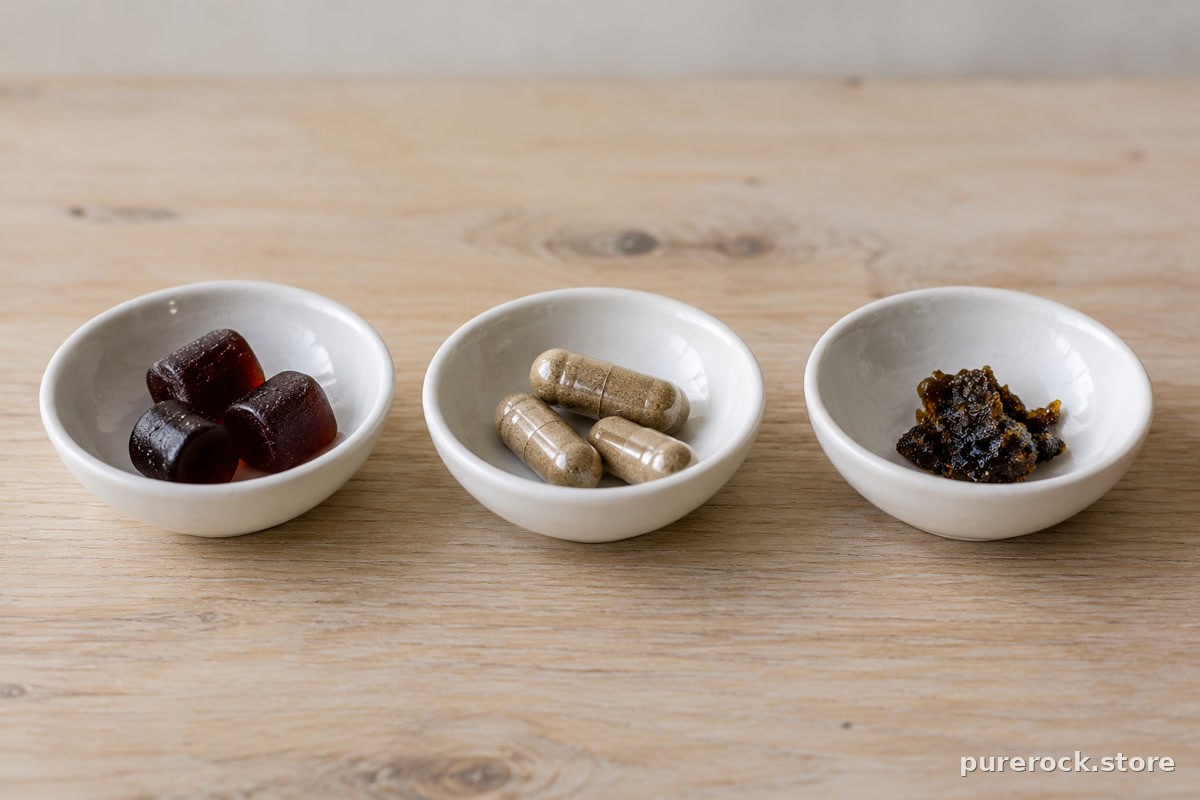
Gummies vs. Resin vs. Capsules, at a Glance
| Gummies | Capsules | Resin | |
|---|---|---|---|
| Disclosed dose per unit | Often small or blended | Usually stated | Stated per gram, measured by you |
| Taste | Candy-like | Neutral | Strong, earthy |
| Added sugar | Yes | No | No |
| Easiest to verify against trials | Hardest | Moderate | Moderate |
| Best for | People who skip other formats | Travel, precise dosing | Flexibility, minimal additives |
This table is a reasoning aid, not a verdict. A well-labeled gummy with a disclosed dose and a matching certificate beats a poorly labeled capsule. Use dosage guide for what trials tested.
Who Gummies Suit, and Who Should Pick Something Else
Gummies are a reasonable pick if:
- You won’t take resin because of the taste, or capsules because you dislike swallowing them.
- The panel states a shilajit amount and you’ve done the cost-per-mg math.
- The added sugar fits your day.
Choose resin or capsules if:
- You want to match what trials tested as closely as possible.
- You are watching sugar, for example with diabetes or prediabetes.
- You want fewer unknown ingredients, which makes it easier to tell what is causing any effect or side effect.
If you are shopping with a particular audience in mind, see shilajit gummies for men or Himalayan shilajit gummies for how origin claims work on a gummy label.
Side Effects and Who Should Talk to a Doctor First
Gummy-specific issues (sugar, gummy-base sensitivity, eating too many because they taste like candy) are covered in shilajit gummies side effects. The general shilajit questions, including interactions, are in shilajit side effects.
Two cautions apply to any format. Talk to a doctor before use if you are pregnant, breastfeeding, on prescription medication, or managing a chronic condition. And note that the safety evidence is thin: a 2018 case report in Gynecological Endocrinology (Stavropoulos et al.) described a pregnant woman who developed high blood pressure and low potassium after six months of a herbal supplement called “mumijo,” a shilajit-like material; she was treated with potassium and stopping the supplement. That is a single case and doesn’t show shilajit caused it in anyone else, but it illustrates why pregnancy is not the time to experiment.
FAQ
Do shilajit gummies work?
No trial has tested gummies. The human trials that exist used purified resin or a standardized extract at 250 to 500 mg a day, and they were small. A gummy could deliver a comparable amount only if its panel discloses the shilajit dose and the material is comparable.
What are the benefits of shilajit gummies?
The benefits attributed to gummies are borrowed from resin and extract studies, such as the testosterone, strength and bone-density findings above. They came from small trials, not gummies. See shilajit benefits for the claim-by-claim evidence.
Are shilajit gummies reviews trustworthy?
Treat them with caution. Reviews describe taste, texture and subjective feeling, which trials didn’t measure and which a placebo can influence. They can’t tell you the dose or whether the product is contaminated. Shilajit reviews explains how to read them.
What makes a shilajit gummy “pure”?
There is no legal definition of “pure shilajit gummies.” Look for a disclosed shilajit amount, no proprietary blend hiding it, an independent certificate of analysis for heavy metals on the finished product, and a short ingredient list.
Are shilajit gummies better than resin?
Not on evidence. Resin has the trial history and no added sugar. Gummies win on taste and convenience. The right choice is the one you will actually take consistently, once the label passes the checks above.
Bottom Line
Shilajit gummies are a delivery format, not a different treatment, and no trial has tested them. Judge a gummy by whether it discloses the shilajit amount per serving, avoids hiding it in a blend, comes with a finished-product certificate for heavy metals, and costs sensibly per milligram. If it can’t pass those checks, resin or capsules are easier to verify. If you have a medical condition or take medication, ask your doctor before starting any form.