 Purerock
format
Shilajit Capsules vs. Resin vs. Gummies: Which Fits You?
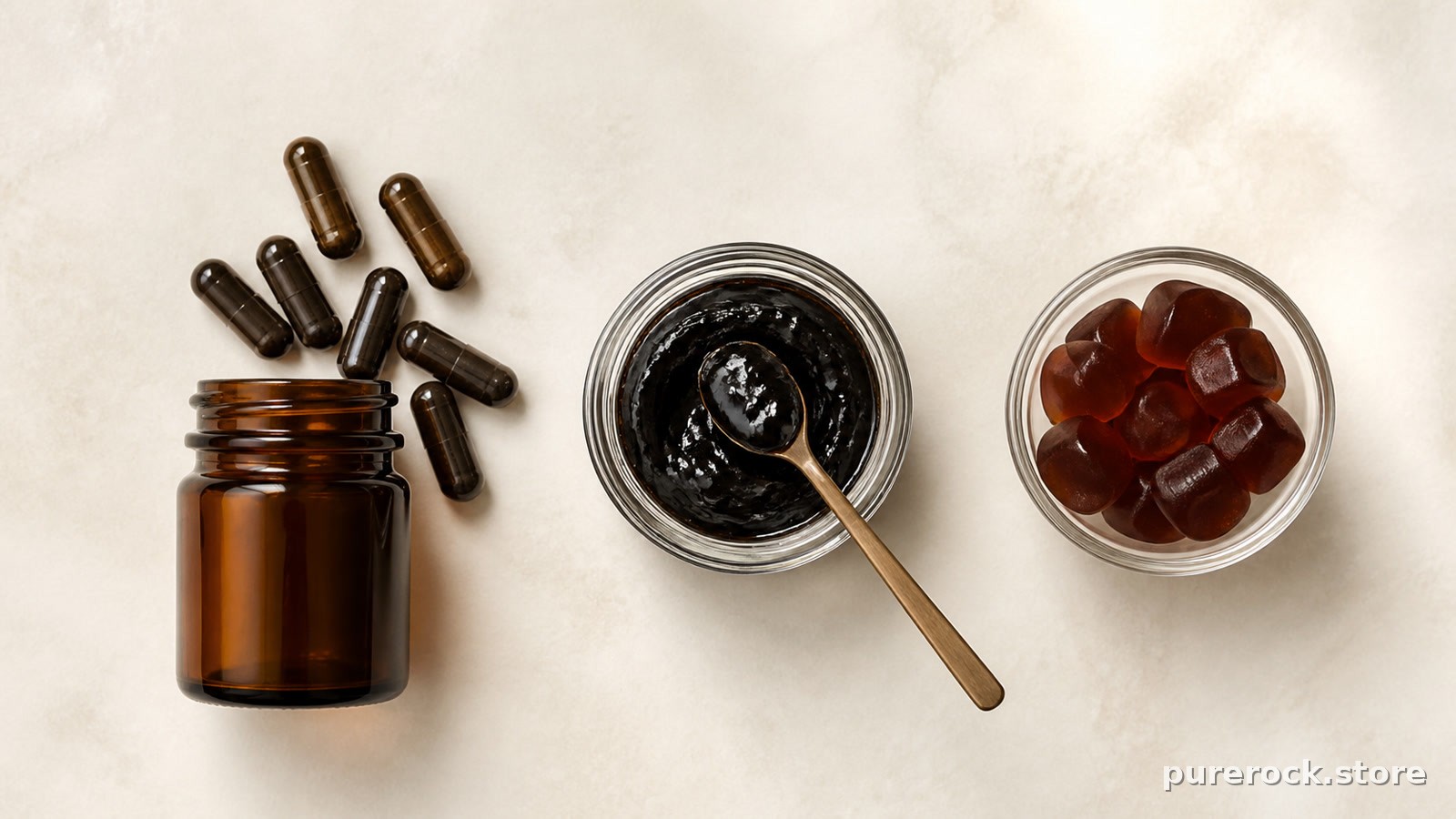
Shilajit now ships in three very different packages, and the format you pick changes more than convenience — it changes how much fulvic acid and trace mineral content actually reaches your bloodstream, how consistent your dose is from day to day, and how much you’ll spend per month. Resin, capsules, and gummies are not interchangeable products wearing different wrappers; each one involves a different level of processing between the raw mountain source and what lands in your mouth. This guide breaks down the practical differences so you can match a format to how you actually live, not just to what showed up first in a search result.
Key takeaways
- Resin is the least processed format, often the cheapest per mg of product (though not necessarily per mg of fulvic acid), and the format most prone to scoop-to-scoop dosing variance unless you weigh it.
- Capsules offer the most consistent, trackable dose and the easiest travel experience, at a moderate price premium over resin.
- Gummies are the most palatable and pill-averse-friendly format, but typically carry the lowest shilajit concentration per unit and the highest cost per mg of active extract.
- Switching formats is not a 1:1 swap — mg-equivalent content per serving differs enough between resin, capsules, and gummies that you should recalculate your intake rather than assume equal dosing.
- No format is universally “better” — the right choice depends on how much you value taste, travel convenience, dosing precision, and cost, in that order of priority for you personally.
The core tradeoff: processing vs. convenience
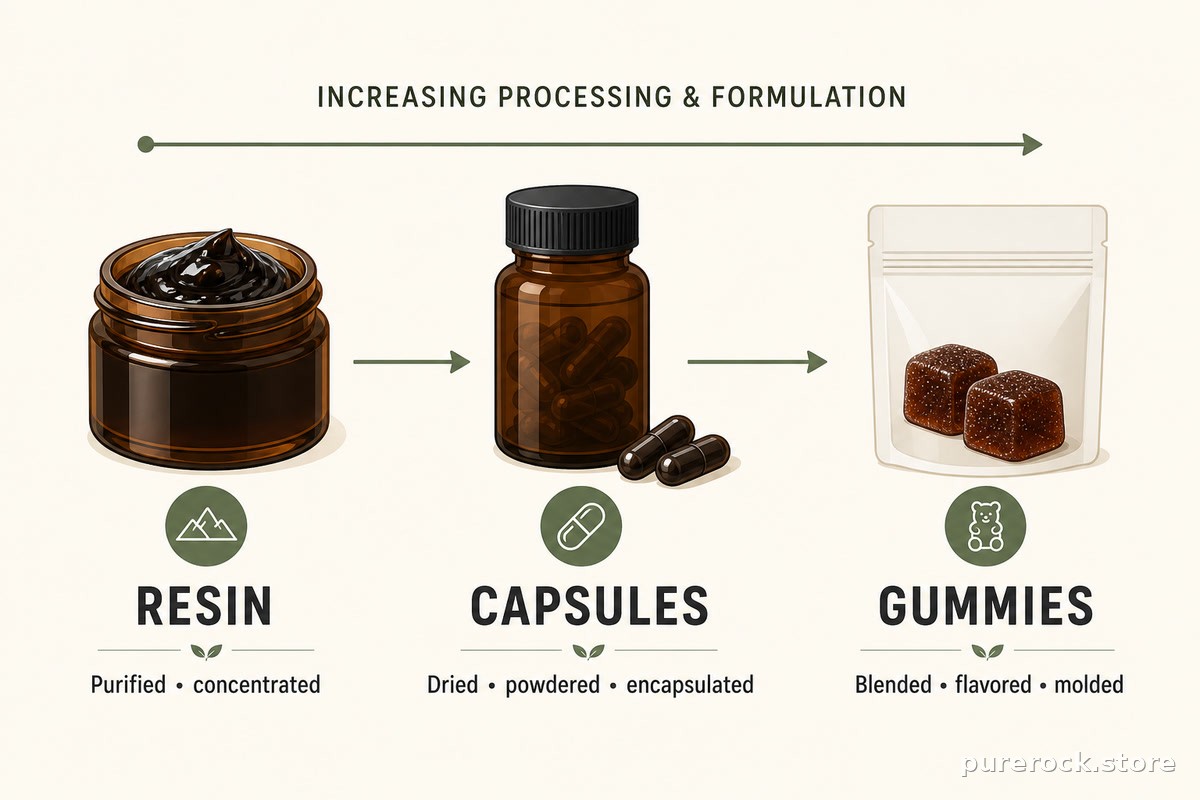
Purified shilajit resin is the least processed form available to consumers — it’s the reduced, semi-solid exudate scraped from rock and purified through repeated dissolution and filtration cycles, with nothing else added. Capsules take that same purified extract, dry it into a powder, and encapsulate a measured amount. Gummies go a step further: the extract is blended into a sugar or pectin base along with flavoring, binders, and often preservatives, then set into a chewable form.
Each additional processing step buys you convenience — no bitter taste, no measuring, no cleanup — but it also dilutes the fraction of the gummy or capsule that is actually shilajit versus filler. A typical resin dose is close to 100% purified shilajit by weight. A capsule dose is usually 90-95% shilajit extract with a small amount of anti-caking agent or capsule shell material. A gummy dose is frequently the lowest-concentration option, since a meaningful volume of the gummy has to be sugar, gelatin or pectin, and flavoring just to hold its shape and taste palatable.
It helps to think of this as a spectrum rather than three fixed categories. On one end sits raw, unpurified shilajit as it’s scraped from rock — not something you should ever consume directly, since it can carry heavy metals and organic contaminants before purification. Purified resin sits one step past that: the raw material has gone through repeated dissolution, filtration, and low-heat reduction to remove contaminants while preserving the fulvic acid and mineral profile. Capsules sit further along the spectrum, since the purified resin has to be dried into a free-flowing powder before it can be filled into a capsule shell, and that drying step is an additional point where processing choices (temperature, drying time) can affect potency. Gummies sit at the far end, combining the dried extract with a manufactured base that has its own temperature and shelf-stability requirements. None of this makes gummies or capsules “bad” — it just means the format you choose reflects a deliberate tradeoff between how close you want to stay to the source material and how much convenience you want in exchange.
Absorption and bioavailability
Bioavailability differences between formats come down to two variables: how much active fulvic acid and dibenzo-alpha-pyrone content survives processing, and how the body’s digestive process interacts with the delivery vehicle.
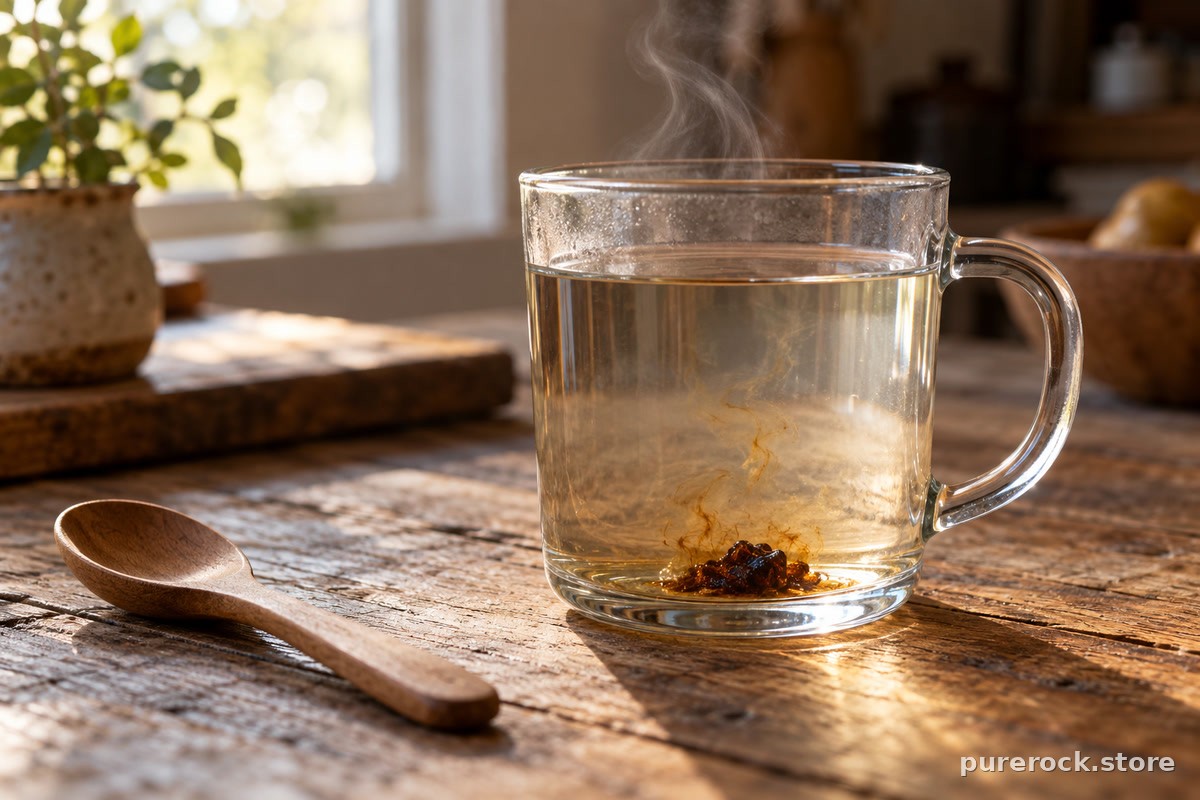
Resin dissolved in warm water or milk is generally considered the reference standard, since it undergoes the least additional processing after purification and dissolves quickly, giving the compounds early exposure to the stomach for absorption. Capsules deliver a comparable concentration of the same purified extract, but the gelatin or vegetarian capsule shell has to dissolve first, adding a short absorption lag — typically not clinically meaningful for a daily supplement, but relevant if you’re taking it for a fast-acting effect before a workout.
Gummies are the format where absorption claims deserve the most scrutiny. Heat used during gummy manufacturing (to melt and set the pectin or gelatin base) can degrade fulvic acid content if temperatures aren’t controlled, and the lower overall shilajit concentration per gummy means you’re often consuming multiple gummies to match a single capsule or resin dose. We weren’t able to find published stability data measuring how much fulvic acid survives gummy manufacturing, so treat heat exposure as a reasonable caution across processed formats rather than a measured loss — and not as a verdict on any one brand’s gummies.
None of this means gummies are ineffective; it means the format has a structurally lower ceiling on active-compound concentration per dose, which shows up in the mg-equivalent comparisons below.
There’s also a timing dimension worth considering separately from raw absorption percentage. No human pharmacokinetic study has compared how quickly shilajit is absorbed across formats or with and without food, so any “fastest” claim is an inference, not a measurement. Resin already dissolved in warm liquid at least skips the step of a shell or gummy base breaking down, and many traditional routines call for taking it first thing in the morning before food. Capsules, by contrast, are frequently taken with a meal, both because the shell needs digestive fluid to break down and because some users report less stomach sensitivity when shilajit is taken alongside food rather than on an empty stomach. Gummies are almost always chewed and swallowed without regard to meal timing, since the format is designed around convenience rather than optimizing an absorption window — which is a reasonable tradeoff if your priority is consistency of habit over maximizing peak absorption speed.
Taste and convenience
This is where the formats diverge most sharply for the average person.
Resin has a distinctive, strong, somewhat bitter and earthy taste that a meaningful share of first-time users find unpleasant. It has to be dissolved in warm (not boiling) water, tea, or milk before consumption, which means it doesn’t travel well for a quick dose on the go — you need a cup, warm liquid, and a few minutes of stirring since resin dissolves slowly.
Capsules solve the taste problem entirely. There’s no flavor to mask because nothing touches your tongue before the capsule dissolves in your stomach. They’re also the most travel-friendly format: no water needed beyond swallowing, no melting risk in a hot car or gym bag, and no measuring a pea-sized dose off a spoon.
Gummies solve the taste problem differently — by masking it with fruit or berry flavoring rather than avoiding it. For people who dislike swallowing pills, or who want a supplement that doesn’t feel like “medicine,” gummies are the more palatable format. The tradeoff is added sugar and, for some users, digestive sensitivity to sugar alcohols or pectin fillers at higher intake.
Portability is a related but distinct factor from taste. A resin jar is glass or plastic, needs to stay upright to avoid leaking, and isn’t something most people want to carry loose in a bag — it’s a “kept at home” format for most users. Capsule bottles are rigid, sealed, and built for travel; a week’s supply fits in a pocket organizer or a daily pill case without any risk of melting, spilling, or needing refrigeration. Gummies fall in between: they travel reasonably well in their original container, but a loose handful in a bag can clump together in heat, especially in a hot car or during summer travel, since the sugar/pectin base is more heat-sensitive than a capsule shell.
Dosage precision and mg-equivalents
Dosage clarity is one of the most underrated differences between formats. Because resin is measured by scooping a small portion (commonly described in “pea-sized” or “grain-of-rice-sized” amounts before a kitchen scale is used), it’s the format most prone to dosing inconsistency between individual doses. A common resin serving is roughly 300-500 mg, but the actual amount can vary noticeably scoop to scoop unless you’re weighing it.
Capsules remove nearly all of that ambiguity: each capsule is manufactured to a fixed weight, typically 250-500 mg of shilajit extract per capsule, so two capsules reliably deliver twice the extract of one. This is the format best suited to anyone tracking a specific daily target or titrating a dose under a doctor’s guidance.
Gummies are dosed per-gummy as well, but the mg of actual shilajit extract per gummy is usually lower than a capsule’s per-unit dose — commonly in the 100-250 mg extract range per gummy — which means matching a capsule-equivalent dose often requires two or more gummies, along with the associated sugar intake.
This is also where reading a supplement facts panel carefully matters more than the marketing copy on the front of the label. Some brands list the total weight of the gummy or capsule rather than the mg of shilajit extract it actually contains, which can make a low-potency product look comparable to a higher-potency one at a glance. Look specifically for a line that reads “shilajit extract” or “purified shilajit” with a standardized fulvic acid percentage (often expressed as “standardized to X% fulvic acid”), since that percentage is a better signal of potency than the raw weight of the capsule or gummy alone. A 500 mg capsule standardized to a low fulvic acid percentage can deliver less active material than a 300 mg capsule standardized to a higher percentage.
Cost per dose
Sticker price is a poor way to compare these formats, because container sizes and per-serving mg content vary so much. What matters is cost per equivalent mg of shilajit extract delivered.
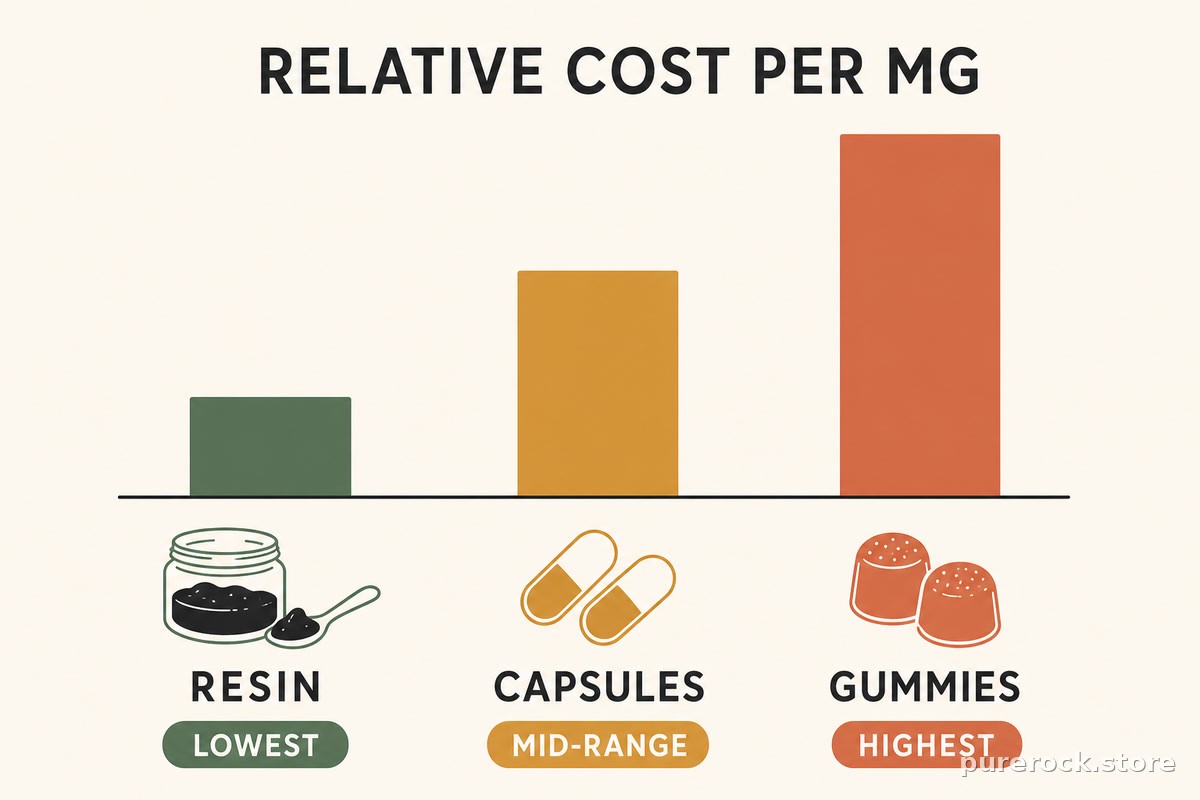
Resin is often the cheapest format per mg of product, since you’re paying almost entirely for the raw purified material with minimal packaging or processing overhead added to the price. Capsules typically carry a moderate premium over resin for the same extract weight, reflecting encapsulation and standardized manufacturing costs. Gummies tend to be the most expensive per mg of actual shilajit extract, since a meaningful share of the cost goes into flavor systems, coating, and the sugar/gelatin base rather than the extract itself.
To make this concrete: if a 30-day resin supply runs roughly $25-35 for around 300 mg daily doses, the equivalent monthly capsule supply at a similar per-dose extract weight often lands in the $30-45 range, reflecting encapsulation and standardized manufacturing overhead. A comparable 30-day gummy supply, delivering the same total mg of extract, frequently costs $35-55 or more, since you typically need two to three gummies daily to match the extract content of one resin serving or capsule, and each of those gummies carries its own share of flavoring and base-material cost. These ranges vary widely by brand and purity claims, so treat them as directional rather than exact — the relative ordering (resin cheapest, capsules moderate, gummies priciest per mg of product) is a rough pattern, not a rule.
That ordering can flip when you measure what’s actually in the product. In ConsumerLab’s 2024 testing of eight shilajit supplements, the resins contained far less fulvic acid than the extracts in capsules and pills, and the concentrated extracts were less expensive than resins for an equivalent amount of fulvic acid. So resin may be cheapest per gram of product while costing more per mg of fulvic acid — another reason to look for a tested fulvic acid figure rather than comparing weights alone.
| Format | Extract per dose | Taste | Absorption speed (not measured in humans) | Dosing precision | Relative cost per mg of product | Best for |
|---|---|---|---|---|---|---|
| Resin | ~300-500 mg | Strong, earthy, bitter | Likely quickest (already dissolved) | Lowest (scoop-based) | Lowest | Value, ritual/routine users, those unbothered by taste |
| Capsules | ~250-500 mg | None (masked by shell) | Likely slight lag (shell dissolves) | Highest (fixed per-unit) | Moderate | Travel, taste-sensitive users, precise dose tracking |
| Gummies | ~100-250 mg | Masked with flavoring | Likely slowest (multiple steps + sugar base) | Moderate (fixed per-unit, but lower concentration) | Highest | Pill-averse users, occasional/casual use |
Shelf life and storage
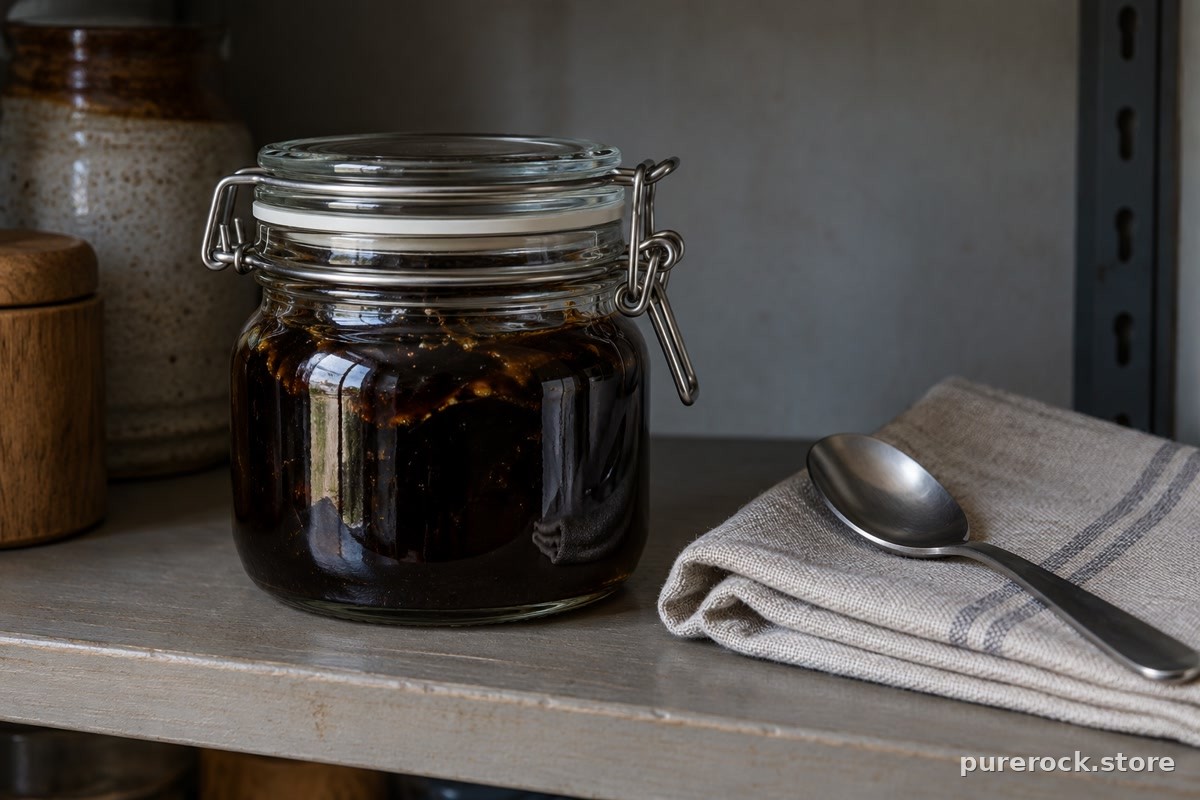
Resin is hygroscopic — it absorbs moisture from the air — so it needs an airtight container, cool storage, and a dry utensil each time it’s scooped, or it can develop mold over time. Properly stored resin has a long shelf life, often multiple years, since it’s minimally processed and low in moisture to begin with.
Capsules are the most storage-forgiving format: sealed in a standard supplement bottle, they’re shelf-stable at room temperature for the duration printed on the label, with no risk of the contents absorbing ambient moisture the way loose resin can.
Gummies have the shortest practical shelf life of the three. The sugar/pectin base can dry out, become sticky, or clump if stored in heat or humidity, and preservative-free formulations in particular should be checked against printed expiration dates rather than assumed to last as long as a capsule bottle.
Storage conditions matter more than most people expect. A resin jar left near a stove, a sunny windowsill, or a bathroom (where humidity spikes from showers) will degrade faster than one kept in a cool, dark pantry — the same logic that applies to storing honey or raw spices. Capsule bottles are more forgiving but still benefit from staying out of direct sunlight and away from temperature swings, since UV exposure can slowly degrade some of the same fulvic acid compounds that heat affects during gummy manufacturing. If you live somewhere with a hot, humid climate, that alone can be a practical reason to lean toward capsules over resin or gummies, simply because the sealed bottle format is the most resistant to ambient moisture and heat fluctuation.
Which format fits which use case
- Daily routine, budget-conscious, don’t mind the taste: resin is often the cheapest per gram (check fulvic acid content if that’s what you’re paying for), and the small ritual of dissolving it in warm water or tea works well as a habit anchor.
- Travel, gym bag, or a taste-averse routine: capsules are the most practical — no water needed beyond swallowing, no melting risk, and consistent dosing across every capsule.
- Precise dose tracking, e.g., following a specific daily target discussed with a doctor: capsules again, since fixed per-unit mg content removes the guesswork that comes with scooping resin.
- Pill-averse users or anyone who wants a more palatable daily supplement: gummies, accepting the tradeoff of lower extract concentration per unit and added sugar.
- Occasional or trial use before committing to a routine: gummies or capsules are lower- commitment starting points than a resin jar, since they don’t require learning a scooping and dissolving process.
FAQ
Can I switch between formats without changing my dose? Not directly — because mg-equivalent content per serving differs by format (see the table above), switching from capsules to gummies or resin means recalculating how many units match your prior daily intake rather than assuming a 1:1 swap. Check the supplement facts panel on both products and compare mg of shilajit extract (or the standardized fulvic acid percentage) rather than the number of units.
Is one format “more natural” than another? Resin is the least processed, since it skips encapsulation and the sugar/gelatin base entirely. That doesn’t automatically make it more effective for everyone — it just means fewer manufacturing steps sit between the purified source material and what you consume.
Do capsules or gummies contain fillers? Capsules typically contain a small amount of anti-caking agent and the capsule shell material itself (gelatin or a vegetarian alternative). Gummies contain a larger share of non-shilajit ingredients by volume, since the sugar/pectin base, flavoring, and coloring are structurally necessary to form a chewable gummy.
Which format is best for a first-time user? Capsules or gummies tend to be the lower- commitment starting point, since they don’t require learning a scooping-and-dissolving routine or tolerating resin’s strong taste. Starting with a smaller, well-labeled dose and paying attention to how you feel over the first couple of weeks is more useful than picking a format based on absorption-speed differences alone, which are modest in day-to-day practice.
Can I mix formats, like resin some days and capsules on travel days? Yes — many people do exactly this, using resin at home and capsules when traveling. The only thing to track is the mg-equivalent so your total daily intake stays consistent, since the two formats aren’t dosed identically per unit.
Does the format affect how shilajit tastes when mixed with other things, like coffee or smoothies? Only resin has a taste to consider here, since capsules and gummies are consumed whole. Resin dissolved into coffee, warm milk, or a smoothie base tends to blend in reasonably well once fully dissolved, though its earthy flavor is still detectable to most palates even when diluted.
This comparison is educational and not medical advice. If you’re managing a health condition or taking medication, talk to a doctor before starting any new supplement, regardless of format.
Related Guides
- Shilajit gummies: do they work?: the umbrella guide to the format.
- How to choose the best shilajit: a brand-free checklist.
- Shilajit price and cost per serving: how to compare costs fairly.