 Purerock
format
Shilajit Resin: What It Is, How to Use and Store It
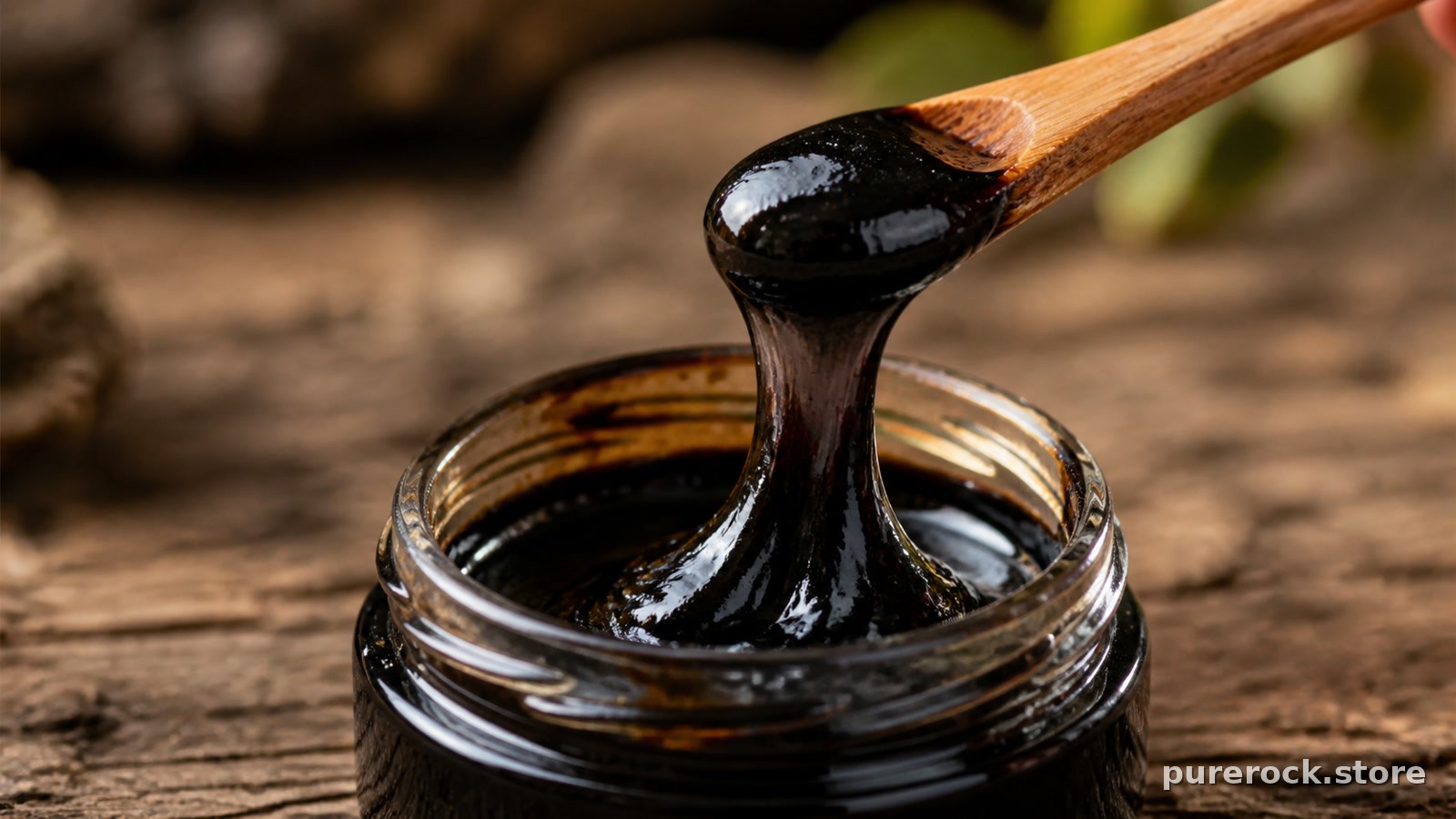
Shilajit resin is the format most people picture when they hear the word “shilajit” — a dark, tar-like substance sold in small jars, meant to be pinched off in tiny amounts and dissolved in warm water or milk. But “resin” covers a wide range of actual products, from genuinely raw exudate scraped off rock faces to heavily processed pastes cut with fillers. If you’ve bought a jar and aren’t sure whether what you’re looking at is right, or you’re trying to figure out how to use it without wasting half the jar or ruining the rest, this guide walks through the format specifically — not shilajit in general, but resin as a physical product you have to handle, dose, and store correctly.
Key Takeaways
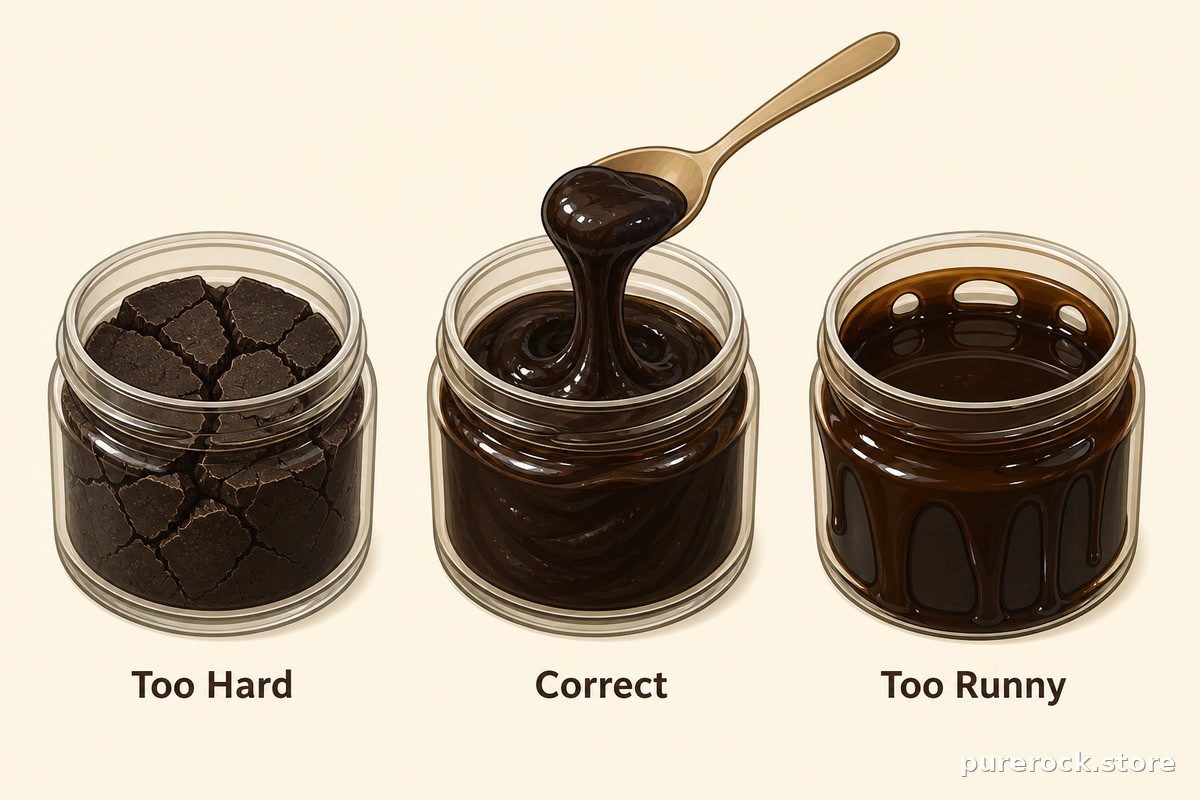
- Properly purified resin should be firm-but-pliable at room temperature, non-gritty, and softens with body heat — not rock-hard, not runny.
- A “pea-sized” dose is roughly 3–5mm across; compare it against a real dried pea until you have a consistent feel for the size.
- Dissolve in warm (not boiling) water or milk, stirring 60–90 seconds — boiling isn’t necessary and some people avoid it to protect heat-sensitive compounds.
- Storage failures, not sourcing, cause most of the “my resin went bad” complaints — keep it airtight, cool, and away from direct sunlight.
- Origin labels like “Himalayan” aren’t a reliable purity signal on their own; third-party lab testing and a disclosed fulvic acid percentage matter more.
What Raw Shilajit Resin Actually Is
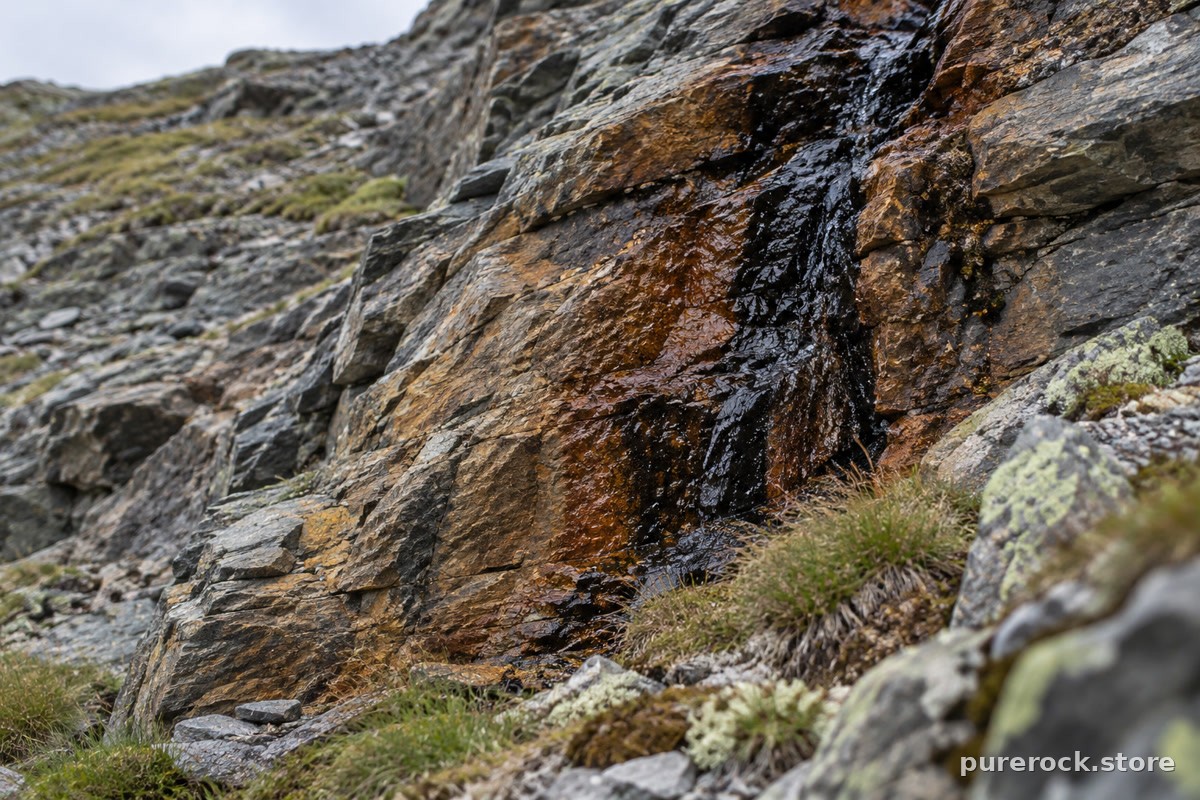
Shilajit is generally thought to form over centuries as plant matter gets compressed between rock layers in high-altitude mountain ranges and slowly breaks down under pressure, heat, and microbial activity. The result is a mineral-rich, organic exudate that seeps out of rock crevices, particularly in the Himalayas, Altai, and Caucasus ranges, during the warmer months when the rock heats up enough for the material to soften and ooze out. Exactly which plants are involved is still debated: reviews name candidates including mosses, liverworts, Euphorbia royleana, and clover (Trifolium repens) (Carrasco-Gallardo et al., 2012; Kamgar et al., 2025).
In its rawest form, this exudate looks less like a smooth paste and more like a dark, gummy tar mixed with rock debris, plant fiber, and grit. What ends up in a consumer jar has gone through some form of purification — typically a sun-drying, filtering, and re-concentrating process meant to remove insoluble rock particles and biological contaminants while preserving the fulvic acid, humic acid, and trace mineral content that make shilajit what it is. The purification method matters more than most buyers realize: overheating during processing can degrade fulvic acid content, while under-purification leaves heavy metals and microbial contamination in the final product.
What the Texture Should Actually Feel Like
This is where a lot of confusion happens, because “sticky” gets used to describe products that range from nearly solid to nearly liquid, and only a fairly narrow band in the middle is actually correct.
Properly purified and stored shilajit resin should be:
- Firm at room temperature, softening with body heat. When you press a clean utensil or fingertip into it, it should give slightly and stick to the tool, not smear off wetly or crumble like a dry solid.
- Pliable, not pourable. You should be able to pinch off a small piece and roll it between your fingers without it dripping. If your jar’s contents pour or slosh like syrup, it’s either been over-diluted or was never fully purified.
- Slightly warm-responsive. Resin softens noticeably in a warm hand or warm room and firms back up in the cold. This temperature sensitivity is normal and expected — it’s not a sign of degradation.
- Non-gritty. You shouldn’t feel sand-like particles when you rub it between your fingers. Grit usually means incomplete filtration of rock sediment.
If a jar arrives rock-hard and unyielding even after warming in your palm for a minute, or if it’s runny enough to coat the inside of the jar like honey, something is off with either the sourcing or the processing — see our guide on spotting fake or adulterated shilajit for the fuller purity checklist.
Seasonal and shipping conditions also affect first impressions. A jar that traveled through a hot warehouse or sat on a delivery truck in summer can arrive noticeably softer than it will be once it settles at room temperature for a day or two — give a new jar 24–48 hours in a stable, cool spot before judging its texture. Conversely, a jar that shipped in winter or was refrigerated in transit may arrive firmer than usual and simply need a few minutes of ambient warming. Judging texture immediately out of the shipping box is one of the more common sources of false “this seems off” reactions.
How to Measure a Pea-Sized Dose
Most resin products are dosed by describing a “pea-sized” or “rice-grain-sized” amount rather than by weight, because weighing out 300–500mg on a kitchen scale isn’t practical for most people. Here’s a more concrete way to get consistent:
- Use a clean, dry utensil — a small metal or wooden spoon, or a designated dosing stick if the product includes one. Avoid plastic, which can pick up odor and stain.
- Pinch or scoop an amount roughly the size of a dried pea — about 3–5mm across. For most commercial resins, this lands in the range that manufacturers label as a “serving,” though you should always defer to the specific product’s label since concentration varies by brand and origin.
- Don’t eyeball from a knife tip or fingertip alone the first few times — compare your pinched amount against an actual dried pea or a grain of rice sitting next to your dosing area until you have a feel for the size. Consistency matters more than precision down to the milligram.
- If your jar includes a scoop, use it as your calibration reference even after you’ve stopped needing it — manufacturer scoops are usually sized to the labeled serving.
For guidance on how often and how much to take, see our dedicated dosage guide — dose size and dose frequency are separate questions, and resin format doesn’t change the underlying frequency guidance.
Dissolving It Properly
Shilajit resin is water-soluble but not instant-dissolving — dropping it into cold water and expecting it to vanish in seconds will leave you with a stubborn clump at the bottom of the glass.
- Use warm, not boiling, water or milk. Around 40–50°C (105–120°F) is enough to soften the resin without needing near-boiling temperatures that some people worry could degrade heat-sensitive compounds. Boiling isn’t strictly required, and using it “just to be safe” isn’t necessary.
- Stir or swirl for 60–90 seconds. The resin will initially clump and then gradually disperse into the liquid, turning it a translucent amber to dark brown depending on concentration.
- Let it sit a minute if it’s stubborn. A very firm piece may need an extra minute of soaking before it fully breaks down, especially in a smaller volume of liquid.
- A full dissolve means no visible chunks and an even color throughout the glass. Slight sediment at the very bottom is common with less-processed resins and isn’t a sign of a problem — it’s often mineral content that doesn’t fully solubilize.
Taste-Masking: Making It Palatable
The taste is genuinely the biggest complaint about resin as a format — it’s often described as bitter, earthy, and mineral-heavy, not unlike a strong, unpleasant tea. A few approaches people commonly use to make it more tolerable:
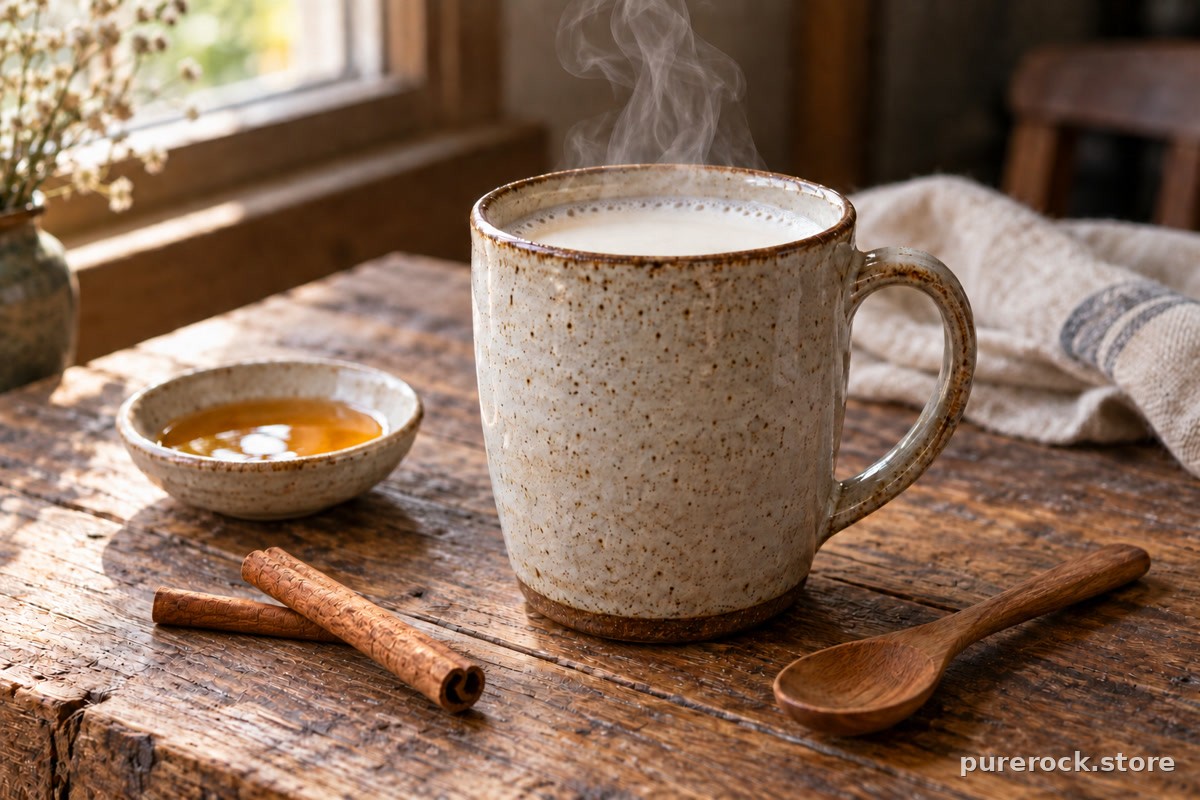
- Warm milk instead of water softens the bitterness noticeably and adds a creamy mouthfeel that masks a lot of the earthiness.
- A small amount of honey or a pinch of cinnamon, added after the resin has dissolved, cuts the bitterness without overwhelming it.
- Chase it rather than mix it — some people prefer to place the dose directly under the tongue or swallow it on a spoon, then immediately drink a beverage of their choice, rather than trying to dissolve it into something they have to taste for several minutes.
- Cold brew coffee or a small amount of fruit juice can also mask the flavor, though very acidic liquids may take longer to fully dissolve the resin than warm water does.
If taste is a dealbreaker regardless of method, that’s a reasonable reason to consider capsules instead — see our capsules vs. resin vs. gummies comparison for how the formats trade off convenience against cost and bioavailability.
It’s worth experimenting with more than one masking method before giving up on resin as a format — people’s reactions to the taste vary a lot, and what one person finds unbearably earthy, another barely notices once it’s mixed into warm milk with cinnamon. Rotating between two or three of the approaches above (rather than sticking with plain water every time) also helps prevent the “I dread taking this” fatigue that causes a lot of people to abandon a supplement routine within the first few weeks, regardless of the format.
How to Store Resin So It Doesn’t Harden or Spoil
This is the part most guides skip, and it’s where people actually run into problems months after buying a jar that seemed fine on arrival.
Keep it airtight. Shilajit resin is hygroscopic — it actively absorbs moisture from the air — which means leaving the lid loose or the jar open for extended periods lets it pull in ambient humidity and become gummier and wetter than intended, or, in dry climates, lose moisture and become brittle and hard to scoop. Always reseal the jar fully immediately after use.
Store it cool and dry, away from direct sunlight. Heat softens resin significantly, and prolonged exposure to warm conditions (a car dashboard, a sunny windowsill, near a stove) can cause it to soften and separate. Whether ordinary household warmth measurably reduces fulvic acid content hasn’t been studied that we could find, but cool storage is the safe default. A kitchen cabinet or pantry shelf away from any heat source is generally adequate — refrigeration isn’t necessary and can actually make the resin too hard to scoop comfortably, though it won’t damage the product.
Avoid metal utensils that react. Repeated contact with certain reactive metals over a long period is a minor but avoidable risk; wood, glass, or stainless steel dosing tools are the safer default and won’t introduce any taste or reaction.
Watch for mold, not just texture change. A properly purified resin, stored correctly, is essentially self-preserving — its mineral density and low water content make it inhospitable to most microbial growth. That said, if moisture gets introduced (for example, from a wet spoon dipped repeatedly into the jar) and you see visible white or green fuzzy spots, discard that jar. This is different from the resin simply darkening or firming up with age, which is normal.
If it hardens too much to scoop, don’t microwave it or apply direct high heat. Instead, hold the closed jar in a warm (not hot) water bath for a few minutes, or simply warm the dosing utensil under hot water before scooping — the resin softens quickly against gentle, indirect warmth.
Think about seasonal shifts, not just a fixed spot. A jar that sits happily on a countertop in a mild spring climate can turn noticeably softer once summer heat sets in, or firmer once winter heating dries out indoor air. If you notice a consistency change that tracks with the season rather than with how you’ve been storing it, that’s expected behavior, not a sign the product has spoiled — reassess the actual storage spot only if the change is sudden or accompanied by an off smell.
Glass over plastic for long-term storage. Most resin ships in glass jars for a reason — glass doesn’t absorb odor or oils the way some plastics can over months of repeated opening and closing, and it doesn’t react with the resin’s acidic compounds. If you ever transfer resin to a different container for travel, choose glass or food-grade stainless steel rather than a plastic pill case.
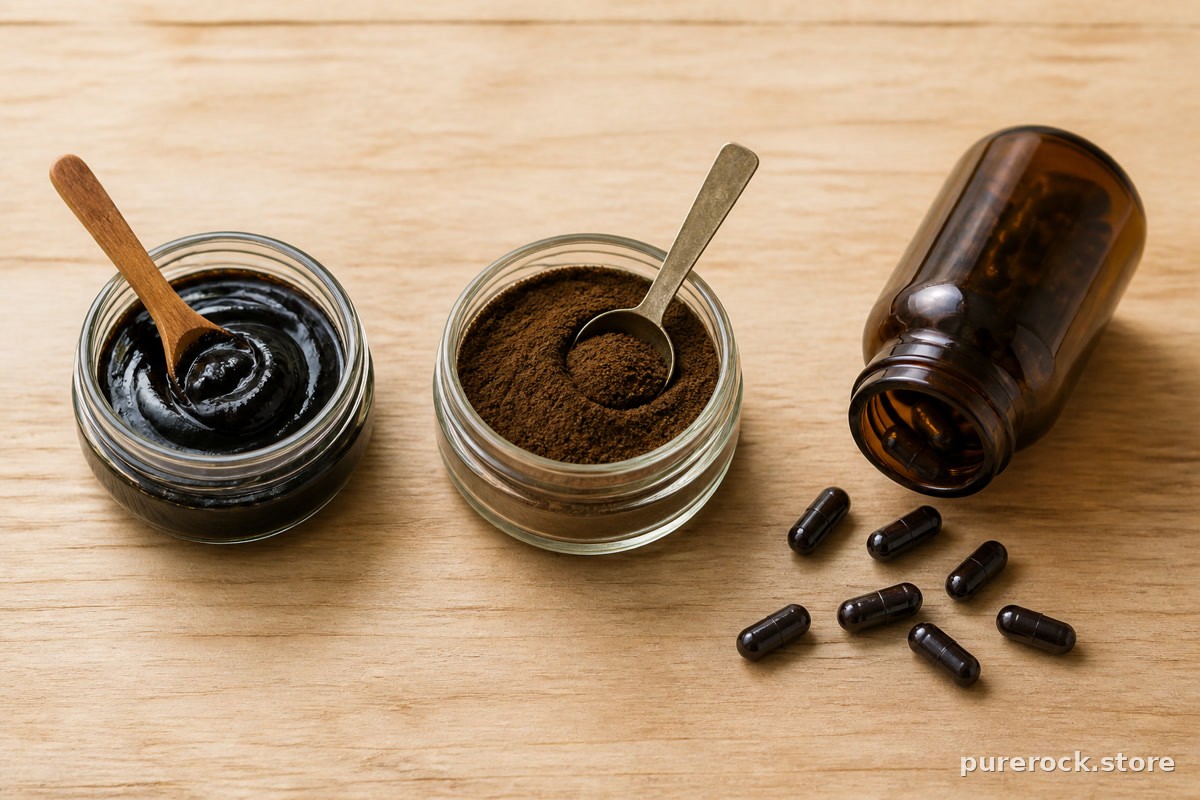
Resin vs. Shilajit Powder
Resin isn’t the only unprocessed-adjacent format on the market — powdered shilajit is also common, and the two are often confused as interchangeable when they’re not quite the same thing.
Powder isn’t simply resin that’s been dried further and ground up. Published manufacturing processes describe dissolving raw shilajit in water, filtering out the insoluble material, and then concentrating and drying that water extract into a powder — US patent 6,440,436, for example, describes a multi-step water-extraction and fractionation process that ends in a free-flowing powder. Some products also add a carrier or anti-caking agent to keep it from clumping. The appeal is shelf stability and ease of measuring by weight or with a measuring spoon, since powder doesn’t have resin’s temperature-dependent softness. The tradeoff is that the extra extraction and drying steps can involve additional heat exposure, and many buyers find it harder to verify purity in powder form since fillers and anti-caking agents blend in visually in a way they wouldn’t in a sticky resin.
Resin, by contrast, is generally considered closer to the raw, minimally processed state, which is part of why it commands a price premium and is the format most purity-focused buyers default to. If ease of dosing and shelf life matter more to you than staying as close as possible to the raw exudate, powder (or capsules made from powder) is a reasonable alternative — just apply the same scrutiny to sourcing and lab testing either way.
Travel is one practical scenario where the format choice actually matters day to day. Resin’s temperature sensitivity — softening in heat, hardening in cold — makes it a little more fragile in a checked bag or a hot car than powder or capsules, which hold their form across a wider range of conditions. If you travel frequently and find yourself repeatedly dealing with a jar that’s arrived either too soft or too firm to dose comfortably, that’s a reasonable signal to switch formats for trips even if you keep resin as your at-home default.
Himalayan Resin vs. Other Regional Sources
Not all shilajit resin comes from the same place, and origin does correlate with some real differences, though “Himalayan” has also become something of a marketing catch-all.
- Himalayan (Nepal, India, Bhutan, Tibet): The most commonly referenced origin in Western markets, associated with high-altitude collection and a long-standing traditional use history. Specific altitude figures on labels are rarely verifiable, so treat them as marketing unless backed by documentation. Quality varies enormously by specific region and altitude even within “Himalayan” as a label.
- Altai (Russia, Mongolia, Kazakhstan): Extracted from a different mountain range with its own distinct mineral profile; some lab analyses suggest comparable or in some respects higher trace mineral diversity, though direct standardized comparisons across brands are limited.
- Caucasus and other regional sources: Less commonly marketed in the West but used regionally; quality depends heavily on the same purification standards that matter everywhere else.
The practical takeaway is that origin alone isn’t a reliable purity signal — a poorly purified Himalayan resin can be lower quality than a well-processed Altai one. What matters more consistently is third-party lab testing for heavy metals and microbial contamination, and a fulvic acid percentage disclosed on the label, regardless of which mountain range it came from. Our purity guide covers how to evaluate those signals directly rather than relying on origin claims alone.
Price can be a loose secondary signal, though not a dependable one on its own. Genuine high-altitude resin is labor-intensive to collect and purify, so an unusually cheap jar relative to comparable brands is worth a closer look at the lab testing documentation before buying — it doesn’t automatically mean the product is fake, but it removes one of the assumptions (“it’s expensive so it must be the real thing”) that buyers sometimes lean on instead of actually checking for a certificate of analysis.
FAQ
Does shilajit resin expire? Properly purified resin, stored airtight and away from heat and light, doesn’t spoil in the way perishable food does — its low water content and mineral density make it naturally resistant to microbial growth. Printed best-by dates vary by brand, and we couldn’t find published stability studies on how long resin keeps once opened — so follow the date on your jar and inspect the resin before each use. Darkening or firming with age is normal; visible mold is not. For expiry dates and shelf life across every format, not just resin, see what shilajit tastes like and whether it expires.
Why does my resin smell strongly, almost like tar or asphalt? A strong, earthy, tar-like smell is normal and expected for shilajit resin — it comes from the same organic compounds responsible for its color and texture. A sour, chemical, or distinctly “off” smell that wasn’t there when you first opened the jar is a different matter and, combined with visible mold or a slimy texture, is a reason to discard that jar.
Can I take shilajit resin on an empty stomach? Many people do, though some find it easier on the stomach mixed into warm milk with food nearby rather than taken completely fasted. There’s no strong evidence that timing relative to meals changes its effects meaningfully; personal tolerance is the main deciding factor. If you notice stomach discomfort taking it fasted, try it with food instead.
Is it normal for resin to look slightly different jar to jar, even from the same brand? Yes — resin is a minimally processed natural product, so batch-to-batch variation in color, exact texture, and moisture content is normal, similar to how raw honey varies between harvests. Significant differences (a sudden change in smell, an unusual grittiness, or a texture far outside the firm-but-pliable range) are worth flagging to the seller, but minor cosmetic variation between jars isn’t a red flag on its own.
How long does a typical jar actually last with daily use? A common jar size is around 20 grams. At a typical pea-sized serving of roughly 300–500mg once or twice daily, a 20-gram jar lasts somewhere in the range of one to three months depending on dose size and frequency — worth factoring into cost comparisons between resin and other formats like capsules, which are pre-measured but usually cost more per serving.
A Quick Note on Safety
Shilajit resin, like any shilajit product, should be sourced from a supplier that provides third-party lab testing for heavy metals (lead, arsenic, mercury, cadmium) and microbial contamination — raw, unpurified shilajit can carry both risks if it hasn’t been properly processed. This guide is educational and not medical advice; talk to a healthcare provider before adding shilajit to your routine, particularly if you’re pregnant, nursing, or managing an existing health condition.
Related Guides
- What is in shilajit: minerals, fulvic acid and lab variability.
- How to choose the best shilajit: a brand-free checklist.
- What is shilajit?: the plain-language definition and glossary.