 Purerock
purity
How Is Shilajit Made? From Rock Seep to Finished Resin
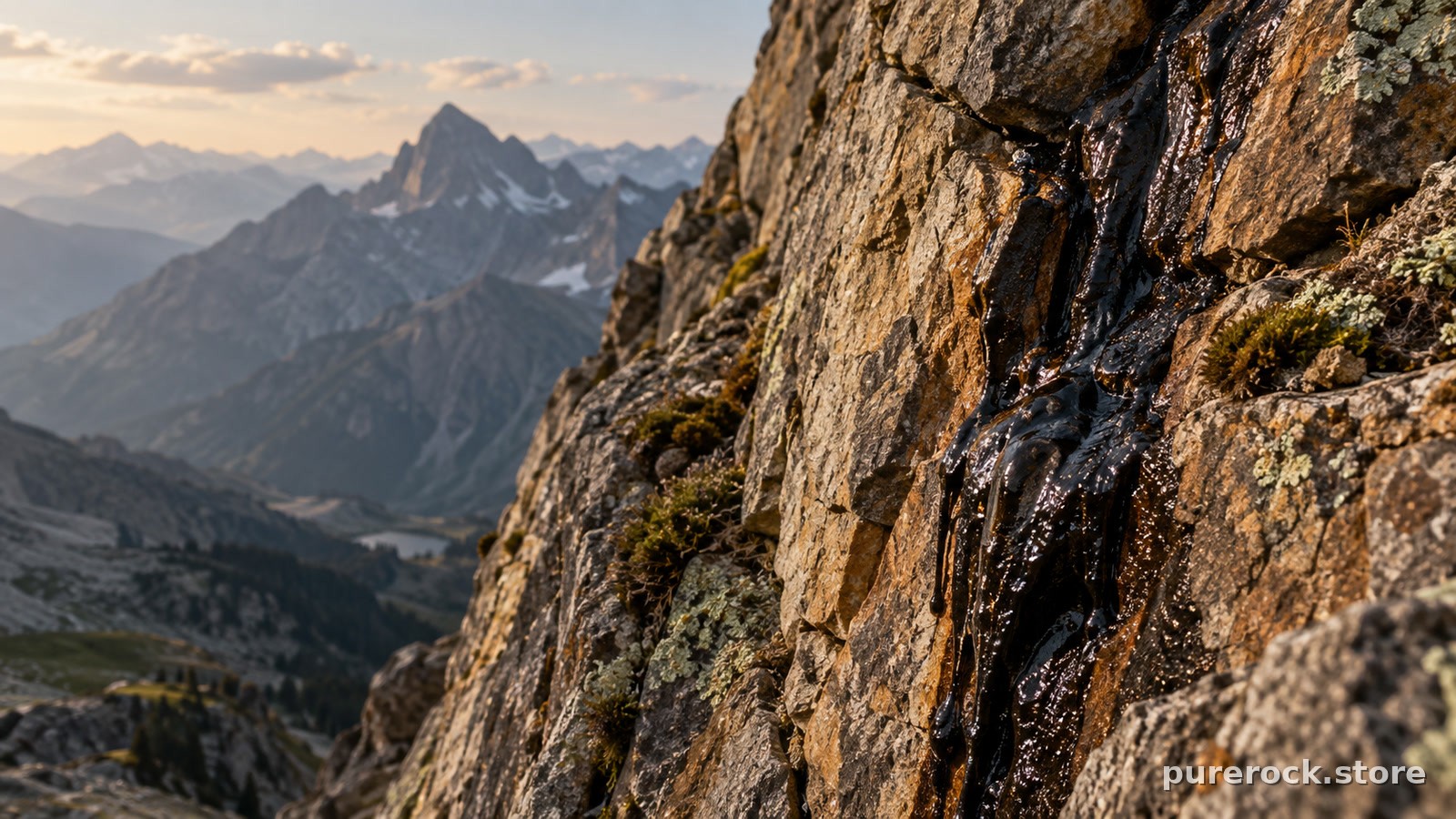
Nobody manufactures shilajit from scratch. Nature makes the raw material slowly, and people collect it and clean it up, so “how is shilajit made?” is really two questions: how the rock produces it, and what happens between the cliff face and the jar. The second half is where most of the quality differences between products come from, and where most of the marketing goes quiet.
Key Takeaways
- Scientists still disagree about exactly how shilajit forms. The most common explanation is slow humification of plant material, such as mosses, liverworts, and latex-bearing plants, by microbes in rock crevices, but a 2025 chemistry review says its source “is not known.”
- Raw shilajit is gathered from steep rock faces, where it oozes out during warm months. As collected, it’s mixed with stone, sand, soil, and plant debris.
- Traditional Ayurvedic purification (shodhana) dissolves the raw material, lets the grit settle, filters it through cloth, and dries it in the sun or over heat. Some versions process it with herbal decoctions, which can add substantial weight to the finished product.
- Industrial processes add steps like centrifugation, spray drying, solvent separation, and standardization to a fulvic acid percentage.
- Purification reliably removes insoluble grit. It isn’t designed to remove dissolved metals, and one 2025 study found some finished supplements carrying more thallium than any raw sample it tested.
How Is Shilajit Formed? The Competing Theories
The literature has no settled answer. A 2025 review of shilajit’s chemistry in Critical Reviews in Analytical Chemistry (Kamgar et al.) says plainly that its “source is not known”: some researchers think it forms from dead plant residues or animal excrement, while others think it’s a mineral that gradually seeps out of rock. The same review notes that no complete chemical analysis of shilajit has ever been done.
The main explanations in the literature:
1. Plant humification (the leading theory). This is the view most reviews lean toward. A 2012 review in the International Journal of Alzheimer’s Disease (Carrasco-Gallardo et al.) describes shilajit as formed over centuries by microbes gradually decomposing plants. It names Euphorbia royleana and Trifolium repens (white clover), plus mosses such as Barbula, Fissidens, and Thuidium and liverworts such as Marchantia and Pellia. A 2007 review in Phytotherapy Research (Agarwal et al.) places the process in “rock rhizospheres,” the thin zones of rock where roots and microbes live.
2. The latex-plant theory. A 1988 paper in Ancient Science of Life (Lal et al.) treated shilajit as derived mainly from the latex of cactus-like Euphorbia species. Later reviews list Euphorbia as one contributor among many.
3. Mineral or mixed origin. Older descriptions called shilajit a bitumen, a mineral resin, a plant fossil, a substance of mixed plant and animal origin, or even an inorganic substance. The background section of a 2002 US patent on purified shilajit (US 6,440,436) lists all of these and calls the question controversial. The inventor’s own view is that humic substances form when “plants, algae, and mosses (bryophytes)” interact with microorganisms.
New evidence: plant DNA. A 2026 study in Biochemical Genetics (Ulug et al.) ran DNA metabarcoding on processed shilajit from the Pamir-Alai Mountains and identified 50 plant taxa. The most common families were Apiaceae (the carrot family) and Asteraceae (the daisy family). That’s strong evidence that plants contribute, though it doesn’t show how the material forms, and it covers one region.
Every theory involves organic matter meeting mineral-rich rock over long periods, so composition varies with local plants, rock chemistry, and climate. Why that makes origin claims hard to judge is covered in our guide to Himalayan origin claims.
How Is Shilajit Harvested?
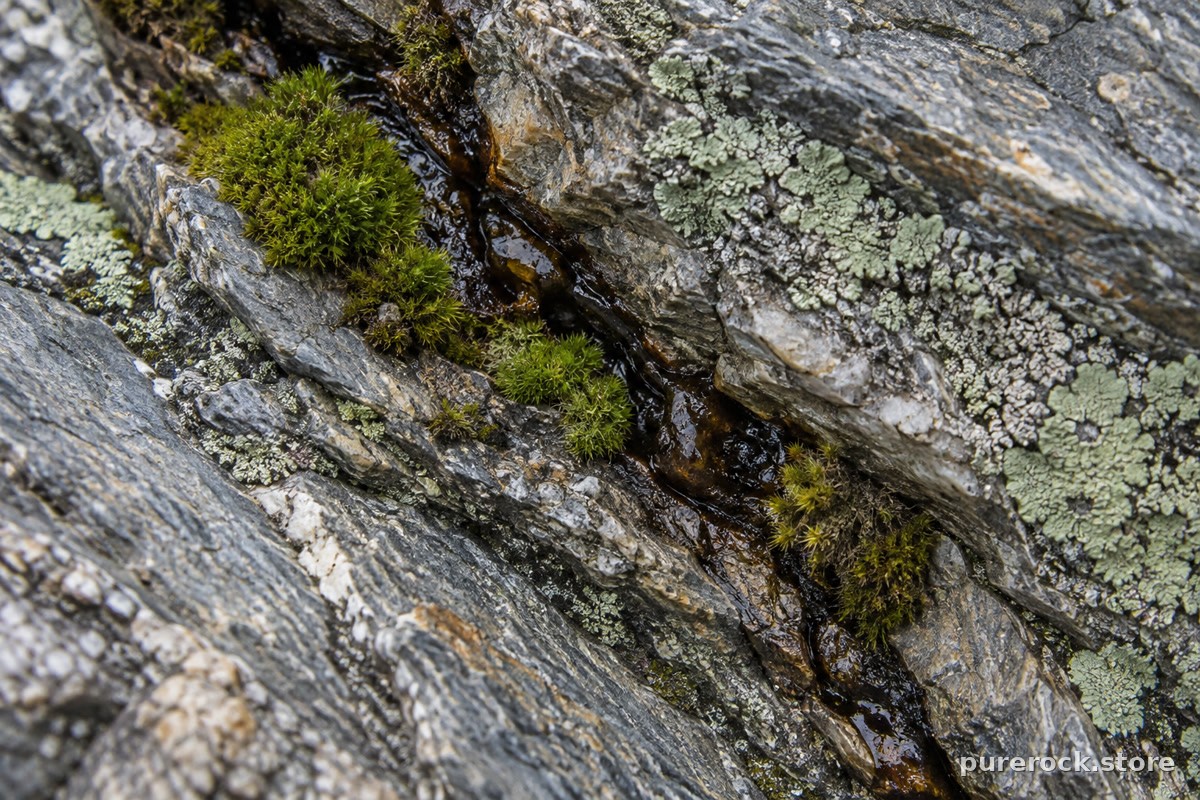
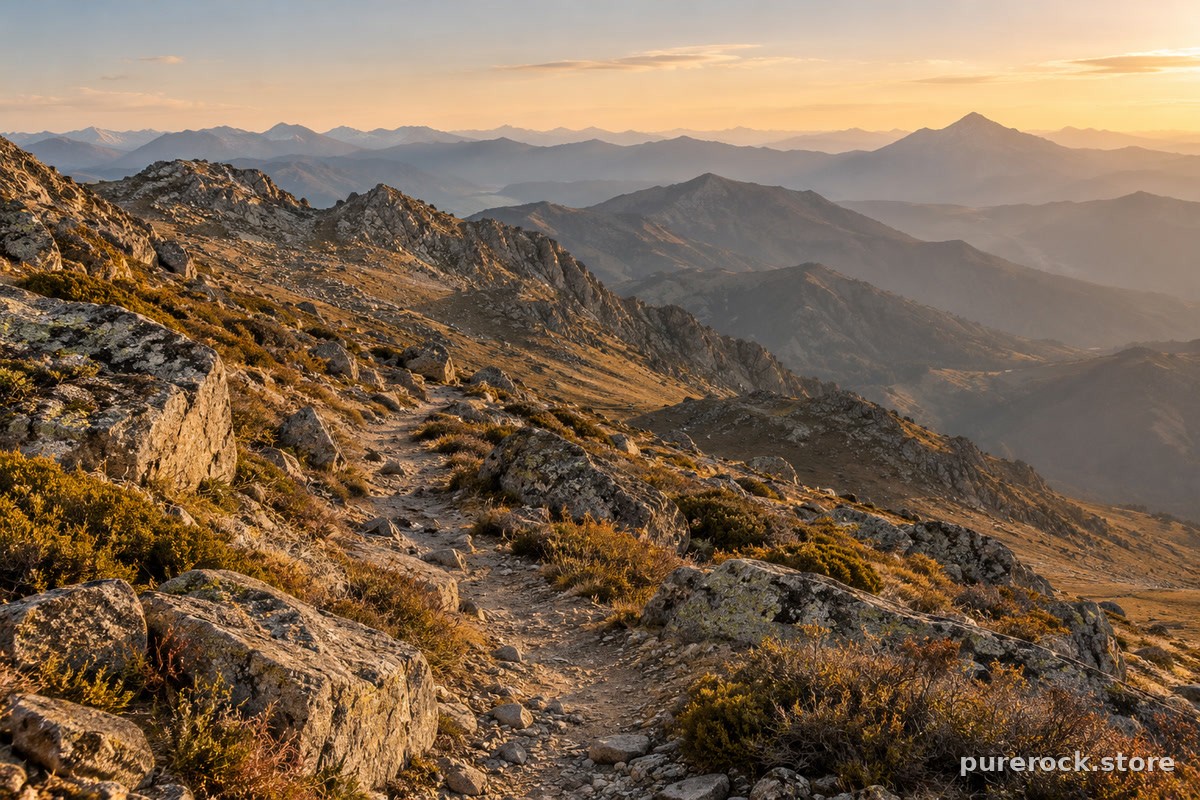
Traditional descriptions agree that shilajit oozes out of rock when it warms up. A 2012 study in the International Journal of Ayurvedic Medicine (Pathak et al.) describes it as a “mineral pitch that oozes from the rocks of the Himalayas, as they become warm in the summer months,” and says it is gathered “from steep rock faces.” A 2020 paper in the Journal of Ayurveda and Integrated Medical Sciences (Elias et al.) cites the classical text Rasaratna Samuchaya, which describes the exudate coming out of sun-heated rock in summer.
Elias et al. describe raw shilajit as containing “stone, mud, wood, sand and various physical and metallic impurities,” which is why classical texts treat purification as mandatory. The US patent adds a microbial concern: the periphery of a shilajit deposit is “heavily infested” with microorganisms, some of which produce mycotoxins.
We couldn’t find a peer-reviewed study of modern collection practices, such as tools, the amount taken per site, or how often a site is revisited. Most detailed accounts online come from sellers. There is one useful data point on how much of the raw material is debris: when Pathak et al. dissolved and filtered 2 kg of crude shilajit from an Ayurvedic pharmacy, the water extract was only 37.7% of the starting weight. Raw material varies, but in that sample most of the mass didn’t dissolve.
The Traditional Shilajit Purification Process (Shodhana)
In Ayurvedic pharmacy, shodhana means purification before use. Elias et al. note that classical texts warn that unpurified shilajit causes effects such as burning sensations and dizziness. That’s a traditional claim, not a tested one. There isn’t one recipe. The classical texts list several liquids for the job, including cow’s milk, cow’s urine, a decoction of Triphala (a three-fruit blend), and juice of Bhringaraja (Eclipta alba), and two ways of drying: in the sun (Suryatapi) or over heat (Agnitapi).
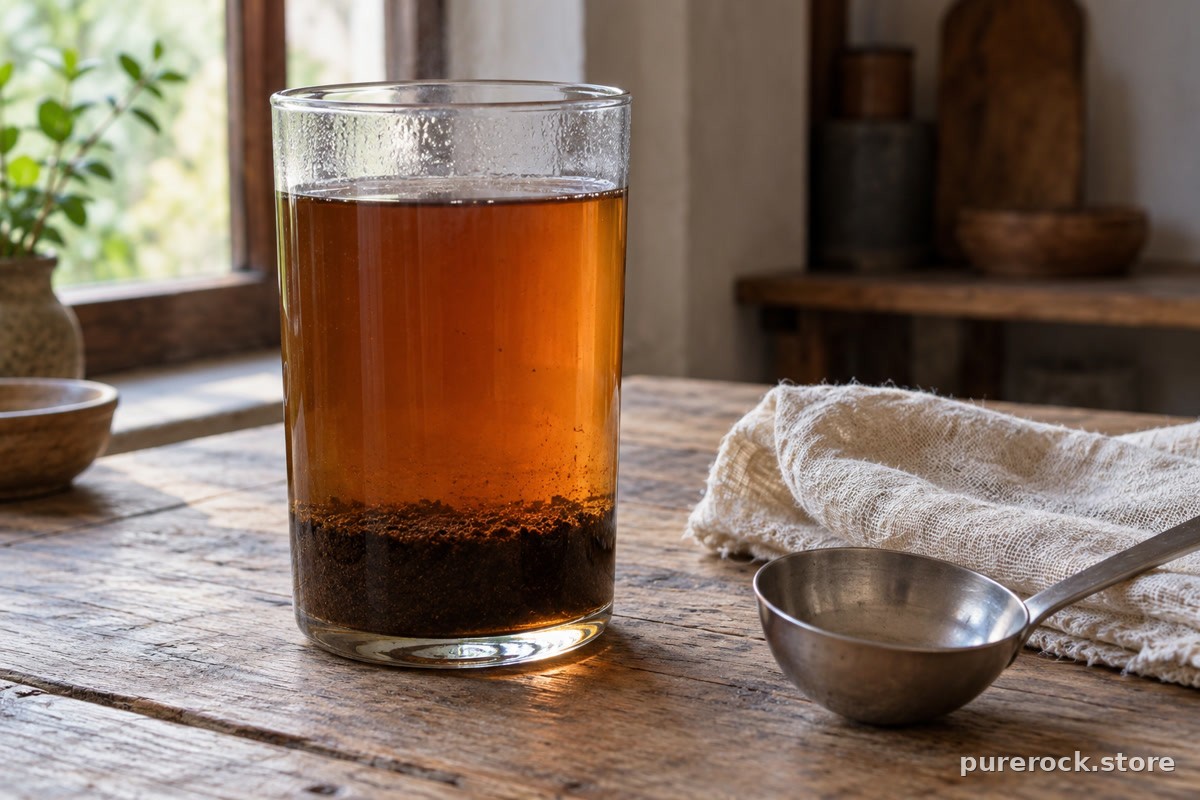
The water method (Pathak et al., 2012). Researchers dissolved 2 kg of crude shilajit in 8 liters of hot water, stirred it, and left it for 24 hours so the insoluble matter could settle as “muddy sediment.” They filtered the liquid on top through cotton cloth into a second vessel, added more hot water to the sediment, and repeated the settle, decant, and filter cycle until the thin film on the surface of the final vessel disappeared and the solution was clear.
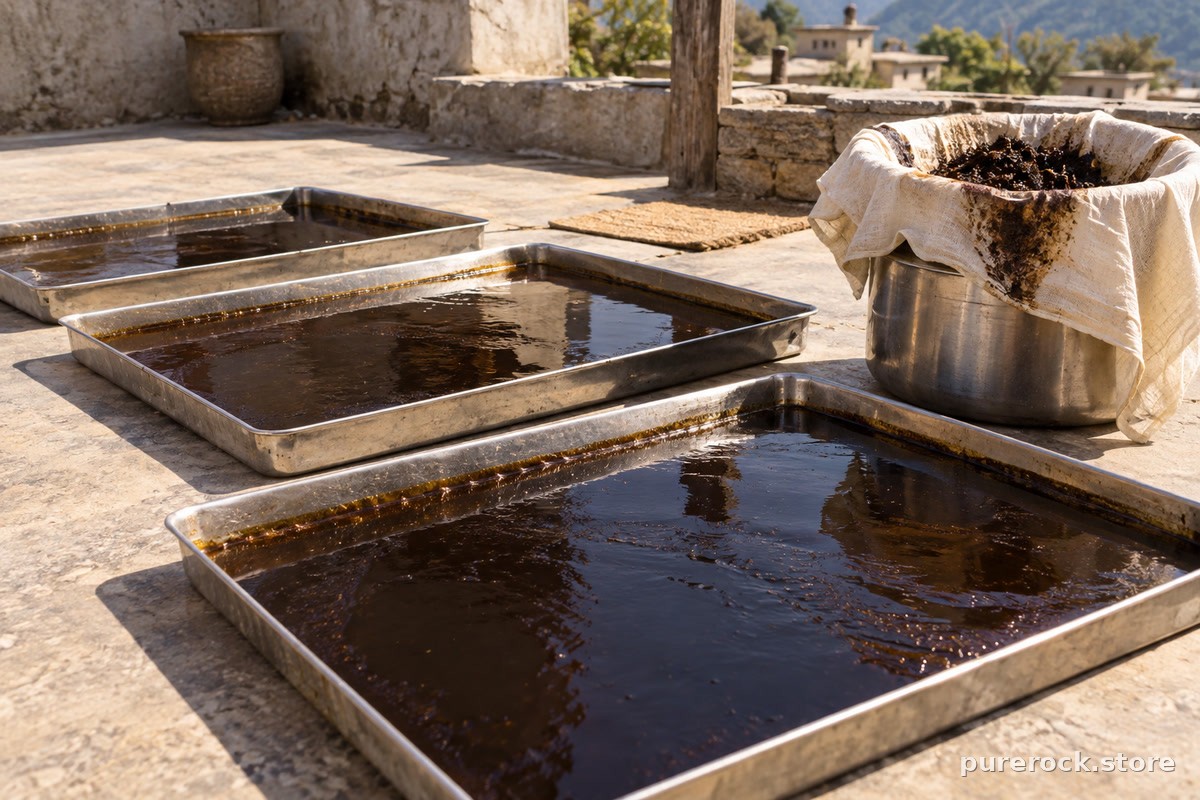
The sun-drying method (Elias et al., 2020). Researchers mixed 250 g of ground raw shilajit with Bhringaraja juice, heated it gently until syrupy, and set it in sunlight. Each day they skimmed the creamy surface layer onto a ghee-smeared plate to dry in the sun. It took eight days.
Some of these methods add material as well as removing it. In the Pathak study, water-extracted shilajit was then processed seven times with Triphala decoction over 20 days, and its weight rose by 51%. With Guduchi decoction, it rose by 38%. The authors put the difference down to how much dissolved solid each decoction carried. Traditionally purified shilajit can therefore be part shilajit and part herbal extract. That’s intentional in Ayurvedic pharmacy, but it matters if you’re comparing it with a product sold as straight shilajit.
Industrial Extraction: Filtering, Drying, and Standardizing
Commercial production starts the same way, with water and the removal of what doesn’t dissolve, then adds equipment and chemistry.
Water extraction and clarification. A 2019 study in the Journal of Research in Pharmacy (Bugaev et al.) tested raw material from an Altai supplier with different water ratios, ultrasound, centrifugation, and drying methods. The authors measured silicon and aluminum, two elements from rock and clay. The combination with the least of these used a 1:2 ratio of raw material to water without ultrasound. Centrifuging the solution “significantly” reduced both elements, and spray drying reduced them further. The authors also noted that existing production methods focus on maximizing humic and fulvic acid yield “without accenting on processes” that reduce unwanted substances.
Drying to a resin, plate, or powder. Evaporating the water yields a thick resin or dried plates. Spray drying yields a powder, often with a carrier added. How different formats are made and labeled, including the carrier issue, is covered in our post on shilajit powder and drops.
Fractionation and standardization. The 2002 patent goes much further. After water extraction and filtration, it uses hot methanol to pull out small phenolic compounds, sodium hydroxide to precipitate polymeric quinones, acidification below pH 3 to precipitate humic acids so the fulvic acids stay in solution, then activated carbon and an ion-exchange resin. The claimed end product contains at least 60% low-to-medium molecular weight fulvic acids and at least 0.3% dibenzo-alpha-pyrones. A 2014 review in Phytotherapy Research (Stohs) identifies those two compound groups as the likely key constituents and calls for more studies using standardized products. That’s the logic behind labels that say “standardized to X% fulvic acid.”
The extract used in most human trials is of this standardized type. Resin that has only been dissolved, filtered, and dried is a different material, even if both are sold as “purified shilajit.”
Process Steps, Purpose, and What Can Go Wrong
| Step | Purpose | What can go wrong |
|---|---|---|
| Collection from rock faces | Gather raw exudate in the warm season | Soil, sand, plant debris, and microbes come along. Origin and collection practice are rarely documented |
| Dissolving in water (or a traditional liquid) | Get the soluble fraction into solution | Dissolved metals go into solution too. Herbal liquids add their own solids and change the product |
| Settling and decanting | Let heavy grit sink so the liquid can be poured off | Rushed settling carries fine silt forward |
| Cloth or mechanical filtration | Remove remaining visible particles | Cloth can’t catch very fine clay or anything dissolved |
| Centrifugation | Spin out fine particles filtration missed | Optional, so many small producers skip it |
| Sun drying (Suryatapi) | Evaporate water gently into resin | Slow and weather-dependent. Open trays are exposed to dust and microbes |
| Heat or spray drying | Faster, more controlled drying | Powders often need a carrier, which dilutes the extract |
| Solvent and ion-exchange fractionation | Separate fulvic acids and small phenolics, drop humic acids and polymeric quinones | Yields a different material from traditional resin. Solvent residues need testing |
| Standardization and lab testing | Confirm fulvic acid, metals, and microbes batch by batch | Only as good as the test method and whether results are shared |
What Purification Removes, and What It Can’t
Every method above does one job well: separating what dissolves from what doesn’t. Sand, stone, plant fiber, and most clay settle out or get filtered. Bugaev et al. showed that centrifugation and spray drying cut silicon and aluminum further. The patent process is designed to remove humic acids, polymeric quinones, and, according to its authors, the mycotoxin risk from the deposit’s microbes.
What none of these methods is designed to remove is dissolved metal. The patent doesn’t specifically address toxic heavy metals. It deliberately keeps iron, copper, zinc, and magnesium in “conjugated forms” at 3–5%. The Bugaev study measured only silicon and aluminum. If a contaminant dissolves in water along with fulvic acid, a cloth filter or a settling tank has no reason to catch it.
The evidence fits that concern:
- Finished supplements can carry thallium. A 2025 study in BMC Chemistry (Kamgar et al.) measured thallium in raw shilajit and commercial supplements. Raw samples contained up to 0.226 µg per gram. Some supplements contained up to 0.5 µg per gram, more than any raw sample tested. The raw and supplement samples weren’t matched, so this shows supplements can carry thallium, not that processing adds it. The authors called for regular monitoring.
- Metal levels vary between studies. A 2024 review in Biological Trace Element Research (Hussain and Saeed) pooled published analyses and found around 65 metals reported in shilajit, including lead, arsenic, cadmium, and mercury. Most were below WHO and FDA limits, “except in few studies where exceeded levels were reported.”
- Manufacturing claims aren’t proof. A 2008 study in JAMA (Saper et al.) found that 20.7% of Ayurvedic medicines bought online contained detectable lead, mercury, or arsenic, and 75% of those contaminated products claimed good manufacturing practices. Products from rasa shastra, the branch of Ayurvedic pharmacy that combines herbs with metals and minerals, were more likely to contain metals (40.6% vs 17.1%). It covered Ayurvedic products generally, not shilajit alone.
A well-run process lowers risk, but only a batch certificate with a heavy-metal panel shows what it left behind. Our guide to spotting fake shilajit covers what a credible certificate looks like.
Is Shilajit Harvesting Sustainable?
There isn’t much hard data on this. The reviews above describe formation over centuries (Carrasco-Gallardo et al. call shilajit “a millenary product of nature”). If so, a scraped deposit won’t refill on any timescale that matters commercially. We found no peer-reviewed estimate of reserves, regeneration at harvested sites, or the effect of rising demand.
That gap cuts both ways. Claims that shilajit is “endlessly renewable” or “ethically wild-harvested” are as unverified as claims that it’s being mined out. If sustainability matters to you, ask the seller who collects their raw material and under what permits or agreements. A seller who deals directly with collectors can usually answer. A reseller buying through a broker usually can’t.
How to Ask a Seller About Their Process
A seller who knows their process can answer each of these in a sentence or two:
- “Is this resin, a dried extract, or a standardized extract?” The answer tells you which research applies.
- “How was it purified: water only, or with herbal liquids?” If herbal decoctions were used, ask what share of the finished weight is shilajit.
- “How was it dried: sun, heat, or spray drying? Is there a carrier?” Any carrier should be on the label.
- “Do you centrifuge or only filter?” A producer who has considered this has usually thought about fine mineral residue too.
- “Can I see a batch-specific certificate with a heavy-metal panel, and does it include thallium?” Lead, arsenic, cadmium, and mercury are standard panels. Thallium rarely is, which is exactly why it’s worth asking about.
- “Who collects the raw material, and where?” This covers traceability and sustainability in one question.
Vague answers such as “traditionally purified” or “proprietary process” aren’t proof of a problem. They just tell you nothing.
FAQ
Where does shilajit come from? It comes from mountain rock. The traditional source is the Himalayas, but reviews also report it from ranges including the Altai, Caucasus, and Hindu Kush, and a form called Andean shilajit has been described in northern Chile.
Is sun-dried shilajit better than heat-dried? There’s no good comparative evidence either way. Sun drying is traditional and gentle but slow and exposed to dust; controlled heat or spray drying is faster and more repeatable. What the finished batch contains matters more, and only a lab test shows that.
Does purification make shilajit safe? It removes insoluble debris, but filtering and drying aren’t designed to remove dissolved metals. A 2025 study found some finished supplements with more thallium than any raw sample it tested, though the samples weren’t matched pairs.
Why do some purified products weigh more than the raw material they came from? Some traditional methods process shilajit repeatedly with herbal decoctions. In one 2012 study, seven rounds with Triphala decoction increased the weight by 51%, because the decoction’s solids stayed in the product.
Related Guides
- What is shilajit?: the plain-language definition and glossary.
- What is in shilajit: minerals, fulvic acid and lab variability.
Bottom Line
Shilajit starts as a slow natural process that scientists still can’t fully explain, most likely plant matter humified by microbes in mineral-rich rock. What you buy is shaped more by what happens next: how it was collected, what it was dissolved in, how well the grit was separated, and how it was dried and standardized.
Every purification method is good at removing what doesn’t dissolve and poor at removing what does. The process description and the lab report answer different questions, so a careful buyer asks for both.