 Purerock
purity
Shilajit Minerals and Composition: What Labs Report
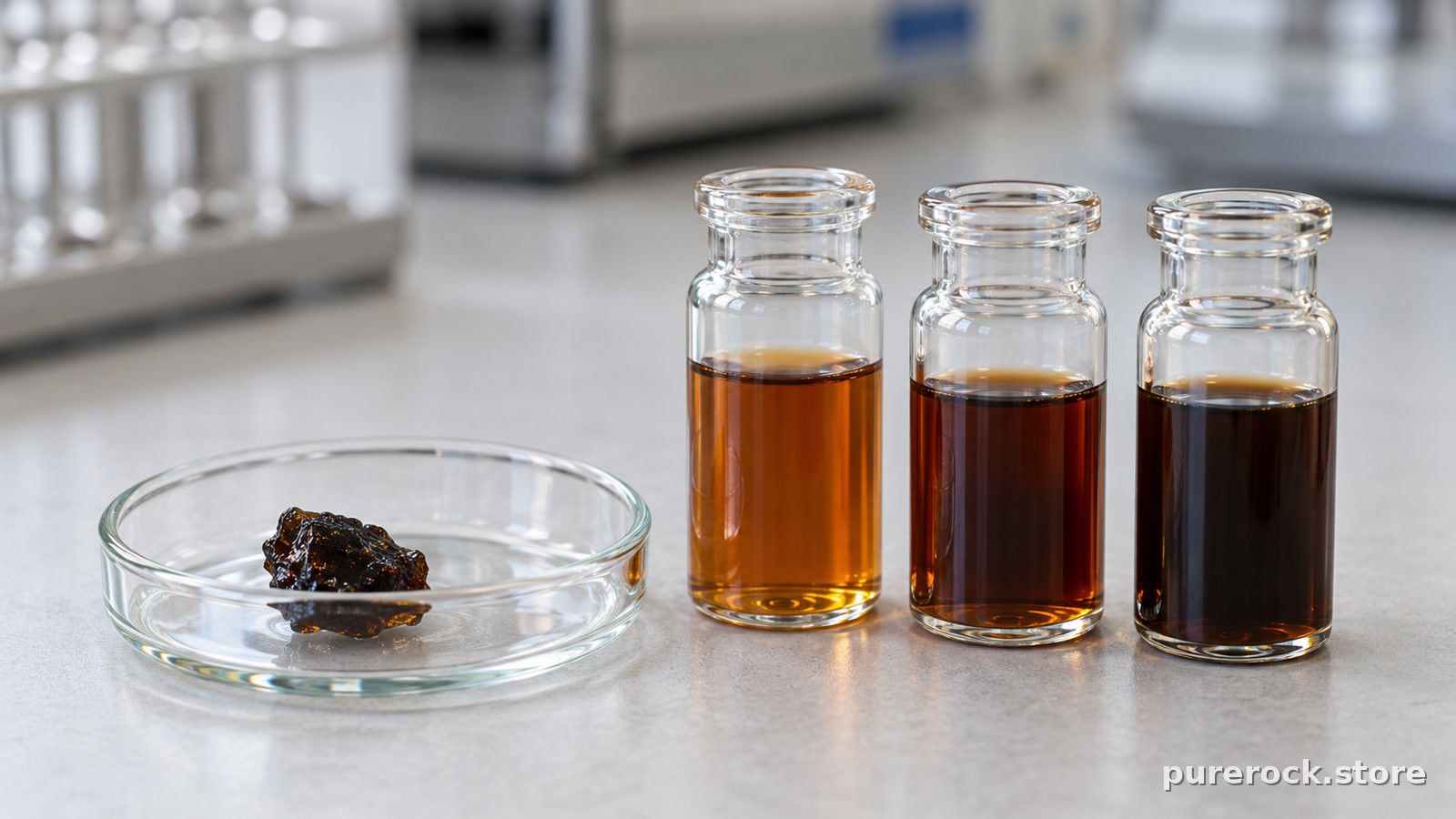
Published analyses describe shilajit as mostly humic substances (a decayed-organic-matter fraction that includes fulvic acid), with roughly a fifth of its weight in calcium, potassium, and magnesium, plus amino acids, phenolic compounds, and trace metals. The exact numbers depend on where the sample came from and how it was measured. One review of the literature concluded that its chemical composition is not known with certainty.
Key Takeaways
- No single “shilajit composition” exists. Published figures come from different samples, regions, and methods, and they don’t line up neatly.
- Humic substances are the bulk of the material. Reported minerals are a smaller share, and calcium, potassium, and magnesium lead the list.
- We found no analysis in the sources reviewed that quantifies vitamins in shilajit. “Vitamin-rich” claims lack support there; some products add vitamins separately.
- Label percentages (especially “% fulvic acid”) depend on the lab method, so two products can’t be compared by that number alone.
- The most useful document a seller can offer is a batch-specific lab report showing method, units, and contaminant results.
What Researchers Have Measured
Most composition work falls into four groups: humic fractions, minerals, organic markers, and contaminants. For a general introduction first, see what shilajit is.
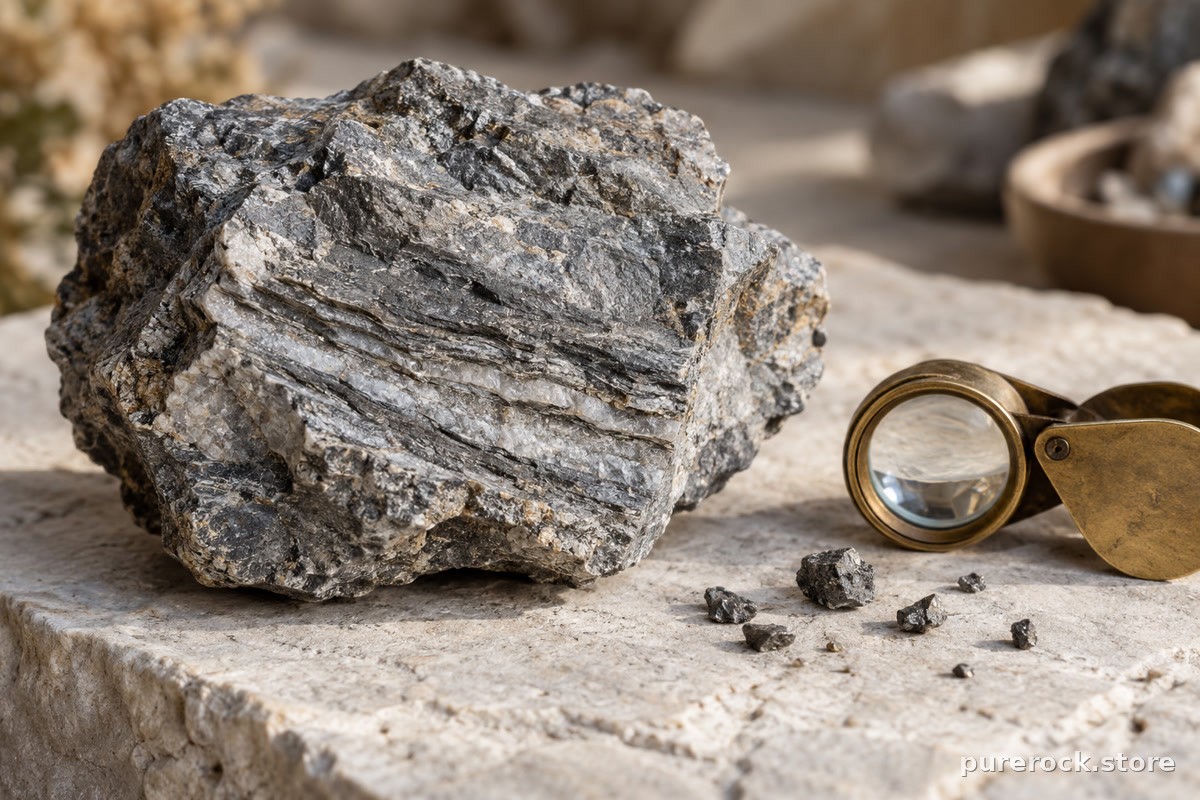
Humic substances. The 2025 review (Kamgar et al., Critical Reviews in Analytical Chemistry) reports that more than 80% of shilajit’s weight is humic substances. A 2012 review in the International Journal of Alzheimer’s Disease (Carrasco-Gallardo et al.) gives 60 to 80%. Both are reviews drawing on earlier lab work, not new measurements of the same sample.
Fulvic acid. A subset of humic substances. A 2018 review (Winkler and Ghosh) says shilajit contains about 15 to 20% fulvic acid. The next sections explain why that figure is soft.
Dibenzo-α-pyrones (DBPs). Aromatic compounds found free and bound to protein-like carriers. A 2014 review (Stohs) says the key constituents appear to be DBPs and fulvic acid and their derivatives, which is a hypothesis about what drives the effects reported in studies, not a measured guarantee in every product.
Minerals and metals. The 2025 review reports about 20% of the weight is calcium, potassium, and magnesium, and lists chromium, selenium, and cobalt among other elements present.
Phenolic acids. A 2026 Scientific Reports study (Kamgar et al.) quantified nine phenolic acids in eleven samples from Iran, India, Nepal, Russia, and Kyrgyzstan, led by gallic acid.
Reported Constituents and Ranges
This table includes only figures from sources we checked. Each row has a different sample type and method, so ranges can’t be combined into a single “typical” profile.
| Constituent | Reported figure | Sample / source | Caveat |
|---|---|---|---|
| Humic substances | More than 80% of weight | Literature review (Kamgar et al., 2025) | Compiled from earlier studies |
| Humic substances | 60 to 80% | Review (Carrasco-Gallardo et al., 2012) | Different compilation, different range |
| Fulvic acid | About 15 to 20% | Raw shilajit, review (Winkler and Ghosh, 2018) | Method not specified in the review |
| Fulvic acid | At least 50% (specification) | Purified extract used in a 2019 trial (Keller et al.) | A manufacturer’s specification, not an independent measurement |
| Fulvic acid | 6.9 mg to 2,206 mg per serving | Eight retail supplements (consumer-testing report, 2024) | Per serving, so depends on serving size and form |
| DBPs (free and conjugated) | 10% (specification) | Same purified extract (Keller et al.) | Specification, not a measurement across products |
| Calcium, potassium, magnesium | About 20% of weight combined | Review (Kamgar et al., 2025) | Raw material; finished products differ |
| Calcium | About 2 to 13 mg per serving in most products | Eight retail supplements (consumer-testing report, 2024) | Small amounts relative to daily needs |
| Gallic acid | Up to 2,839 µg/g | Iranian sample, 11 samples total (Kamgar et al., 2026) | Highest value in the set, not an average |
| Rosmarinic acid | Up to 216 µg/g | One Iranian sample (same study) | Described as “exceptionally high” by the authors |
| Thallium (contaminant) | Up to 0.226 µg/g | Natural shilajit (Kamgar et al., 2025) | Mostly “a few tenths” of µg/g |
| Thallium (contaminant) | Up to 0.5 µg/g | Commercial supplements (same study) | Up to 0.095 µg per pill |
The consumer-testing figures come from the 2024 report, which also found that amounts of fulvic acid were typically not listed on labels. The thallium figures are from a 2025 BMC Chemistry paper.
Why Composition Varies So Much
Several things move the numbers, and some are hard to separate.
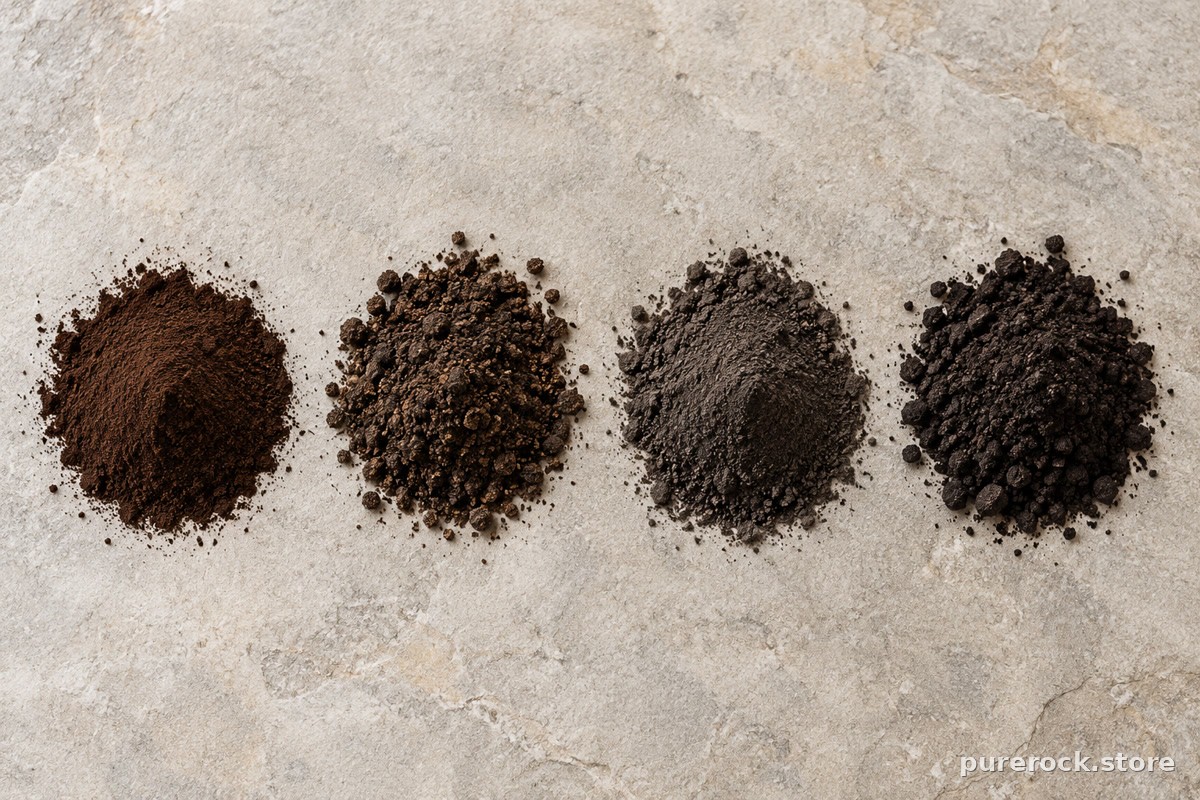
- Geography. The phenolic acid study reported “pronounced geographical variation” between regions. The 2025 review also notes many differences in composition between regions.
- Unknown origin. If a material forms from varying mixtures of plants, microbes, and rock, there’s no reason for two seams to match. See how shilajit forms and how it is made into resin.
- Processing. Purification, filtration, and drying change what’s left. One 2025 chemistry study analyzed a single traditionally collected sample (Basavaraja et al.) as a “compositional baseline,” while explicitly calling its findings hypothesis-generating.
- Method. Different instruments and extraction procedures answer slightly different questions.
- Product type. Raw material, resin, and dried extracts are different starting points.
Origin labels don’t solve this. Our guide to Himalayan shilajit origin claims explains why a region on a jar can’t be verified by a buyer.
Why Fulvic Acid Percentages Are Slippery
Fulvic acid isn’t one molecule. It’s defined by solubility: the fraction that stays dissolved at both high and low pH. Older methods counted everything that stayed soluble, including non-humic compounds.
A 2014 Journal of AOAC International paper (Lamar et al.) described a standardized method that separates fulvic acid by resin adsorption and weighs it gravimetrically on an ash-free basis. It was validated for humate ores and agricultural products, not for shilajit supplements. A 2025 paper by overlapping authors (Vialykh et al.) found that 14 of 25 commercial products sold as fulvic acid contained fulvic fractions by a UV screening method, meaning the other 11 did not. That study covered fulvic acid products generally, not shilajit specifically.
The practical consequence: “50% fulvic acid” is meaningful only alongside the method. Our deeper comparison is in shilajit vs fulvic acid.
Extract vs. Raw Paste
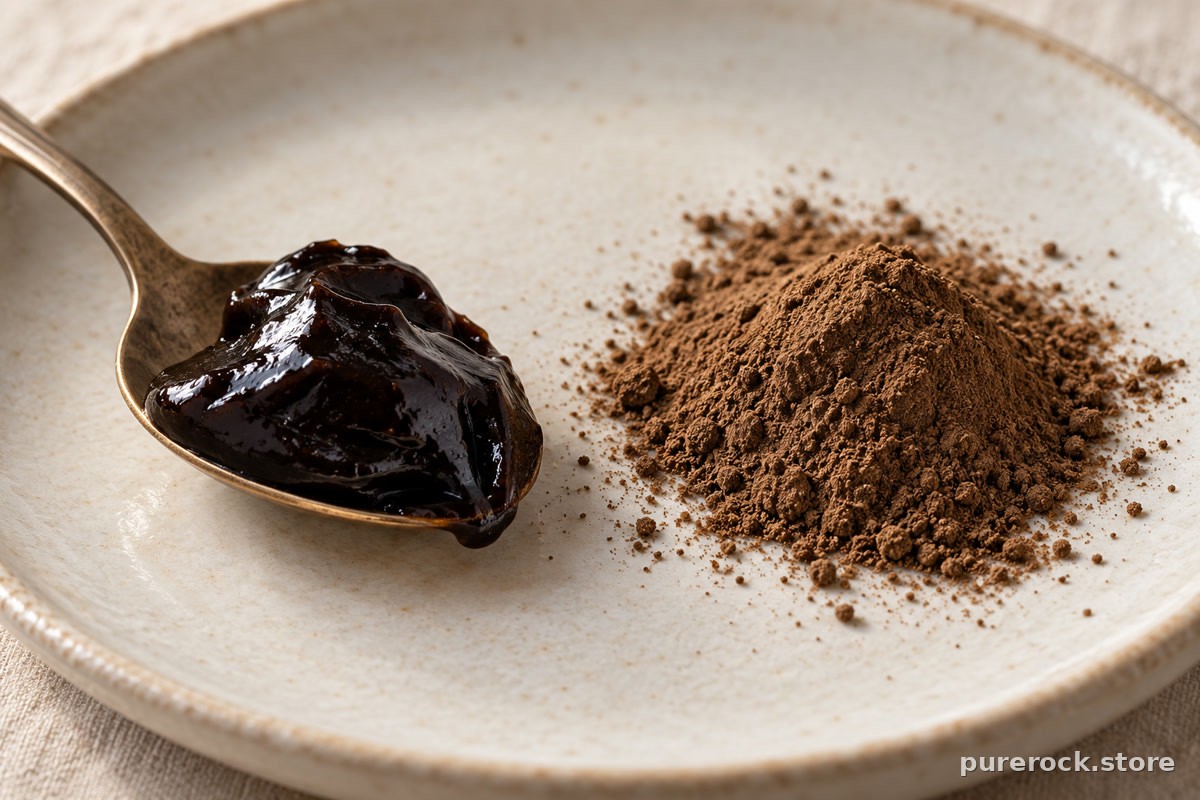
“Shilajit extract” and “shilajit paste” (resin) are not interchangeable terms.
| Raw or purified resin (“paste”) | Extract (powder, capsule, tablet) | |
|---|---|---|
| What it is | Soft, tar-like purified material | Material processed to concentrate or standardize certain components |
| Water content | Variable, rarely stated | Usually dried |
| Standardization | Rare | Sometimes, to fulvic acid and/or DBPs |
| Typical fulvic acid | Lower in the 2024 consumer test | Higher in the 2024 consumer test |
| What trials used | Not the form tested in the trials we reviewed | Purified, standardized extracts |
A 2026 chromatography study (Kohli et al., Journal of Chromatography A) compared shilajit raw material, extract, and resin and used HPLC for markers (fulvic acid, hippuric acid, urolithin A), gravimetric analysis for total fulvic acid, and ICP-MS for 14 elements. Some authors are affiliated with a wellness company’s R&D department, so weigh that as you would any manufacturer-linked analysis. The abstract doesn’t give figures that would settle which form is “richer,” and we can’t make that comparison for you.
For how to prepare resin, see the resin guide.
What About Vitamins?
Shilajit is often described as containing “vitamins and minerals.” In the reviews and analyses we checked, minerals, amino acids, proteins, fatty acids, humic substances, and phenolics are discussed, but vitamins are not reported as a measured constituent. The 2012 Carrasco-Gallardo review is about a formulation of shilajit combined with complex B vitamins, which means the vitamins were added.
That doesn’t prove shilajit contains no vitamins. It means we found no published analysis supporting the claim. If a product advertises vitamin content, ask whether the vitamins are added and in what amount.
What a Lab Report Should Show
A trustworthy report is specific. Look for:
- Batch or lot number matching your product, and a test date.
- Lab name and accreditation (for example, ISO 17025 accreditation), with the lab independent of the seller.
- Heavy-metal panel with results in stated units (µg/g, ppm, or per serving), covering lead, arsenic, cadmium, and mercury. Thallium is a reasonable addition given the 2025 data.
- Method named for each result, such as ICP-MS for metals and a stated procedure for fulvic acid.
- Limits of detection or quantification, so “not detected” has meaning.
- Fulvic acid result with method (gravimetric, HPLC, or titration), rather than a bare percentage.
- Microbial and moisture results, particularly for resin.
- Serving-size basis, so contaminant results can be converted per serving.
Red flags: a generic certificate with no batch number, a lab with no name, “tested” with no numbers, or a report showing only fulvic acid and no contaminants. Our guides to spotting fake shilajit and the supplement buying guide go further. For the contaminant picture, see shilajit side effects.
How to Read a Constituent Table Without Over-Reading It
A table of constituents looks authoritative, but each row hides choices. Check four things before trusting any number you see here or on a product page.
What was measured. “Fulvic acid” can mean a chemically isolated fraction or the output of a broad assay that also counts related humic material. A 2025 analysis of commercial “fulvic acid” products found that only some contained fulvic fractions at all (Vialykh et al., PMID 40802521), which is why the method name matters as much as the percentage.
What the sample was. Raw material, a purified extract and a finished resin are different substances. A figure from one says little about the other, and a single-sample baseline, like the one in Basavaraja et al., describes that sample only.
How the result is expressed. Percent of dry weight, milligrams per gram and milligrams per serving are not interchangeable. A high percentage in a tiny serving can deliver less than a modest percentage in a large one.
Who ran the analysis. Several of the published compositional studies come from academic labs, and at least one includes company research staff among its authors. That does not invalidate the numbers, but it is worth knowing when a result happens to flatter a product.
Read together, these caveats are why we report ranges here and not a single “typical” composition. For the practical side, see how to spot fake shilajit and the buying guide.
What Composition Doesn’t Tell You
Knowing what’s in shilajit doesn’t show what it does in a person. A constituent present in a sample, or active in a cell culture, isn’t evidence of an effect from an oral supplement. The few human trials tested particular extracts, and the Keller trial was funded by the extract’s manufacturer. For how those trials hold up, see is shilajit legit?.
FAQ
What minerals are in shilajit?
Reviews report calcium, potassium, and magnesium as the main ones, together about 20% of weight, along with traces of others such as chromium, selenium, and cobalt. Amounts vary by sample, and finished products may differ from raw material.
Does shilajit contain vitamins?
We found no published analysis measuring vitamins in shilajit. Some products add vitamins to the formula, so check the supplement facts panel.
How much fulvic acid is in shilajit?
Estimates run from about 15 to 20% in raw material to at least 50% in standardized extracts, and a 2024 test of eight products found 6.9 to 2,206 mg per serving. The figure depends on form, sample, and method.
Is shilajit extract better than paste?
It’s more concentrated and sometimes standardized, which makes dosing easier to compare. That doesn’t make it better for any outcome, since no trial has compared the forms head to head.
Can I check composition at home?
No. Home tests like flame or water solubility can’t measure fulvic acid, minerals, or metals. Only a lab with named methods can.
Bottom Line
Shilajit is mostly humic material with a mineral fraction and variable amounts of fulvic acid, DBPs, and phenolics. Published numbers differ because the samples, regions, and methods differ.
When you evaluate a product, give more weight to a batch-specific lab report with named methods and contaminant results than to any single percentage or origin claim.