 Purerock
format
Shilajit Powder vs. Drops vs. Resin: Labels, Dosing, Storage
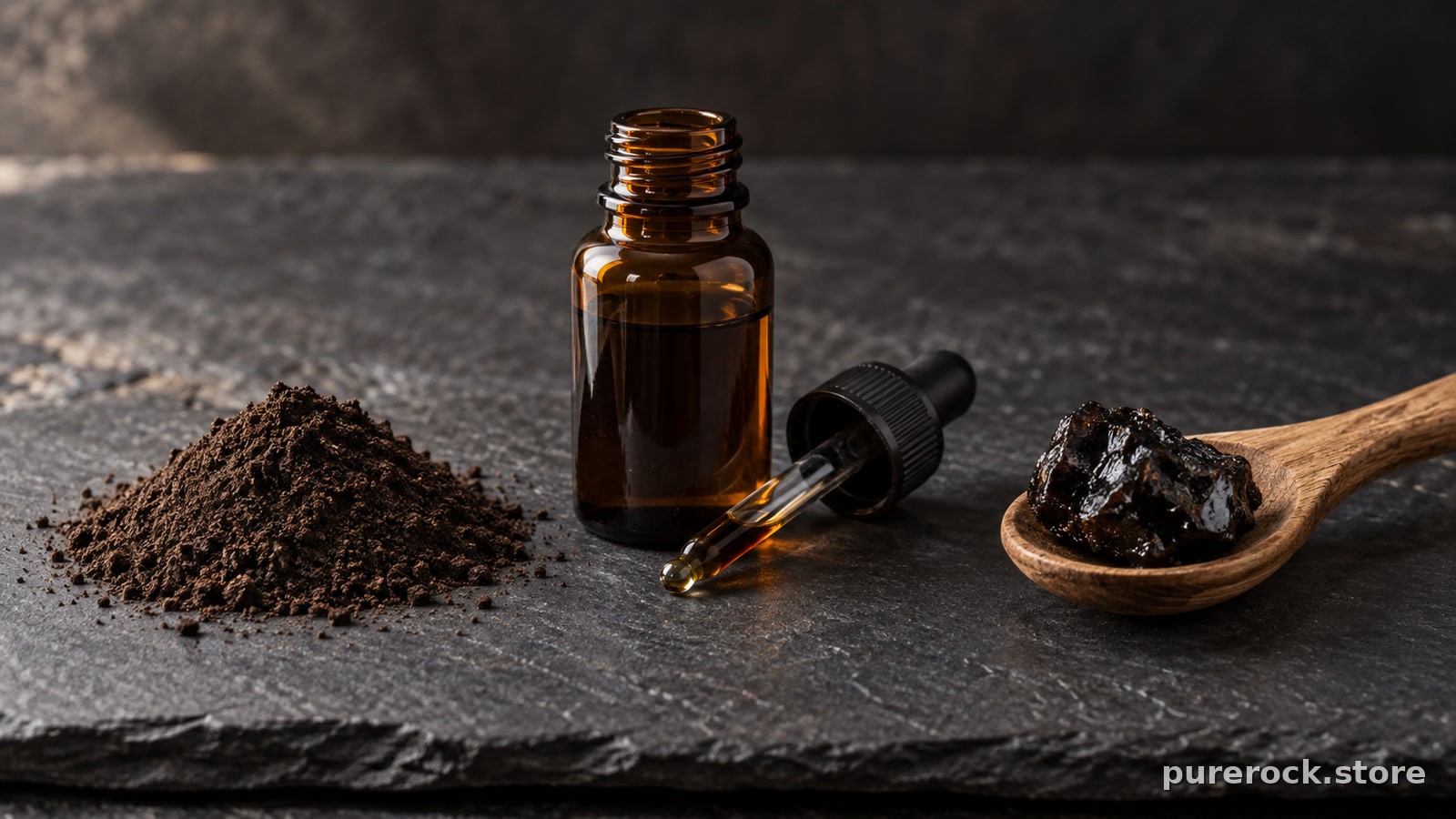
Shilajit powder and liquid shilajit drops get less attention than resin and capsules, yet they are the two formats where the label tells you the least about what you are actually taking. A spoonful of powder can be mostly carrier, and a dropper of liquid can be mostly glycerin or water. This guide covers how each format is made, what to read on the label, and how to work out a real dose and a real price before you buy.
Key Takeaways
- Shilajit powder is usually a water extract of raw shilajit that has been dried, often by spray drying, into a fine powder. It is not simply ground-up resin.
- Powder is the easiest format to dilute without anyone noticing. Carriers such as maltodextrin are a normal part of spray drying, but they reduce the share of each gram that is actually shilajit.
- Shilajit drops are shilajit dissolved in a liquid base, typically water, glycerin, alcohol, or a mix. Under US labeling rules, the amount listed for a liquid extract can include the solvent.
- Drop size is not standard. A study of eye-drop bottles measured anywhere from 20.9 to 40.8 drops per mL, so “per drop” dosing is rough at best.
- Compare products by cost per 100 mg of shilajit extract, and by fulvic acid content when it’s disclosed, not by bottle or bag price.
How Shilajit Powder Is Made
Raw shilajit comes off the rock mixed with sand and debris, so every format starts with purification. For powder, the usual route is to dissolve the raw material in water, remove what doesn’t dissolve, and then dry the liquid into a solid.
A 2019 study in the Journal of Research in Pharmacy (Bugaev et al.) compared ways of doing this. The researchers extracted raw shilajit with water at room temperature, then either dried the extract in an oven at 70°C or ran it through a spray dryer, which sprays the liquid as a fine mist into hot air. Their spray-drying conditions used inlet air no hotter than 140°C and outlet air of at least 80°C. Spray drying, and centrifuging the solution before drying, both lowered the silicon and aluminium left in the final product.
The best-known patent for a standardized extract (US 6,440,436, issued in 2002) goes much further: water extraction, solvent extraction, removal of humic acids, and ion-exchange steps, ending in a product described as a “fine powder” with at least 60% low-to-medium molecular weight fulvic acids and at least 0.3% dibenzo-alpha-pyrones. That is a very different material from resin that has only been dissolved, filtered, and reduced.
So “shilajit powder” can mean at least three things:
- Dried purified extract, spray-dried or oven-dried from a water solution, with or without a carrier.
- Standardized extract powder, processed further to hit a stated fulvic acid percentage.
- Crushed or ground raw material. This is the one to avoid. Raw, unpurified shilajit hasn’t had its insoluble material removed, and it’s not what any human study used.
The label rarely says which one you have, which is where the trouble starts.
Why Shilajit Powder Is the Easiest Format to Dilute
With resin, fillers tend to change the texture, and our guide to shilajit resin explains how genuine resin should behave. A fine brown powder gives you no such clues.
Carriers are a legitimate part of the process. Plant and food extracts rich in small, water-loving molecules tend to go sticky in a spray dryer and cake in storage, so manufacturers add a carrier, most often maltodextrin, to the liquid before drying. A 2022 review in Pharmaceutics (Ng et al.) describes moisture absorption in hygroscopic nutraceutical powders as a real stability problem, and lists encapsulation by spray drying and co-processing with excipients among the standard fixes. The trade-off shows up clearly in a 2015 Molecules study on spray-dried black bean extract (Guajardo-Flores et al.): the powder with 6% maltodextrin had the best recovery of the target compounds, and adding more maltodextrin reduced it. No equivalent study exists for shilajit, but the principle carries over. Every gram of carrier is a gram that isn’t extract.
The carrier ratio is rarely disclosed. A label can list “shilajit extract powder” as the only ingredient even if the material was dried onto a carrier by the raw-ingredient supplier.
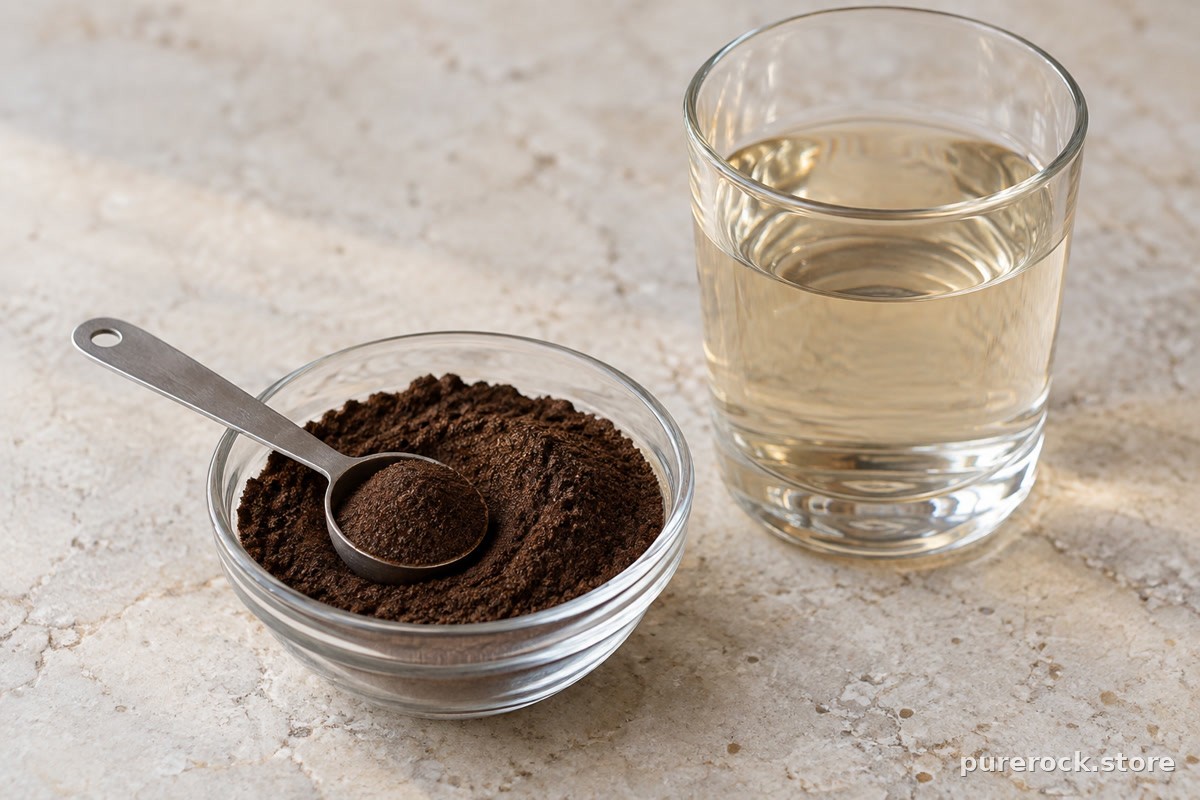
Powder looks the same whatever it is. Dried extract, extract plus maltodextrin, and ground raw rock exudate can all look like a dark brown powder. Color and smell aren’t a test.
“Fulvic acid” itself gets faked. This isn’t specific to shilajit, but a 2025 study in the Journal of AOAC International (Vialykh et al.) screened commercial fulvic acid products with a UV-spectrum method and found that only 14 of 25 contained genuine fulvic fractions. A label percentage is only as good as the lab behind it.
How to Read a Shilajit Powder Label
Work through the label in this order:
- “Extract” or not. “Purified shilajit extract” or “shilajit extract powder” suggests a water-extracted, dried material. “Shilajit powder” on its own, or “raw shilajit,” could be anything, including ground raw material.
- A fulvic acid percentage, with the test method. “Standardized to X% fulvic acid” means something only if a certificate of analysis backs it up. Ask which lab ran the test and which method it used.
- Other ingredients. Under FDA rules (21 CFR 101.36), ingredients that aren’t dietary ingredients, such as maltodextrin, silica, or rice flour, go in an ingredient statement just below the Supplement Facts panel. If maltodextrin is listed there, ask what share of each scoop it makes up.
- Proprietary blends. The same regulation only requires a blend’s total weight, not the amount of each component. “Shilajit blend, 1,000 mg” could contain very little shilajit.
- Serving size in grams, not scoops. A cheap 0.01 g kitchen scale solves the rest.
- A heavy-metal panel on the finished product. Our supplement buying guide covers what a proper certificate of analysis should include.
How Liquid Shilajit and Drops Are Made
Liquid shilajit is purified shilajit dissolved in a liquid base. Product listings usually name one of three, or a mix:
- Water-based. Purified shilajit dissolved in water, sometimes with honey or other additions. Shilajit dissolves readily in water, but water-heavy liquids are the most hospitable to microbes once opened.
- Glycerin-based (glycerites). Vegetable glycerin, usually mixed with water. Glycerin tastes sweet and softens shilajit’s bitterness, and a high proportion of it makes the liquid less friendly to microbial growth.
- Alcohol-based tinctures. Ethanol and water. Alcohol acts as a preservative, but it adds a sharp taste and won’t suit people avoiding alcohol for any reason.
A Virginia Cooperative Extension guide on interpreting water activity results notes that the FDA treats foods with water activity below 0.85 as “water activity-controlled” against pathogenic bacteria, while some yeasts and molds can still grow below that level. A mostly-water shilajit liquid sits well above that line, so it depends on preservatives, careful handling, or refrigeration. If a water-based product lists neither a preservative nor a “refrigerate after opening” instruction, ask the seller how it stays stable once opened.
There’s one labeling detail that matters more than the base. Under 21 CFR 101.36(b)(3)(ii)(B), when a liquid extract still contains its solvent, the quantity listed can be “the volume or weight of the total extract.” So “1 mL shilajit liquid extract” tells you the volume of the whole liquid, not how many milligrams of shilajit are dissolved in it. A useful label also states the ratio or concentration, for example mg of shilajit per mL.
The Dose-Per-Drop Problem
Drops usually come with instructions like “take 10 to 20 drops.” Turning that into milligrams takes three numbers, and labels rarely give all of them.
1. Mg of shilajit per mL. Without it, there’s no dose to calculate. If only the bottle total is given, divide by the volume. A hypothetical 30 mL bottle containing 3,000 mg of shilajit works out to 100 mg per mL.
2. Drops per mL. The traditional assumption is 20 drops per mL. The US Pharmacopeia chapter on the medicine dropper defines a standard dropper as one delivering drops of water weighing 45 to 55 mg each. It also notes that most liquids don’t behave like water, so “the size of drops will vary from one preparation to another.” Glycerin is much thicker than water, and dropper tips differ too. A 2017 study in BMC Ophthalmology (Moore et al.) tested 192 bottles of glaucoma eye drops across 32 bottle designs and found a range of 20.9 to 40.8 drops per mL. That’s nearly a twofold spread.
3. How the dropper is used. A 2014 study in the Journal of Pharmacy Technology (Elliott et al.) compared dosing devices for liquid acetaminophen. In the lab, a 3 mL dropper’s error was 0.8% for a thin solution but 10.6% to 14.6% for thicker suspensions. When 320 consumers measured doses themselves, dropper error reached 26% to 38.4%, versus 4.8% or less for oral syringes.
Here is what that does to the hypothetical 100 mg/mL bottle. “20 drops” is 100 mg if the dropper really gives 20 drops per mL. At 40 drops per mL, the same 20 drops is 50 mg. Studies of purified extract have used 250 to 500 mg a day: 250 mg twice daily in Pandit et al., 2016, and 250 or 500 mg daily in Keller et al., 2019. A drop-counted serving of this bottle could land anywhere from 50 to 100 mg. Whatever amount you and your doctor settle on, the fixes are the same:
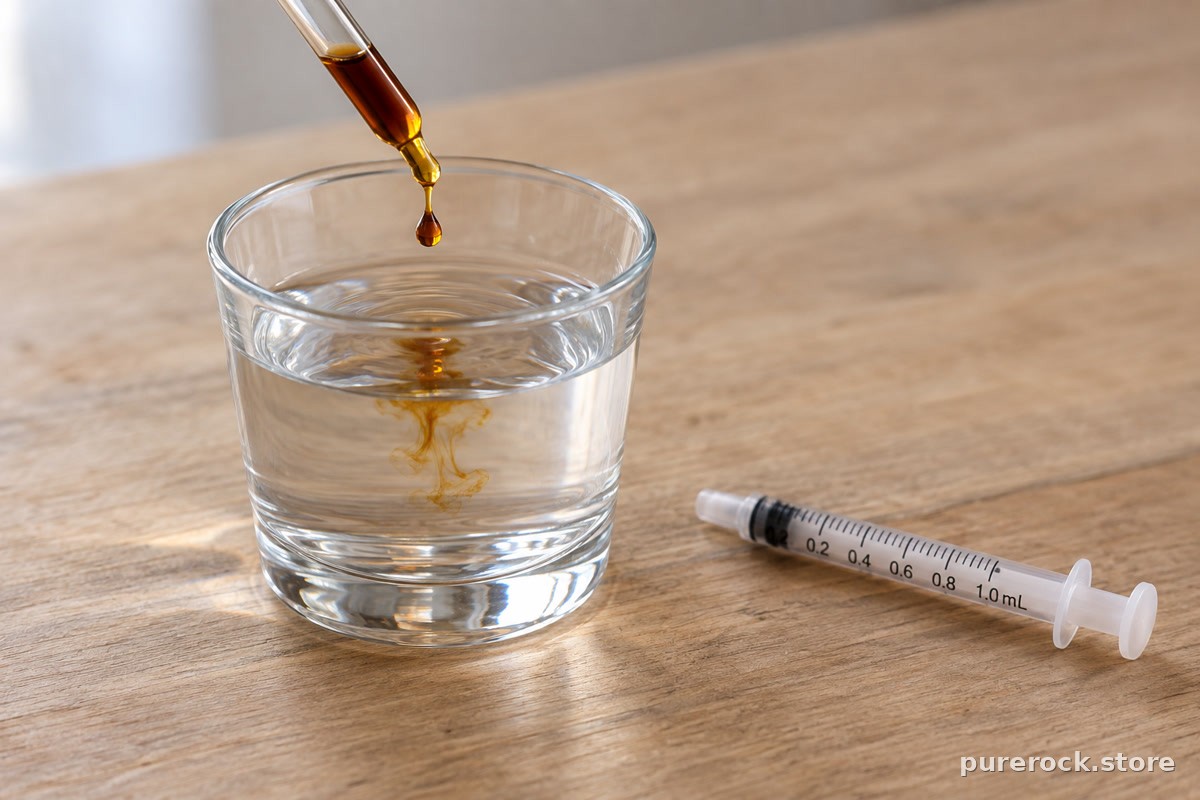
- Use the mL markings on the dropper, or a 1 mL oral syringe, instead of counting drops.
- If the label gives no mg per mL, email the seller. If they can’t answer, you can’t calculate a dose.
Shilajit Powder vs. Drops vs. Resin
Our capsules, resin, and gummies comparison covers those three formats. This table sets powder and drops alongside resin.
| Powder | Drops / liquid | Resin | |
|---|---|---|---|
| How it’s usually made | Water extract dried to powder (spray- or oven-dried), sometimes further standardized | Purified shilajit dissolved in water, glycerin, alcohol, or a mix | Water extract filtered and reduced to a paste |
| What’s often added | Carriers or flow agents (maltodextrin, silica) | Solvent base, sometimes honey, flavor, or preservatives | Usually nothing |
| How you measure a dose | By weight (scale) or scoop | By mL or drop count | By weight or “pea-sized” portion |
| Main labeling blind spot | Carrier share rarely disclosed | Amount listed can include the solvent; mg per mL often missing | Fulvic acid content often missing |
| Dilution risk | High, and invisible | Moderate: concentration is easy to lower | Lower: fillers tend to change texture |
| Storage weak point | Absorbs moisture, then clumps | Microbial growth after opening, dropper contamination | Softens in heat, hardens in cold, absorbs moisture |
| Taste | Bitter, earthy; mixes into drinks | Depends on base: sweet (glycerin), sharp (alcohol) | Strong, bitter, smoky |
| Travel | Good if sealed | Can leak; carry-on liquid limits apply | Awkward in heat |
Storage and Shelf Life for Each Format
We found no published research on how shilajit’s composition changes in storage, so treat any “lasts X years” claim with caution. What damages each format is better understood.
Powder: keep it dry. Hygroscopic powders pull moisture from the air, which leads to clumping and, according to the Pharmaceutics review above, chemical and physical changes that can shorten shelf life. Keep it sealed, use a dry spoon, leave any desiccant packet in, and store it away from bathroom or stove humidity. A solid cake has taken on water; if it also smells musty or shows spots, throw it out.
Drops: protect the bottle once it’s open. A dropper that touches your mouth, or gets set down on a counter, goes back into the whole bottle. Dispense into a spoon or glass instead of straight onto your tongue, keep the cap tight, and follow any refrigeration instruction. Amber or opaque glass limits light exposure. Cloudiness, sediment that wasn’t there before, fizzing, or a sour smell mean the bottle should go.
Resin needs the same airtight, cool, dry-utensil habits, covered in the resin guide. Whatever the format, follow the printed best-by date and don’t buy more than you’ll use in a few months, particularly for liquids.
Mixing Tips: Getting Powder and Drops Into a Drink
Powder. Dropped straight into a full glass, powder often floats and clumps. Make a slurry instead: put the weighed dose in a cup, stir in a teaspoon or two of warm (not boiling) water to form a smooth paste, then top up with a few ounces of water, tea, or milk. It also works stirred into a smoothie or yogurt.
Drops. Measure into a spoon, then add to a small glass of water or tea. Alcohol tinctures taste harsh neat and go down easier diluted. Some sellers say drops “absorb faster under the tongue.” We found no published study comparing under-the-tongue shilajit with swallowed shilajit, so treat that as marketing.
Cost Per Dose: Compare Like With Like
Bag and bottle sizes say nothing about how much shilajit is inside, so normalize:
Cost per 100 mg of shilajit extract = price ÷ total mg of extract in the pack × 100
Two hypothetical examples, not real products:
- A 50 g bag of powder at $30 that is 100% extract contains 50,000 mg: $0.06 per 100 mg. If half the bag is maltodextrin, that doubles to $0.12.
- A 30 mL bottle of drops at $30 containing 3,000 mg of shilajit costs $1.00 per 100 mg, more than 15 times the powder figure.
Better still, compare cost per 100 mg of fulvic acid. Independent testing shows why: in ConsumerLab’s 2024 testing of eight shilajit supplements, fulvic acid ranged from 6.9 mg to 2,206 mg per serving, and resins contained far less fulvic acid than the extracts in capsules and pills. That comparison only works when both products publish a verified fulvic acid figure.
FAQ
Is shilajit powder as good as resin? It depends on the powder. A properly purified, dried extract with a verified fulvic acid figure can be a perfectly reasonable material, and standardized extracts are what several human trials used. A powder of unknown composition, or ground raw material, is a worse bet than tested resin.
How many drops of liquid shilajit equal one dose? There’s no universal answer. Find the mg of shilajit per mL on the label, measure by mL, and do the division. Drop size varies with the liquid and the dropper, so counting drops can be off by a factor of two.
Does shilajit powder dissolve in water? A water-extracted powder should disperse fully in warm water. Heavy grit that won’t dissolve suggests insoluble material that purification should have removed.
Is maltodextrin in shilajit powder bad? Not in itself; it’s a standard spray-drying carrier. The concern is dilution, and brands rarely say how much is in there. Ask for the ratio.
Related Guides
- What is in shilajit: minerals, fulvic acid and lab variability.
- How to choose the best shilajit: a brand-free checklist.
- Shilajit FAQ: quick answers on pronunciation, shelf life and more.
Bottom Line
Both formats are workable, but both hide more on the label than resin or capsules do. Powder is usually a dried water extract, and its main risk is dilution you can’t see, whether from carriers or from lower-grade material. Drops add a solvent, and their main risk is dosing: the labeled amount can include the liquid, and drop sizes vary widely enough to halve your intended dose.
The fixes are simple. Weigh powder, measure liquids by mL, insist on mg-per-serving and fulvic acid figures backed by a batch certificate of analysis, and compare products by cost per 100 mg of extract rather than by bag or bottle price. And whichever format you choose, check with your doctor before starting, especially if you take medication, have a chronic condition, or are pregnant or breastfeeding.