 Purerock
format
Shilajit Honey Sticks: Dose, Sugar, and Are They Worth It?
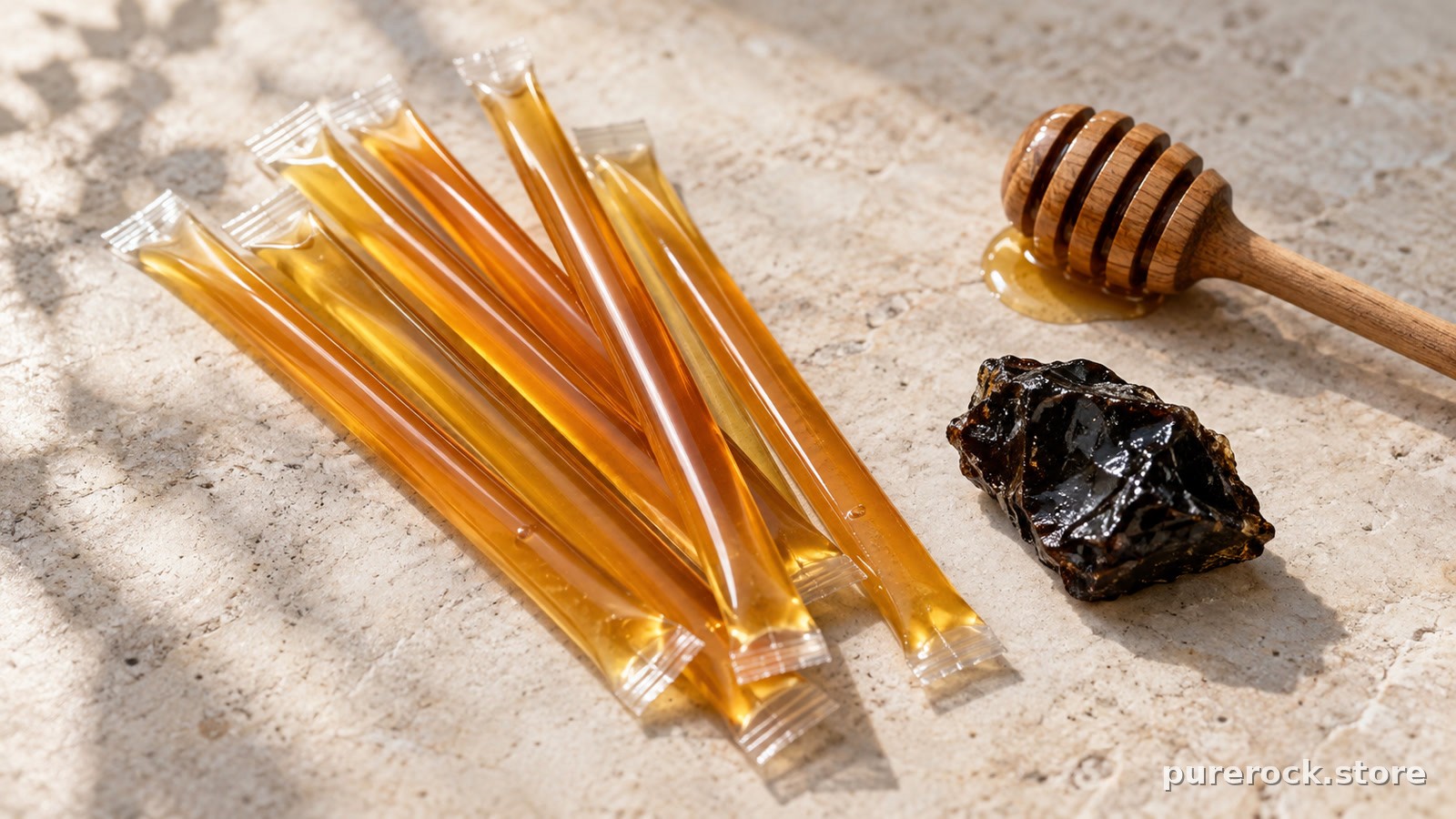
Search for shilajit honey sticks and nearly every result is a product page, so almost nobody explains what you are buying: how much shilajit sits inside a straw of honey, how much sugar comes with it, and whether the format suits a daily habit. This guide works through the arithmetic and the label so you can judge any stick yourself.
Key Takeaways
- A shilajit honey stick is a sealed straw of honey with a small amount of shilajit extract mixed in. By weight, the stick is mostly honey, and the shilajit is a few percent at most.
- The number that matters is mg of shilajit extract per stick, not the total weight of the stick. Put that next to the doses used in published studies, which are most commonly 250 to 500 mg per day.
- Honey is roughly 82% sugar by weight according to USDA data, so a 10 g stick delivers about 8 g of sugar and around 30 calories. For many adults that is a meaningful share of a daily added-sugar budget.
- Honey sticks suit people who can’t tolerate resin’s taste and people who travel a lot. They are a poor fit for anyone managing blood sugar, and no product containing honey should ever be given to an infant under 12 months because of botulism risk.
- Compare products by cost per 100 mg of shilajit extract, not cost per stick, and ask for heavy-metal results on the finished stick, not just the raw resin.
What a Shilajit Honey Stick Actually Is
A honey stick is a thin, heat-sealed plastic straw holding a single serving of honey. You tear off one end and squeeze it into your mouth or into tea. The shilajit version blends purified shilajit extract, as dissolved resin or dried powder, into the honey before the straws are filled.
On the processing spectrum covered in our comparison of capsules, resin, and gummies, a honey stick sits close to resin: usually no gelling agent, binder, or heat-set base. The trade-off is that the only thing masking the taste is sugar, and a lot of it relative to the active ingredient.
Stirring a little honey into shilajit dissolved in warm water or milk is an old habit for softening its bitter, smoky taste. A honey stick is that habit pre-measured and sealed, except the manufacturer chose the ratio, not you.
How Much Shilajit Is in One Honey Stick? The Dose-Per-Stick Math
Start with the reference points from the research. In a randomized, placebo-controlled trial published in Andrologia in 2016 (Pandit et al.), healthy men aged 45 to 55 took 250 mg of purified shilajit twice a day (500 mg daily) for 90 days. A 2019 study in the Journal of the International Society of Sports Nutrition (Keller et al.) gave recreationally active men 250 mg or 500 mg per day for eight weeks. Both were small, male-only, and did not use honey sticks, but they show the dose range the research is about.
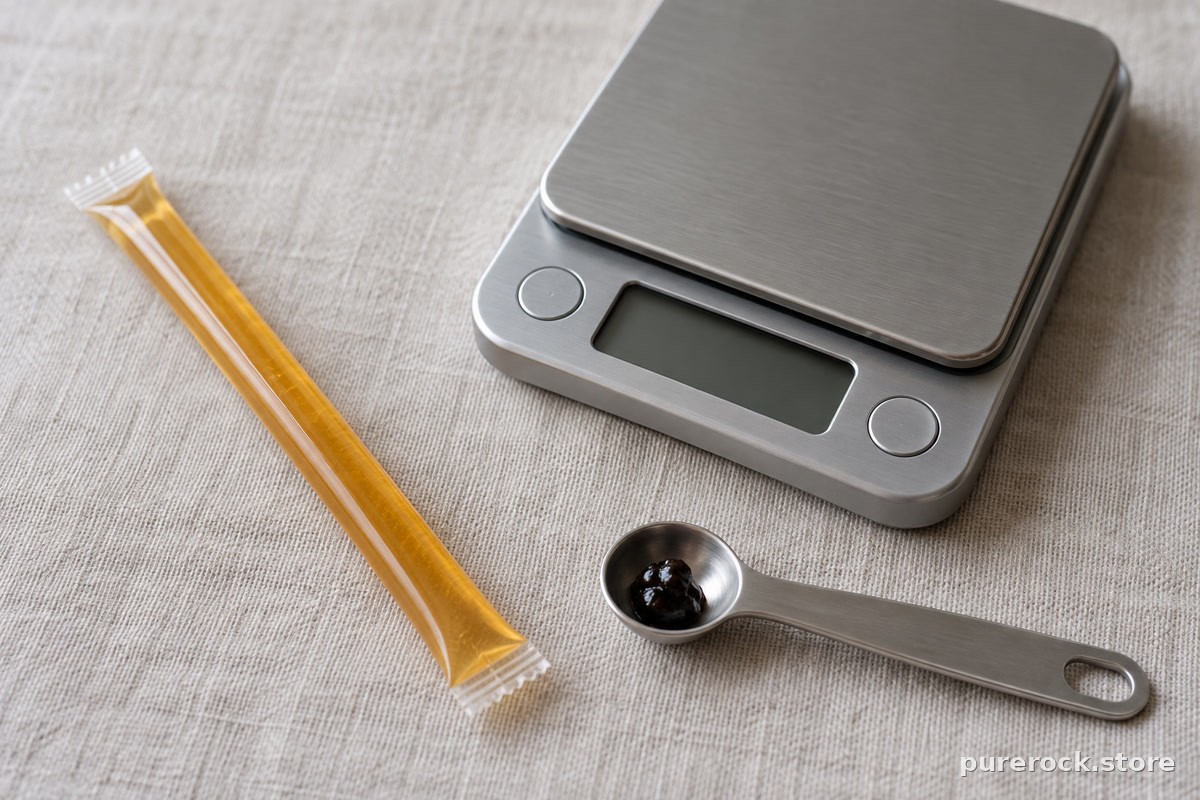
Now compare a honey stick to that range. Sticks are sold by total weight, and labels commonly list something in the region of 5 to 15 grams per stick (check your specific product). The shilajit inside is measured in milligrams. Suppose a stick weighs 10 g and contains 300 mg of shilajit extract. Then:
- Shilajit makes up 0.3 g of a 10 g stick, which is 3% of the stick by weight.
- The other 9.7 g is honey.
- If you wanted to match the 500 mg daily dose from the studies above with 300 mg sticks, you would need close to two sticks a day. With a 150 mg stick you’d need more than three.
That last point explains the format. More shilajit means a stronger taste, and a stick that tastes of resin loses the main reason people buy it. A gentle-tasting stick is very likely a low-dose stick.
Before you accept any stick as “one serving,” divide the mg of extract per stick into the daily amount you and your doctor have discussed. If the answer is two or three sticks, multiply the sugar by the same number.
Reading a Shilajit Honey Stick Label
Honey stick labels are short, which makes the important lines easy to skim past. Check them in this order.
1. Mg of shilajit extract per stick. Look for a specific number next to “shilajit extract” or “purified shilajit.” If you only see total stick weight, or shilajit hidden in a proprietary blend, you can’t do any of the math above.
2. Fulvic acid percentage. Many extracts are standardized to a stated fulvic acid content, written something like “standardized to X% fulvic acid.” Equal mg of extract can differ in potency if the percentages differ, and “rich in fulvic acid” with no number tells you nothing.
3. Total sugars and calories per stick. In the US, a product sold as a dietary supplement carries a Supplement Facts panel, so look for grams of total sugars and calories listed per stick. If you can’t find them, estimate from honey weight using the USDA figures in the next section.
4. Honey type and origin. “Raw,” “wildflower,” or a named floral source describe the honey, not the shilajit. The same goes for “Himalayan shilajit honey sticks”: the word Himalayan might describe the shilajit, the honey, or just the branding. Geographic origin is notoriously hard to verify from a label, so treat that word as a claim rather than evidence.
5. Other ingredients. Expect only two ingredients: honey and shilajit extract. Added flavors, syrups, or “honey blend” wording mean you are buying something other than honey plus shilajit.
6. Lot number and best-by date. A lot number is what connects the stick in your hand to a specific lab report. Without one, a certificate of analysis could belong to any batch.
The Sugar and Calorie Cost of a Daily Stick
Honey is the main ingredient, and it has a nutritional cost. According to USDA FoodData Central (FDC ID 169640), honey contains about 82.1 g of total sugars and 304 kcal per 100 g, with almost all of that sugar being fructose and glucose.
Nutrition authorities treat honey as an added sugar. The Harvard T.H. Chan School of Public Health’s Nutrition Source summarizes the American Heart Association’s guidance as no more than about 100 calories a day of added sugar for most women (around 6 teaspoons) and about 150 calories a day for most men (around 9 teaspoons, or 36 g). It also notes that the body does not treat honey differently from other caloric sweeteners.
The table applies the USDA figures to plausible stick sizes, treating the whole stick as honey since the shilajit’s weight is negligible. Your label is the final word.
| Honey per stick | Sugar per stick (approx.) | Calories per stick (approx.) | Sugar from one stick daily for 30 days | Sticks needed for 500 mg/day at 150 mg per stick |
|---|---|---|---|---|
| 5 g | 4.1 g | 15 kcal | ~123 g | 4 sticks (~16 g sugar) |
| 10 g | 8.2 g | 30 kcal | ~246 g | 4 sticks (~33 g sugar) |
| 14 g (USDA “packet” size) | 11.5 g | 43 kcal | ~345 g | 4 sticks (~46 g sugar) |
| 20 g | 16.4 g | 61 kcal | ~493 g | 4 sticks (~66 g sugar) |
One small stick is roughly a spoonful of honey in tea. But when a low-dose stick means eating several a day to reach research-level amounts, the “supplement” can use up most of a daily added-sugar allowance. As with the sugar in shilajit gummies, health framing makes that sugar easy to overlook.
Who Honey Sticks Suit, and Who Should Skip Them
Reasonable fits:
- People who can’t get past resin’s taste. A honey stick hides it without gelatin, pectin, or sugar alcohols.
- Travelers. A sealed stick needs no cup, spoon, or warm water, and takes up almost no space.
- People who already use honey. If you sweeten morning tea anyway, a stick replaces that honey rather than adding to it.
Poor fits:
- Anyone managing blood sugar, including anyone with diabetes or prediabetes or told to limit added sugar. Capsules deliver shilajit with no sugar at all.
- Infants under 12 months, without exception. The CDC’s botulism prevention guidance says directly: “Do not feed honey to a child who is younger than 1 year old,” because honey can contain the bacteria that cause botulism. The CDC also warns against honey-containing products such as honey pacifiers. Keep sticks away from small children, since they look like candy.
- Pregnancy and breastfeeding. Shilajit itself lacks safety data here, whatever the format. Talk to your doctor first.

Honey Sticks vs. Gummies vs. Resin
Honey sticks sit between the two: simpler than a gummy, easier than resin, and usually carrying more sugar per mg of shilajit than either.
- Compared with resin: resin offers the most shilajit per gram and no sugar, but you measure, dissolve, and taste it. A honey stick trades those chores for sugar and a fixed dose.
- Compared with gummies: both use sugar to cover the taste, but a gummy adds a gelling agent and often flavors, colors, or sugar alcohols. A two-ingredient stick makes a reaction easier to trace; gummies are sturdier in a bag.
- Compared with capsules: capsules are the zero-sugar, fixed-dose option.
Cost Per Dose: The Only Price Comparison That Works
Shelf price means little when one box holds 150 mg per stick and another 400 mg. Normalize:
Cost per 100 mg of shilajit extract = (price of the box ÷ number of sticks) ÷ (mg of extract per stick) × 100
A hypothetical example, not a real product: a box of 30 sticks at $30 works out to $1.00 per stick. At 150 mg per stick, that’s about $0.67 per 100 mg of extract. A second hypothetical box at $45 for 30 sticks with 400 mg each is $1.50 per stick but only about $0.38 per 100 mg. The more expensive box is the cheaper way to buy shilajit.
Multiply the per-100 mg figure by your intended daily intake, and do the same for any resin or capsule product you’re comparing. With sticks you are partly paying for honey, packaging, and convenience, which is fine as long as you know it.
Storage, Heat, and Crystallization
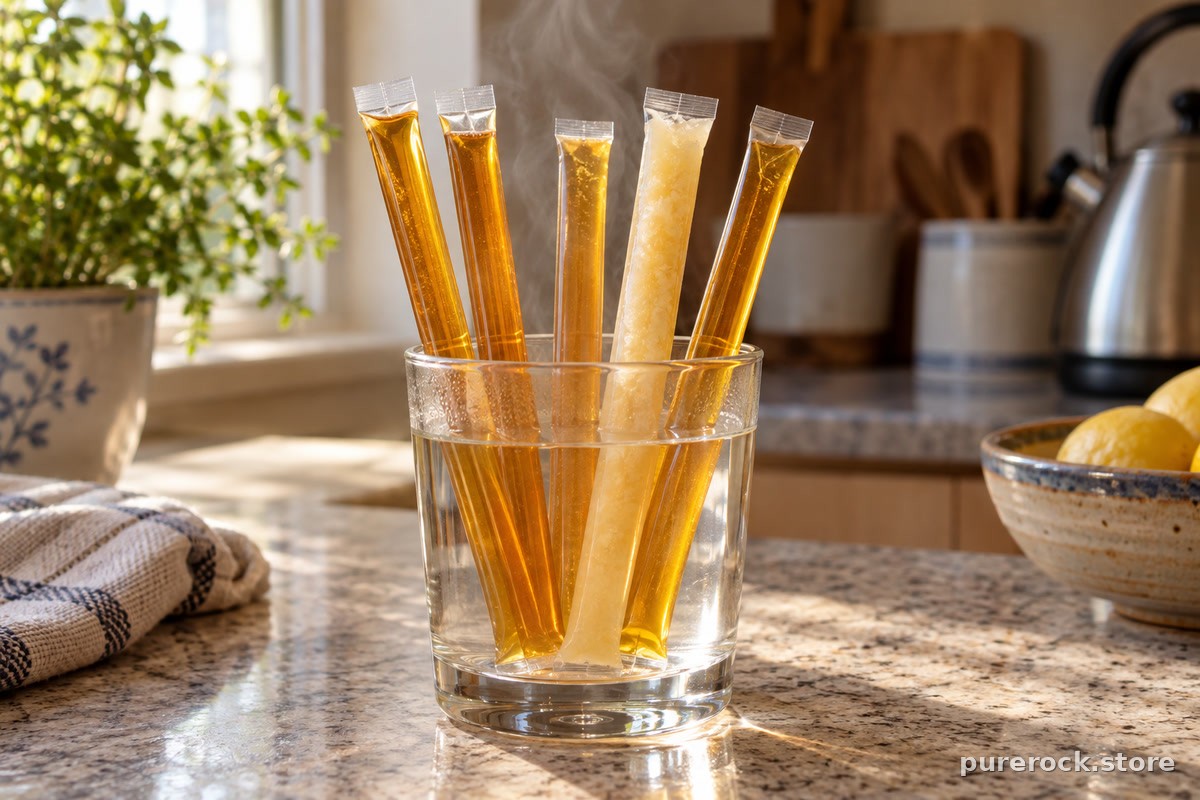
Crystallization is normal. An FAO technical document on honey explains that honeys high in glucose crystallize readily, while honeys with a glucose-to-water ratio below about 1.8 tend to stay liquid. It also notes that honey crystallizes more slowly when kept consistently above 25°C or below 5°C. A cloudy or grainy stick is not a sign that it has spoiled.
To re-liquefy, use gentle warmth. Hold the stick in your hand or set it in warm (not hot) water for a few minutes. The same FAO document describes commercial honey being warmed to 40 to 50°C to dissolve crystals, and warns that honey which recrystallizes after heating forms larger crystals that need more heat the next time. Don’t microwave or boil the thin plastic straws.
Avoid sustained heat. The FAO document notes that prolonged storage above 25°C does more damage to honey quality than a brief warming. Skip the glovebox and sunny windowsill; room temperature out of direct sun is enough.
Seals fail. Ends can split when squashed in a bag. Discard any stick that leaks, fizzes, or smells sour, and respect the best-by date.
Lab Testing Questions to Ask Before You Buy
A stick combines two raw materials, so one certificate of analysis can leave gaps. Ask the seller:
- Was the finished stick tested, or only the shilajit that went into it? Contaminants can come from the honey, the extract, or packaging.
- Does the report cover lead, arsenic, mercury, and cadmium, with results in actual units? “Passed” with no numbers is not a result.
- Does the lot number on the report match the lot number on your box?
- Was the lab independent, and is it named on the report?
- Is the mg of shilajit per stick verified by testing, or is it just the amount the recipe calls for?
For a format-neutral checklist covering sourcing, COAs, and pricing red flags, see our shilajit supplement buying guide.
Are Shilajit Honey Sticks Worth It?
Any benefits of shilajit honey sticks come from the shilajit, and that research is small, short, and mostly in men. The honey adds taste and convenience, paid for in sugar.
They are worth considering if taste or portability is what stops you taking shilajit consistently, the label states mg of extract per stick, and the sugar fits your diet. They are hard to justify if you need several a day, are watching blood sugar, or can’t find the shilajit content.
FAQ
How many shilajit honey sticks should I take a day? There’s no universal number, because sticks vary widely in extract content. Divide the mg of shilajit per stick into the daily amount you’ve discussed with a healthcare provider, then check what that number of sticks adds in sugar. Published studies used 250 to 500 mg of purified shilajit per day, but they did not use honey sticks.
Can I give a shilajit honey stick to my baby or toddler? Never to a baby under 12 months. The CDC advises against giving honey in any form to children younger than one because of the risk of infant botulism. For older children, shilajit hasn’t been studied, so talk to a pediatrician before giving it.
Do shilajit honey sticks go bad? They can. Honey resists spoilage, but split seals let moisture in. Follow the best-by date.
My stick turned cloudy and grainy. Is it spoiled? Probably not. That is crystallization, which happens naturally in many honeys. Warm the stick gently in your hand or in warm water and it will usually turn liquid again.
Is a shilajit honey stick better absorbed than a capsule? We found no published study comparing absorption from honey sticks with capsules or resin, so treat claims that honey “boosts absorption” as marketing.
Are “Himalayan” shilajit honey sticks better? The word alone doesn’t tell you much. It may refer to the shilajit, the honey, or neither, and origin is hard to verify. Lab results for the finished product tell you far more than a place name.
Related Guides
- Shilajit gummies: do they work?: the umbrella guide to the format.
- How to choose the best shilajit: a brand-free checklist.
- Shilajit price and cost per serving: how to compare costs fairly.
Bottom Line
A shilajit honey stick is a small dose of shilajit inside a much larger dose of honey: convenient and palatable for travelers and resin-haters, with a sugar cost that grows with every extra stick, and never for infants. Before buying, find the mg of extract per stick, work out how many you’d need, count the sugar, and compare cost per 100 mg. A product that passes those checks with a lot-matched lab report is at least an honest version of the format.