 Purerock
buying
Shilajit Supplement Buying Guide: What to Check First
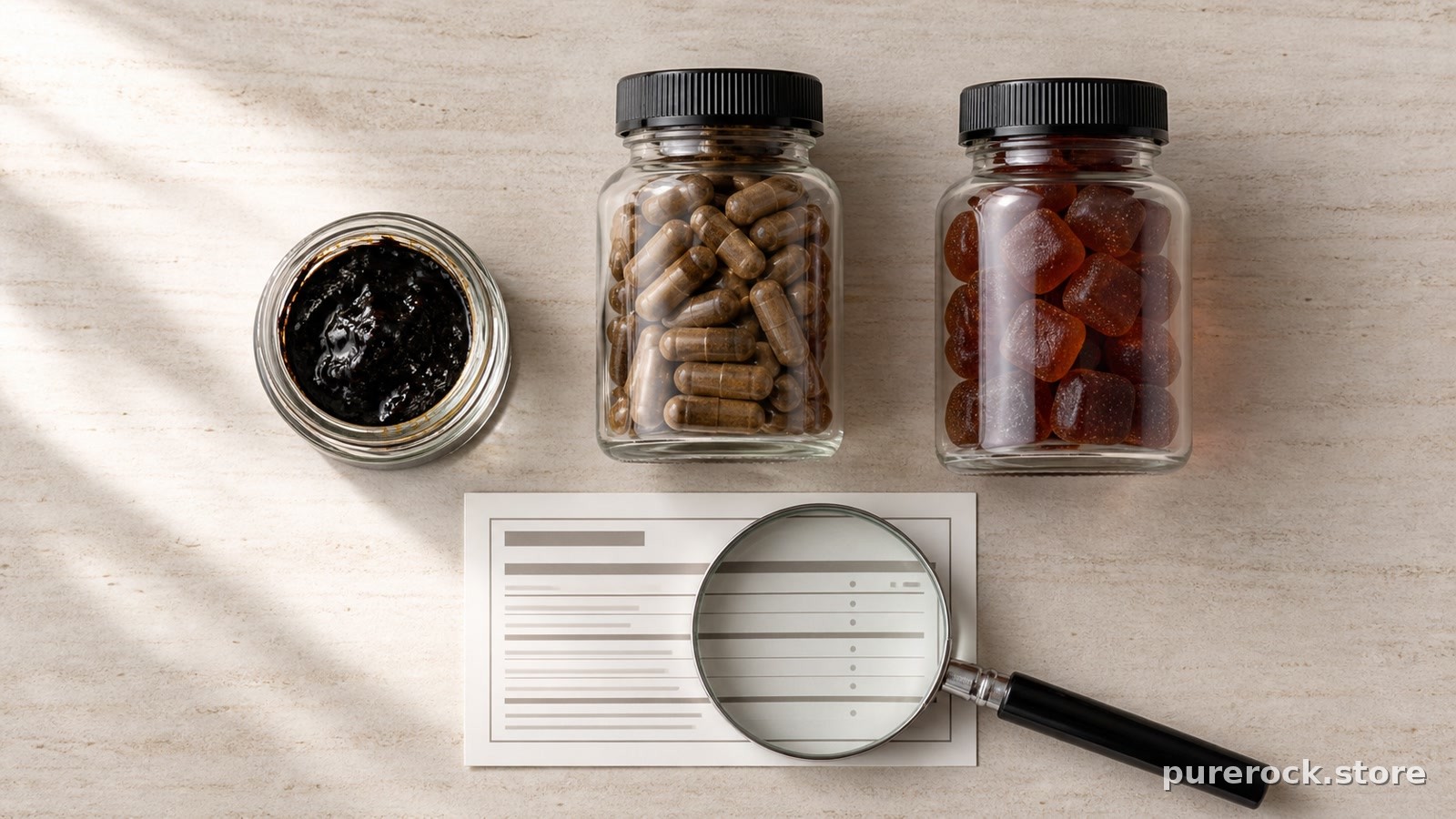
“Shilajit supplement” covers a lot of ground. It’s the umbrella search term for resin, capsules, powder, gummies, and liquid extract alike — and most of what shows up under it is marketing copy dressed up as education. Sellers lean on words like “pure,” “authentic,” and “ancient Ayurvedic formula” because those words are free to print and hard to verify from a product photo.
This guide skips the format-specific mechanics — how resin dissolves, how capsules are dosed, how gummies mask taste — and focuses on the one question that applies no matter what form you’re looking at: how do you actually know what’s in the package before you buy it? The answer comes down to five checks that any legitimate shilajit brand, in any format, should be able to satisfy without you having to dig.
Key Takeaways
- A Certificate of Analysis (COA) should be batch-specific, from a named accredited lab, and cover a full panel — not just fulvic acid.
- Fulvic acid content should be disclosed as an actual percentage, not a vague claim like “rich in fulvic compounds.”
- Heavy metal testing needs to show measured values against a recognized standard (USP, Prop 65), not just a pass/fail badge.
- Sourcing transparency (region, altitude, GMP certification, a real manufacturer address) is checkable — vague language like “pristine mountains” is not.
- A short, named ingredient list beats a “proprietary blend” every time you can’t verify what’s actually in the jar.
- Price that’s dramatically below the category average is a red flag, not a deal — genuine shilajit is labor-intensive to harvest and purify.
Why Shilajit Specifically Needs This Scrutiny
Shilajit isn’t synthesized in a lab to a fixed spec — it’s a mineral-rich exudate scraped from rock strata at altitude, then processed. That means two things that matter for buyers. First, quality genuinely varies by harvest, region, and processing method, so “shilajit” as a category label tells you very little on its own. Second, and more importantly, the same geology that gives shilajit its mineral content also makes it prone to picking up heavy metals — lead, mercury, arsenic, and cadmium — from the surrounding rock. Unprocessed or poorly purified shilajit has shown measurable heavy-metal contamination in independent testing, which is precisely why third-party lab verification isn’t a nice-to-have for this category — it’s the baseline.
This is also a category with very little regulatory oversight standing between raw material and finished product. In most markets, dietary supplements aren’t reviewed for safety or accuracy before they reach shelves — the manufacturer is responsible for making sure the product is safe and the label is truthful, and enforcement is largely reactive. That’s not unique to shilajit, but it matters more here than in categories with simpler, more uniform inputs. A vitamin C tablet made from ascorbic acid has a known, controllable starting material. Raw shilajit is a natural substance harvested from wildly different environments, and the variability that comes with that is exactly why the burden of verification falls on the buyer as much as the seller.
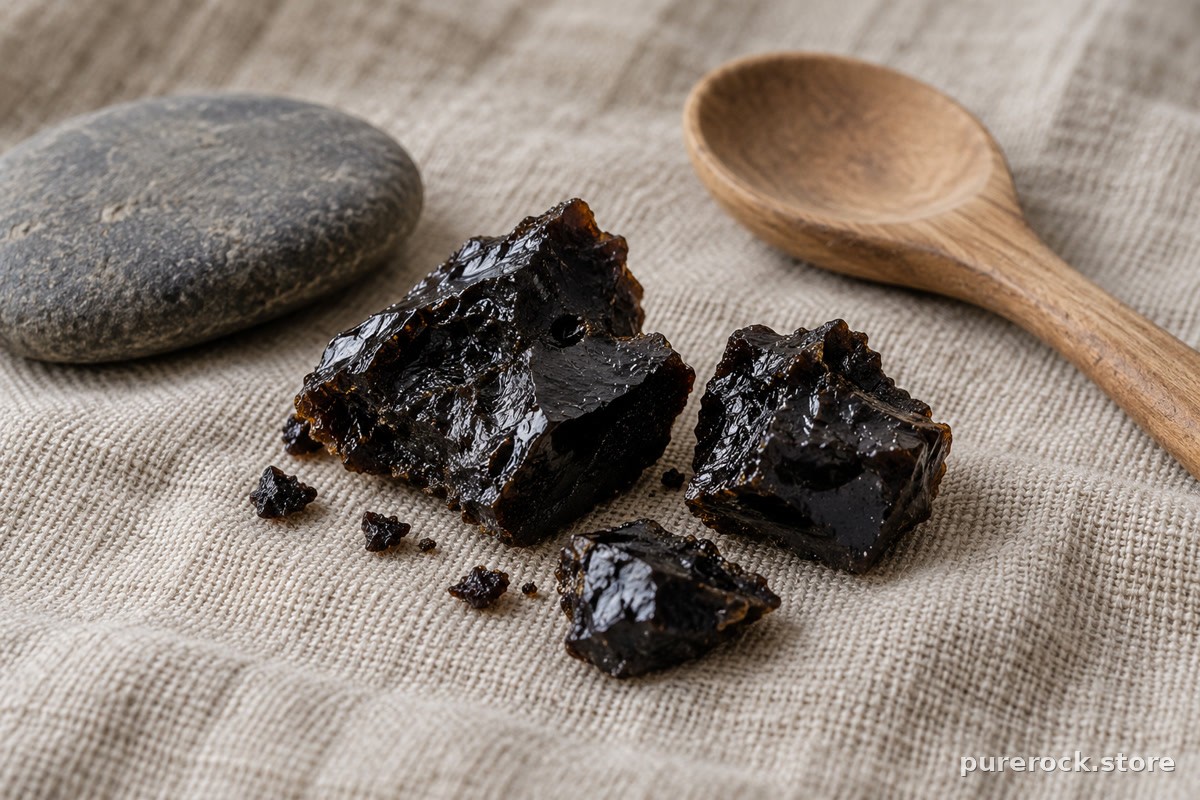
None of this means shilajit is inherently unsafe. It means the burden of proof sits with the manufacturer, and a buyer’s job is to check whether that proof actually exists before purchase, not to take a label’s word for it. Processing method matters too: purification techniques range from simple sun-drying and filtering to multi-stage aqueous extraction and low-heat concentration, and each step is an opportunity to either reduce contaminants or, if done carelessly, concentrate them. A brand that can describe its processing method in plain terms — not just “traditionally purified” — is signaling that it actually understands what happens between raw ore and finished product.
The Five-Point Checklist
1. Third-Party Lab Testing and a Real Certificate of Analysis
A Certificate of Analysis (COA) is a lab report — ideally from an ISO-accredited, independent lab, not an in-house one — that lists what was actually measured in a specific batch of the product: heavy metals, microbial contamination, and often fulvic acid content. Legitimate brands publish these, usually via a QR code or lot-number lookup on the label, or on request.
What to look for:
- Batch-specific, not generic. A COA dated years ago or with no batch/lot number attached to it tells you nothing about the jar in front of you.
- Named, accredited lab. “Tested in an independent laboratory” with no lab name attached is not verifiable. A real COA names the testing facility.
- Full panel, not a cherry-picked one. A COA that only reports fulvic acid and skips heavy metals is answering a different question than the one you’re asking.
If a brand can’t produce a current, batch-specific COA on request, that alone is reason enough to look elsewhere — regardless of format.
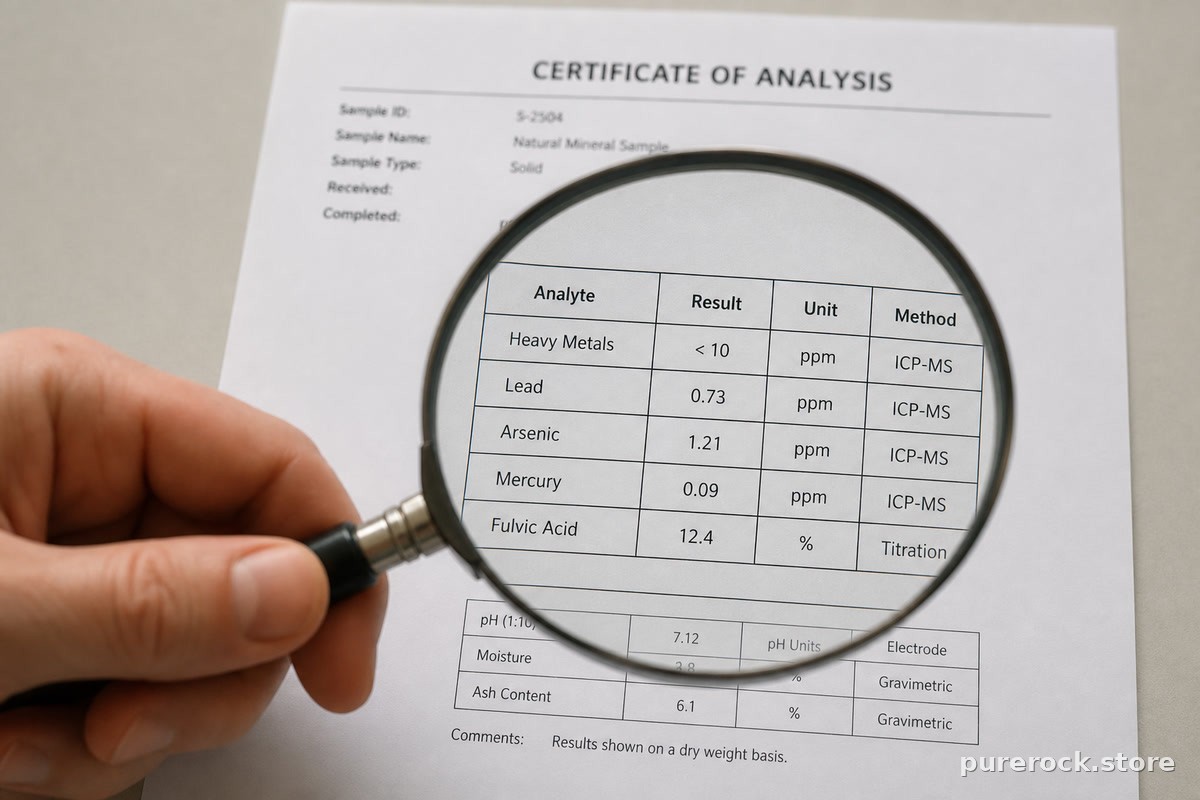
It’s also worth knowing what a COA actually looks like so you can tell a real one from a screenshot pulled off a stock template. A genuine report will show the lab’s name and accreditation number, the specific product and lot number it was run against, a date, a list of tested analytes with numeric results next to each one, and the method used (for heavy metals, this is typically ICP-MS — inductively coupled plasma mass spectrometry). If what you’re shown is a single paragraph of prose summarizing results with no raw data table, that’s a marketing document, not a lab report.
2. Fulvic Acid Percentage, Disclosed and Specific
Fulvic acid is the primary marker used to gauge shilajit’s potency and purity, and reputable products disclose an actual percentage — commonly cited ranges run from roughly 15% to over 60% depending on processing and format concentration. What you want to see on the label or product page is a specific number, ideally backed by the same COA from point one.
Red flags here are vague: “high in fulvic acid,” “rich in fulvic and humic compounds,” or no mention of a percentage at all. Fulvic acid content is a testable, quantifiable value — a brand’s unwillingness to state a number is usually a sign the number either isn’t good or was never measured.
Context matters when reading a fulvic acid percentage, too. Don’t assume format predicts it: in ConsumerLab’s 2024 testing, resins contained far less fulvic acid than the extracts in capsules and pills. Standardized extracts are concentrated for fulvic acid, while raw or traditionally purified resin isn’t, and gummies add sugars and gelling agents that dilute whatever goes in. A percentage that looks unusually high or low for its format is worth a second look — the percentage may be calculated or presented in a way that isn’t apples-to-apples with competitors. When in doubt, the COA should state whether the percentage refers to the raw resin before encapsulation or the finished product as sold.
3. Heavy Metal Testing Specifically Called Out
This deserves its own line item separate from “lab testing” in general, because it’s the single highest-risk factor specific to this category. Look for explicit testing against recognized thresholds (such as USP or California Prop 65 limits) for lead, mercury, arsenic, and cadmium, with results reported as measured values, not just a pass/fail claim.
A product that advertises “heavy metal tested” without showing actual parts-per-million figures is making a claim it isn’t backing up. The number matters more than the assurance.
To put the thresholds in context: USP general chapter limits for dietary supplements cap daily exposure from lead at 5 micrograms, and California’s Prop 65 safe-harbor level for lead is lower still, around 0.5 micrograms per day — which is why some products carry a Prop 65 warning label even when they pass USP limits. Neither number tells you a product is dangerous on its own; what matters is whether the brand reports its actual measured values against these references, rather than simply stating that it “passed testing” without specifying which standard was applied. Two products can both claim to be “heavy metal tested” and mean very different things by it — one testing against a rigorous published threshold, the other testing against an internal standard nobody outside the company has seen.
4. Sourcing and Manufacturer Transparency
Beyond the lab report, transparency shows up in how much a brand is willing to tell you about where the product comes from and who made it:
- Region and altitude of origin. Himalayan sourcing (Nepal, India, Bhutan) is the most commonly cited, though shilajit is also harvested from the Altai and Caucasus ranges. A brand that states a specific region is giving you something checkable; “sourced from pristine mountains” is not a location.
- GMP certification. Good Manufacturing Practice certification (from the facility that processes or encapsulates the product) indicates the product was made under audited quality-control conditions. This applies to capsules and gummies as much as resin.
- A real manufacturer, a real address. A supplement label should identify the company responsible for the product and provide a way to contact them — not just a storefront on a marketplace with no traceable entity behind it.
Sourcing claims are also where it’s easiest to spot copy that was written once and pasted across an entire product catalog. If ten different listings from the same seller all describe their shilajit as coming from “the pristine, untouched peaks of the Himalayas at over 18,000 feet,” that phrasing is doing narrative work, not conveying verifiable information. A brand that’s actually tracking its supply chain can usually say more specific things: which country, which general region within it, whether the raw material is purchased from a single harvesting cooperative or aggregated from multiple sources, and whether that sourcing is consistent batch to batch or opportunistic.

5. Ingredient List Simplicity
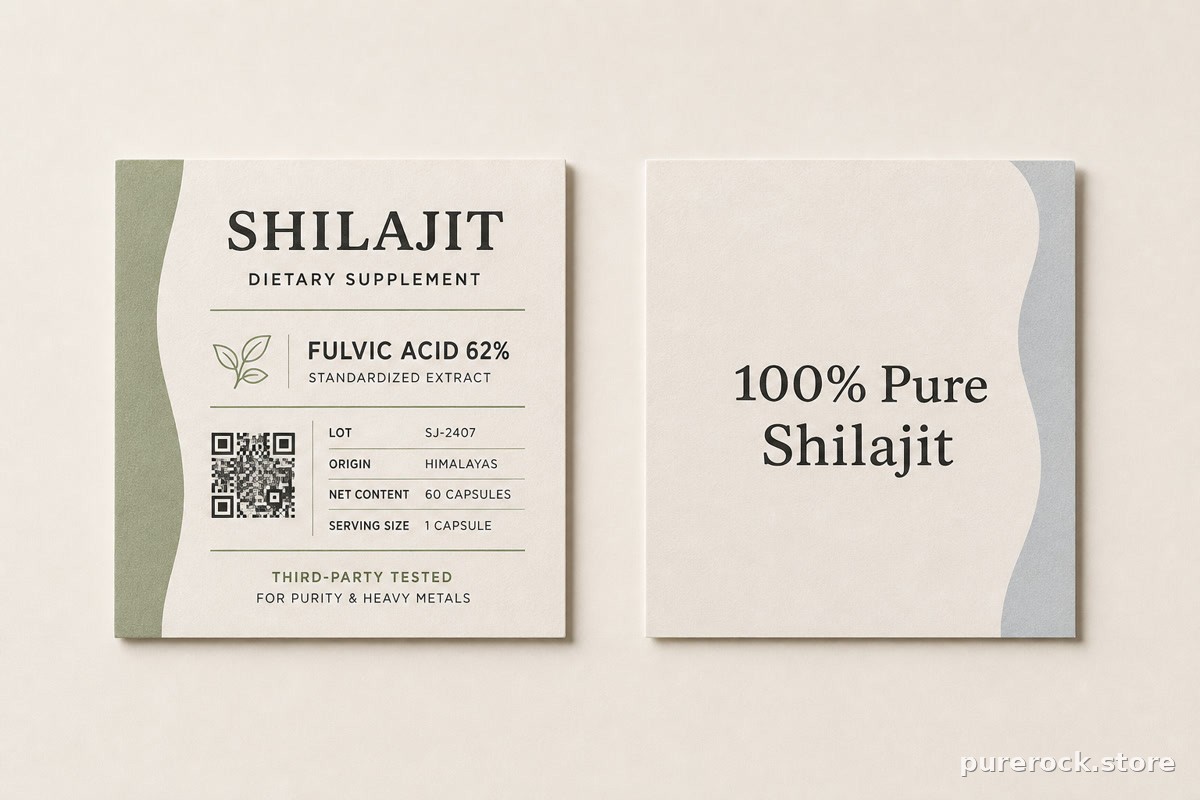
For anything beyond raw resin — capsules, gummies, liquid extracts — check what else is in the product besides shilajit. A short, named ingredient list is a good sign. A long list of unnamed “proprietary blend” components, or fillers and binders with no stated purpose, makes it harder to know what percentage of what you’re taking is actually shilajit versus everything else diluting it.
This is also where it’s worth checking for added ingredients that change the product’s purpose without changing its name. Some capsule and gummy products blend shilajit with other adaptogens, minerals, or stimulants — ashwagandha, ginseng, added B vitamins, or caffeine are common additions. None of these are inherently problematic, but they mean you’re no longer evaluating a single-ingredient shilajit product; you’re evaluating a formulated blend, and the dosing, interactions, and evidence base for the combination may be different from what applies to shilajit alone. A label should make it obvious which product you’re actually buying.
Common Buying Mistakes That Undercut All Five Checks
Even careful shoppers tend to fall into a handful of predictable traps that make the checklist above less effective than it should be:
- Trusting star ratings over documentation. A high average rating on a marketplace listing reflects taste, packaging, and perceived energy, not lab-verified purity. Reviews can’t detect heavy metal content or confirm a fulvic acid percentage.
- Assuming “natural” implies “tested.” These are unrelated claims. A product can be genuinely natural and completely untested, or heavily processed and rigorously verified. Don’t let one substitute for the other.
- Stopping at the first COA link that loads. Some listings link to a COA for a different batch, an expired one, or in rare cases a report for an unrelated product entirely. Check that the lot number on the COA matches the lot number on the jar or box you’d actually receive.
- Treating price as the primary quality signal in either direction. Expensive doesn’t guarantee tested and verified, and cheap doesn’t guarantee contaminated — but a price far outside the category norm, in either direction, is a reason to check the documentation more carefully, not less.
- Buying based on packaging quality alone. Professional photography and premium-looking packaging are marketing investments, not evidence. They say a brand can afford a designer, not that its product passed a heavy-metal panel.
Red Flags That Apply Across Every Format
These show up regardless of whether you’re looking at resin, capsules, gummies, or powder:
- “Proprietary blend” with no breakdown. This phrase exists specifically to avoid disclosing exact quantities. It’s legal, but it’s also the opposite of the transparency this checklist is asking for.
- “Ancient Ayurvedic formula” with no modern data. Traditional use is a legitimate part of shilajit’s story, but a brand leaning entirely on history and mythology while offering zero lab data is substituting narrative for evidence.
- Suspiciously low price relative to the category. Genuine high-altitude shilajit is labor-intensive to harvest and purify. Prices dramatically below the category average, especially for resin, are more often explained by dilution or synthetic filler than by supply-chain efficiency.
- No return policy or no way to contact the seller. If something’s wrong with the batch, you should have a path to actually resolve it.
- Health claims that go beyond “may support.” Shilajit research is still developing, and reputable brands phrase claims cautiously, citing specific studies rather than promising outcomes. Aggressive disease-related claims are a marketing red flag independent of product quality.
- Stock photography instead of the actual product. If every image on a listing is a generic mountain landscape or a stock photo of a jar that doesn’t match what ships, that’s a sign the seller hasn’t invested in showing you the real product — worth noticing alongside the other signals, even though it isn’t disqualifying on its own.
- Reviews that read like they were written for a different product. Copy-pasted or purchased reviews sometimes reference features, flavors, or formats that don’t match the listing. A cluster of generic five-star reviews with no specific detail is weaker evidence than a handful of reviews that mention texture, taste, or packaging specifics.
How This Guide Fits With Format-Specific Guides
This page is deliberately broad — it’s the checklist that applies before you’ve even decided whether you want resin, capsules, or gummies. Once you’ve run a candidate product through these five checks, the format-specific guides go deeper on the mechanics that are unique to each delivery method: how to judge resin’s texture and dissolve behavior, how capsule dosing and fillers work, and how gummies balance flavor masking against fulvic acid content. Think of this page as the filter you apply first, and the format guides as what you read once you’ve narrowed things down to a specific type of product.
FAQ
Is all shilajit tested for heavy metals before it’s sold? No. Testing isn’t universally required or standardized across brands, which is exactly why it’s on the buyer to check rather than assume. Reputable manufacturers test voluntarily and publish batch-specific results because it’s a meaningful differentiator; others skip it, and a jar with no COA gives you no way to know which category it falls into.
What’s a normal fulvic acid percentage to expect? It varies significantly, and more with processing than with format. Reported figures commonly run from about 15% to 60% or more, with standardized extracts at the high end; in ConsumerLab’s 2024 testing, resins contained far less fulvic acid than the extracts in capsules and pills. Gummies, which are diluted with other ingredients, typically report lower percentages relative to the finished product weight. There’s no single “correct” number — what matters is that a specific number is disclosed and traceable to a lab report, rather than the number itself.
Does a higher price always mean better quality? Not necessarily, but price does correlate loosely with the category’s real costs — high-altitude harvesting and multi-stage purification aren’t cheap. A price dramatically below the norm is a stronger red flag than a price above it, but expensive products still need to pass the same five checks; price alone isn’t a substitute for documentation.
Can I trust a product just because it says “lab tested” on the label? Not on its own. “Lab tested” without a named lab, a batch number, or accessible results is a claim, not evidence. Look specifically for a way to view the actual report — a QR code, a lot-number lookup on the brand’s website, or a document available on request — before treating the claim as verified.
Is shilajit regulated the same way as prescription medication? No. In most markets, dietary supplements including shilajit are regulated far more loosely than pharmaceuticals — manufacturers aren’t required to prove safety or efficacy before selling, and independent verification largely happens after the fact, if at all. That regulatory gap is the underlying reason this five-point checklist exists: the diligence has to come from the buyer’s side of the transaction.
The Bottom Line
A trustworthy shilajit supplement, in any format, should be able to answer five questions without hesitation: Is there a current, batch-specific lab report? What’s the fulvic acid percentage? What were the heavy metal results, specifically? Where was it sourced, and who made it? And what else, if anything, is in the ingredient list? If a product’s marketing answers all five before you have to ask, that’s a meaningfully different signal than marketing copy that answers none of them.
This is general educational information, not medical advice. Talk to a healthcare provider before starting any new supplement, particularly if you’re pregnant, nursing, or managing an existing health condition.
Related Guides
- How to choose the best shilajit: a brand-free checklist.
- Shilajit price and cost per serving: how to compare costs fairly.
- How to read shilajit reviews: what reviews can and can’t tell you.