 Purerock
usage
What Does Shilajit Taste Like? Taste, Shelf Life, Fasting
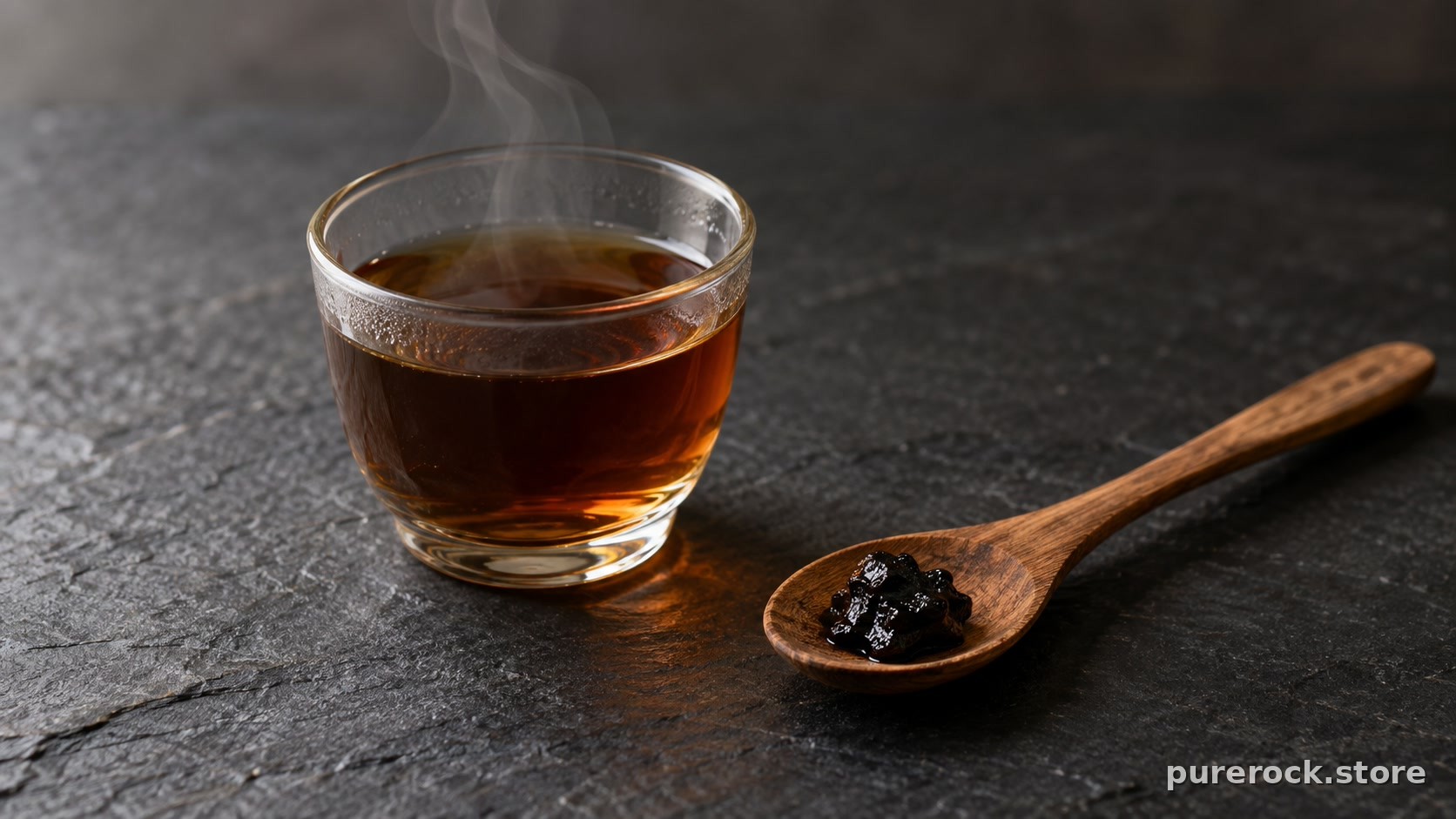
The first time you dissolve a piece of resin and take a sip, you find out what shilajit tastes like: bitter, smoky, earthy, a little like strong black tea left to stew with a lump of tar in it. Nobody warns you about the smell, either. This guide describes both honestly, explains where they come from, and answers the practical questions that follow: can you make it easier to drink, does shilajit expire, and does a daily dose break a fast?
Key Takeaways
- Genuine shilajit resin tastes bitter, smoky, and earthy, with an astringent, mouth-drying finish. Its smell is often described as tarry or faintly urine-like, and classical Ayurvedic texts describe it the same way.
- Most of what you taste comes from humic substances, which estimates put at about 60–80% to over 80% of shilajit, depending on the analysis, plus minerals and a varied mix of organic compounds. Taste varies between batches.
- A sweet, odourless, solvent-like, or sour-and-musty sample is worth a closer look. Taste can raise a question about quality, but only a lab test can answer it.
- In the US, dietary supplements aren’t required to carry an expiration date at all. We found no published stability study on shilajit, so any specific “lasts X years” figure is the seller’s claim, not research.
- A pea-sized serving of resin weighs a few hundred milligrams, so its maximum possible calorie content is tiny. Honey sticks, gummies, and whatever you mix resin into are a different story.
What Does Shilajit Taste Like, Honestly?
Ask ten people and you’ll get ten metaphors, but they cluster around the same handful of notes:
- Bitter first. This is the dominant note and the one people complain about. It sits at the back of the tongue and lingers for a minute or two after you swallow.
- Smoky and tarry. It’s often compared to lapsang souchong tea, a peaty whisky, or the smell of a freshly surfaced road. The resemblance to tar or bitumen is why shilajit has sometimes been called “mineral pitch.”
- Earthy and mineral. Think damp soil, wet stone, or the tang of iron-rich water. Some batches come across faintly salty.
- Astringent. Like over-steeped black tea, it can leave your mouth feeling dry and slightly furry.
- Faintly sour or ammonia-like. Less common as a taste, much more common as a smell.
The smell deserves its own warning. Open a jar of resin and you’ll often get a heavy, tarry smell with an animal or urine-like edge. That isn’t necessarily a fault. A 2019 overview in the International Journal of Pharmaceutical Sciences Review and Research (Pandey, 2019) describes shilajit as “bitter in taste” with a smell that “resembles cow’s stale urine.” It also notes that the classical surgeon-physician Sushruta sorted shilajit into two varieties by smell: gomutra-gandhi (smelling of cow’s urine) and karpura-gandhi (smelling of camphor). So people have been noticing the odour for a very long time.
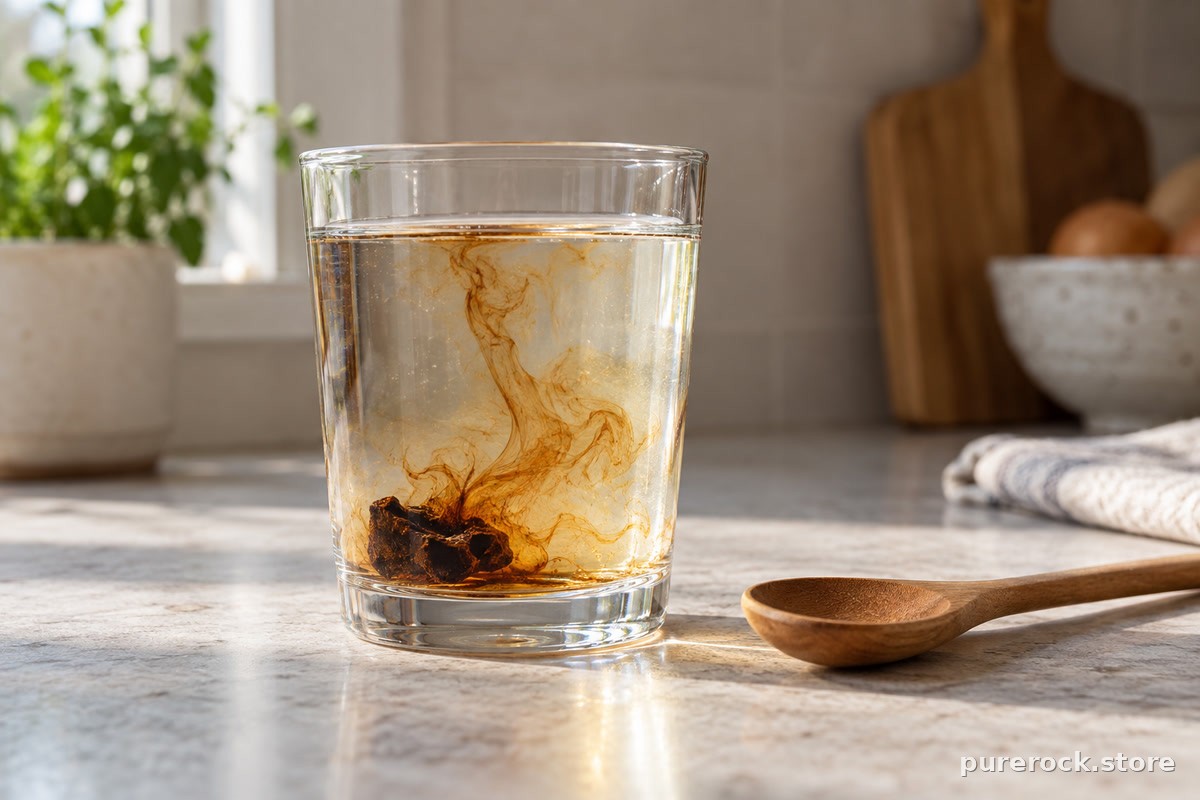
Intensity depends heavily on concentration. A pea-sized piece in a small cup of warm water tastes far stronger than the same piece in a large mug, and an undissolved clump that bursts on your tongue tastes stronger still.
Why Shilajit Tastes the Way It Does
Shilajit isn’t a single compound. A 2007 review in Phytotherapy Research (Agarwal et al.) describes it as “a complex mixture of organic humic substances and plant and microbial metabolites” that seeps out of rock layers in mountain ranges. A 2012 review in the International Journal of Alzheimer’s Disease (Carrasco-Gallardo et al.) estimates that humic substances, including fulvic acid, make up around 60–80% of it; a 2025 chemistry review (Kamgar et al.) puts the figure above 80%, so estimates range from about 60–80% to over 80%, depending on the analysis. The same review lists dibenzo-alpha-pyrones, fatty acids, resins, triterpenes, sterols, aromatic carboxylic acids, amino acids, polyphenols, and phenolic lipids among its other components.
That list helps explain the flavour, though we couldn’t find any study that maps a particular taste to a particular compound:
- Humic and fulvic substances form when plant material decomposes. They’re the same family of compounds that makes peat-stained water brown, so the earthy, peaty, tea-like character isn’t a surprise.
- Aromatic acids and polyphenols belong to chemical classes that tend to taste bitter and astringent in foods generally, which fits the tannic, mouth-drying finish.
- Minerals add the metallic, sometimes salty edge.
Composition also varies with the rock, the plants that grew there, the climate, and the way the material was purified, which is why two jars rarely taste identical. As our resin guide notes, some batch-to-batch variation in colour, texture, and moisture content is normal for a minimally processed natural product.
When the Taste or Smell Seems Wrong
Because the “normal” profile is so distinctive, departures from it are worth noticing. None of the points below proves anything, but each one is a reason to ask the seller for documentation:
- Sweet or candy-like resin. Shilajit shouldn’t taste sweet on its own. If a plain resin, not a gummy or honey stick, tastes of sugar or syrup, ask whether anything was added.
- No smell at all. Genuine resin smells of something. A completely neutral sample is odd.
- Sharp chemical, solvent, or petroleum notes. Tarry is expected. A smell like paint thinner or burning plastic is not.
- A new sour, fermented, or musty smell in a jar that smelled fine when you opened it. This points to moisture getting in (see the expiry section below), not to a problem with the source.
- Grittiness that doesn’t settle. A little sediment is normal. Sand you can feel between your teeth is not.
Adulterants are usually chosen to mimic the obvious sensory cues, so a jar can pass the sniff test and still fail a lab test. We cover the physical home tests, and why none of them is conclusive on its own, in our guide to spotting fake shilajit. The only reliable check is a recent third-party certificate of analysis that includes a heavy-metal panel and a fulvic acid figure.
Shilajit Taste, Shelf Life, and Fasting by Format
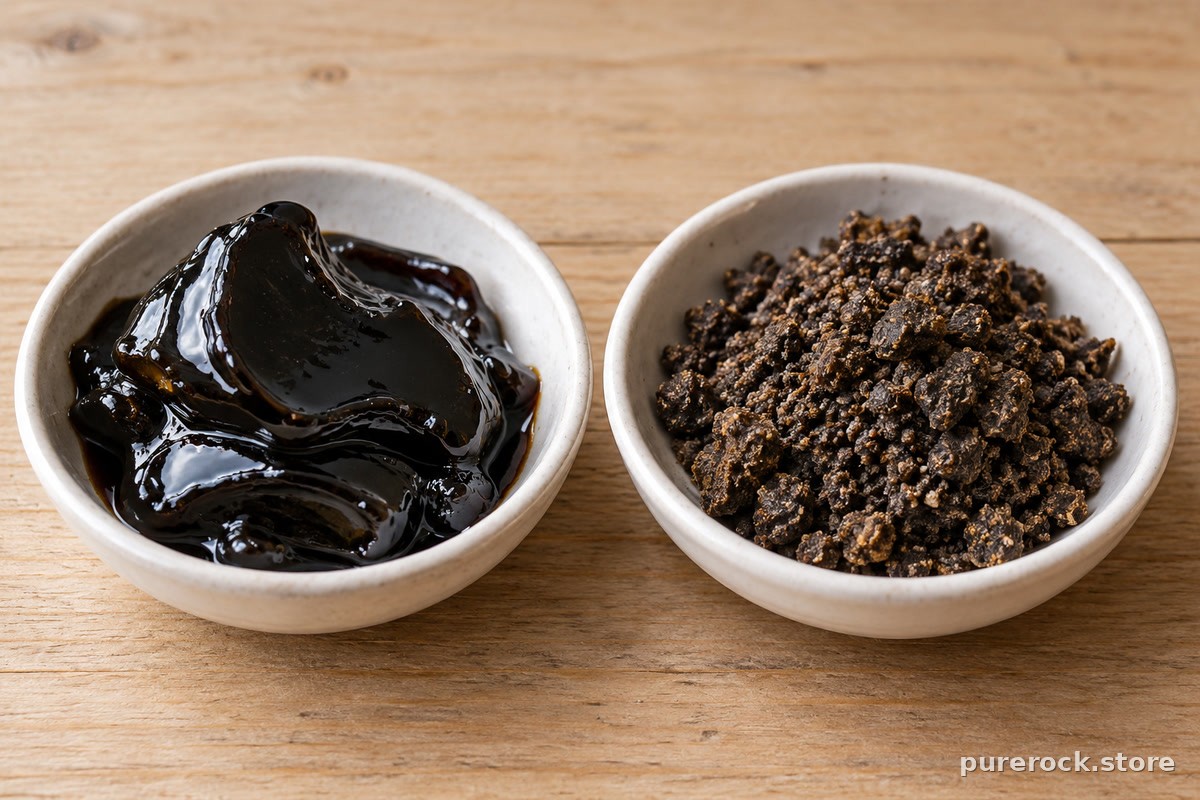
Only resin, and to a lesser extent powder, puts the real taste in your mouth. Every other format hides it in some way, and each hiding method has side effects for shelf life and fasting. The table summarises the trade-offs. The shelf-life column describes what to look for, because no format has published stability data behind a specific number.
| Format | Taste intensity | Typical shelf-life framing | Breaks a fast? |
|---|---|---|---|
| Resin | Strong: bitter, smoky, earthy | Any date is set by the seller; low moisture helps it keep if it stays sealed and dry | The resin itself adds a negligible calorie ceiling; what you dissolve it in may not |
| Powder | Strong once dissolved | Seller-set date; clumping signals moisture uptake | Same as resin; check for carriers or added ingredients |
| Capsules | Minimal (the shell hides it) | Seller-set date; usually the most storage-forgiving format | Negligible calories in most cases; check the label for added ingredients |
| Gummies | Low, masked by sugar and flavour | Seller-set date; the gummy base can dry, sweat, or clump in heat | Yes for sugar-based gummies; each gram of sugar carries about 4 calories |
| Honey sticks | Low to moderate, masked by honey | Seller-set best-by date; crystallisation is normal, leaking or fizzing is not | Yes; a 10 g stick carries roughly 30 calories |
The calorie figures come from two sources. The FDA’s labelling regulation (21 CFR 101.9) uses a general factor of 4 calories per gram of carbohydrate, and USDA FoodData Central lists honey at 304 calories per 100 g, so a 10 g honey stick works out to about 30.
How to Make Shilajit Taste Better
The standard advice, covered in our guide on how to eat shilajit, is to dissolve resin fully in a small amount of warm (not boiling) water or milk, perhaps with a little honey. If you’ve tried that and still dread it, here are some other approaches:
Decide between “fast and strong” and “slow and weak.” There’s a real trade-off here. A concentrated shot of two or three mouthfuls is intense but over in seconds. A larger, diluted drink tastes milder per sip but keeps the bitterness in your mouth for longer. Most people strongly prefer one or the other, and it’s worth trying both before blaming the product.
Try a tiny pinch of salt. A short 1997 report in Nature (Breslin and Beauchamp) found that salt suppresses bitterness in taste mixtures while letting pleasanter tastes come through. That research used model taste solutions, not shilajit, so treat this as an experiment worth trying rather than a guarantee. A few grains is plenty. You aren’t trying to make it taste salty.
Hide it in something already strong and dark. Bitter blends into other bitter-roasty flavours. A small cup of unsweetened cocoa, a spoonful of a thick banana-and-cocoa smoothie, or a strong ginger drink covers smoky notes better than plain water can. Keep the portion small so you actually finish it, and remember that anything with calories changes the fasting answer below.
Clear your palate afterwards. Most of the complaint is about the aftertaste, not the swallow itself. A glass of cold water, a slice of fresh fruit, or brushing your teeth right after takes care of the part that lingers.
Don’t let the jar get damp. Resin that has picked up moisture can start to taste and smell sour on top of its usual bitterness. Storing it properly, covered below, keeps the flavour where it started.
Switch formats if taste is the reason you keep skipping days. Consistency matters more than tradition. Capsules remove the taste entirely with no added sugar. Honey sticks and gummies hide it at a sugar cost.
Does Shilajit Expire?
This is really two questions: is there an official expiry date, and does the product actually degrade?
Expiry dates on supplements are voluntary in the US. The FDA’s small-entity compliance guide for supplement manufacturing states that the rules do not require manufacturers to set an “expiration date,” “shelf date,” or “best if used by” date. It adds that if a company does print one, it should have data to support it. So the date on your jar is the manufacturer’s call, and how much testing sits behind it varies.
“Best by” usually means quality, not safety. For the foods it regulates, the USDA’s Food Safety and Inspection Service explains that a “Best if Used By/Before” date indicates when a product will be at its best flavour or quality, and is not a purchase or safety date. Supplements fall under a different regulator, but the idea is the same: a best-by date is the seller’s estimate of peak quality, not the day the product turns unsafe.
Nobody has published how fast shilajit degrades. We looked for peer-reviewed stability studies measuring how fulvic acid or other constituents change in stored shilajit and didn’t find any. You’ll see confident figures online, such as specific percentage losses over specific months, usually on brand blogs and without a traceable citation. Treat those as marketing unless a study is named.
What you can watch for is physical change, which differs by format:
- Resin: firming up or softening with the seasons is normal. Visible fuzzy spots, a slimy surface, or a new sour or fermented smell means moisture got in, and the jar should be thrown out. The resin guide covers airtight, cool, dry storage in detail.
- Powder: hard clumps or caking mean it has absorbed moisture.
- Capsules: capsules that are soft, stuck together, cracked, or discoloured have been exposed to heat or humidity.
- Gummies: sweating, sticky clumping, hardening, or any mould. The sugar-and-moisture base is the most perishable of all the formats.
- Honey sticks: crystallisation is normal and reversible with gentle warmth. Leaking, fizzing, or a sour smell is not. Keep them at room temperature, out of direct sun.
If a product is past its printed date but looks and smells normal, there’s no research telling you what’s left in it. Replacing an old jar is the cautious choice when you care about getting what the label promised.
Does Shilajit Break a Fast?
It depends on what kind of fast you’re keeping, and on what the shilajit comes with.
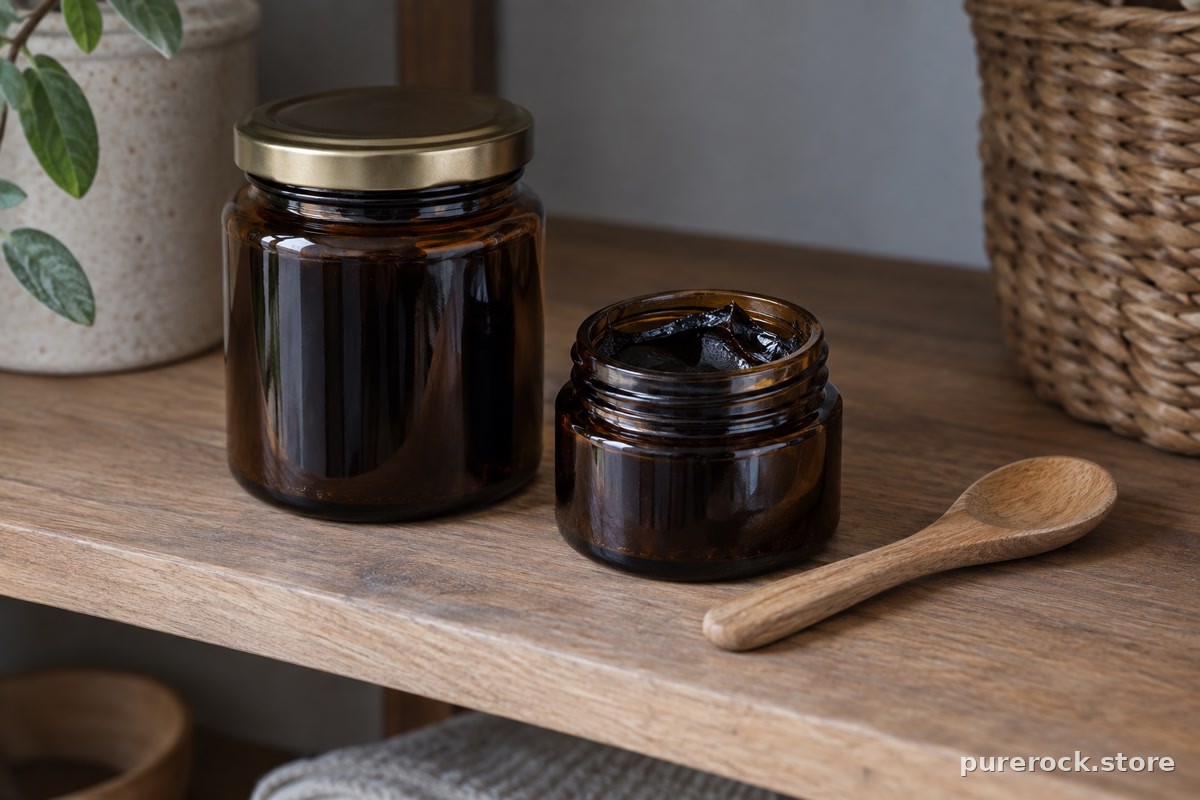
Calorie-based fasting (intermittent fasting, time-restricted eating). A pea-sized serving of resin is commonly cited as about 300–500 mg. Even if every milligram were digestible carbohydrate, which it isn’t, since much of it is minerals and humic material, 0.5 g × 4 calories per gram gives a ceiling of 2 calories. For comparison, FDA labelling rules (21 CFR 101.9) allow any serving under 5 calories to be declared as zero. On a calories-only view, plain resin in plain water is about as close to nothing as a supplement gets, and the same is true of most plain capsules.
The catch is the vehicle. Dissolve that resin in warm milk, stir in honey, or blend it into a cocoa smoothie, and the drink breaks a calorie fast even if the shilajit doesn’t. Honey sticks clearly do too, at around 30 calories for a 10 g stick. Sugar-based gummies do as well: check the total sugars line on the label and multiply by 4 for a rough calorie figure.
Fasting for other reasons. Some people fast to keep insulin low or for cellular processes like autophagy. We found no research on how shilajit affects either one during a fast. Anyone claiming it does or doesn’t “preserve your fast” in that sense is guessing.
Religious fasts. These follow their own rules, which usually aren’t based on calories. Many traditions treat anything swallowed as breaking the fast, so ask someone qualified in your tradition rather than going by a calorie count.
Fasting before surgery, anaesthesia, or a blood test. Follow the instructions your care team gives you, and tell them about any supplements you take, including shilajit. Don’t use the calorie math above to decide what’s allowed before a procedure.
FAQ
Is shilajit supposed to taste bad? Most people find genuine resin unpleasant at first: bitter, smoky, and earthy. That’s expected, and classical descriptions of shilajit call it bitter too. Some people get used to it over time. Others never do and switch to capsules.
Why does my shilajit smell like urine or ammonia? A heavy, tarry smell with a urine-like edge is commonly reported, and a classical Ayurvedic classification even names one variety after the smell of cow’s urine. A new sour or musty smell that wasn’t there when you opened the jar is different, and usually means moisture has got in.
Does shilajit taste different from jar to jar? Yes. Composition varies with the source rock, local plant life, climate, and processing, so some variation in taste and smell is normal. A drastic change, such as suddenly sweet or completely odourless resin, is worth raising with the seller.
Can I take expired shilajit? There’s no published data on how shilajit changes after its printed date, and in the US that date is set voluntarily by the manufacturer. If it shows mould, a sour smell, or a changed texture, throw it out. If it looks normal, it’s a judgement call, and replacing it is the cautious option.
Does a shilajit capsule break a fast? In calorie terms, a plain capsule adds a negligible amount, in line with resin. Check the label for sugars or other added ingredients. For fasts before medical procedures or religious fasts, follow those specific rules instead.
Does shilajit taste better cold? Some people think so, though we’re not aware of any testing on it. The practical problem is that resin dissolves slowly in cold water, and swallowing an undissolved clump is the fastest way to get the strongest possible taste. Dissolve it warm first, then let it cool if you prefer it cold.
Related Guides
- Shilajit FAQ: quick answers on pronunciation, shelf life and more.
- What is shilajit?: the plain-language definition and glossary.
- How to choose the best shilajit: a brand-free checklist.
Bottom Line
Shilajit tastes like what it is: a mineral-rich, humic-heavy exudate from rock. That means bitter, smoky, earthy, and astringent, with a smell that people have compared to tar and urine for centuries. An unusually sweet, odourless, or chemical-smelling sample is a reason to ask for lab documentation, not a verdict in itself.
On the practical questions: you can soften the taste with technique, a pinch of salt, or a different format; any expiry date is the seller’s voluntary estimate rather than published science; and plain resin or capsules add only a negligible number of calories, while honey sticks, gummies, and milky mixers do break a calorie fast. For medical or religious fasts, the rules of that fast come first.